
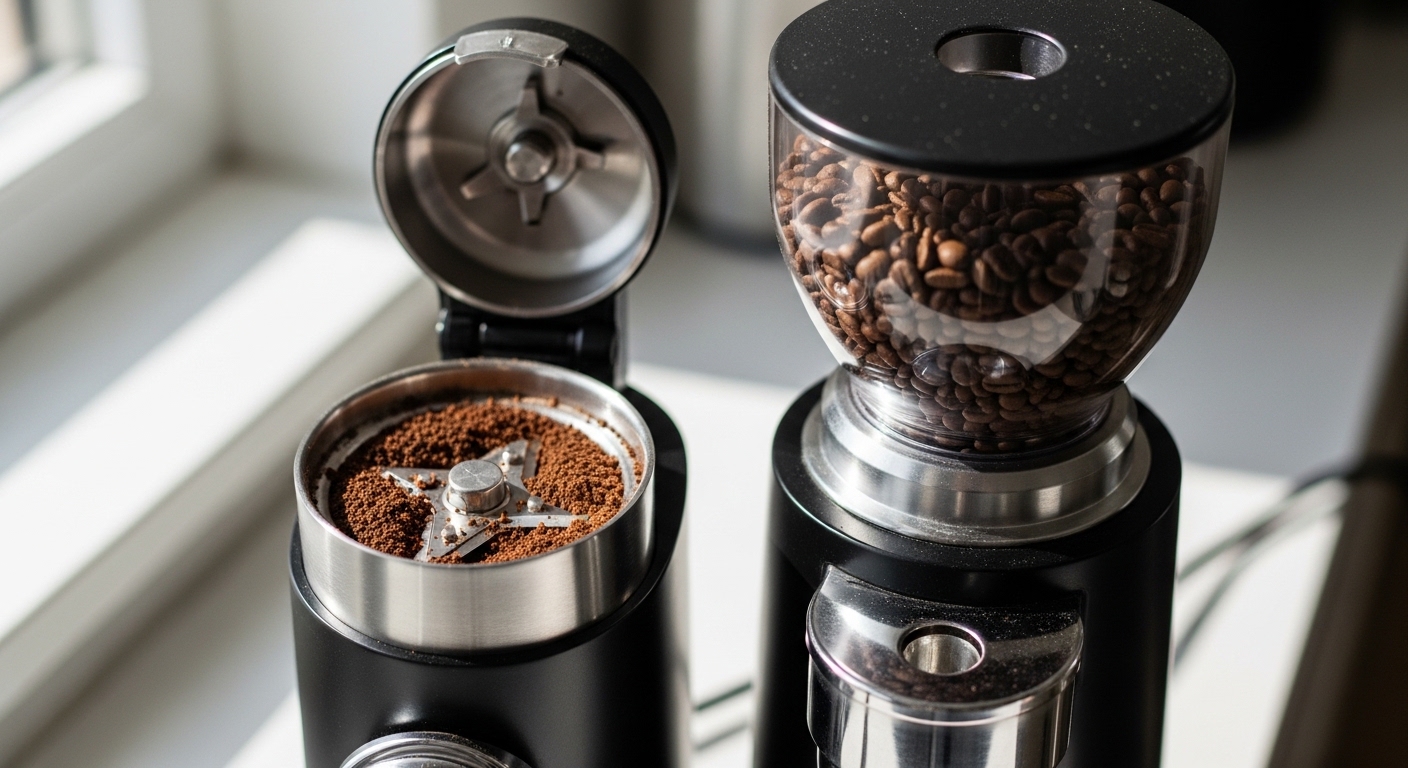
Quick Answer: Is a burr grinder really better than a blade grinder?
Yes—if you care about flavor consistency, a burr grinder is meaningfully better than a blade grinder. A burr grinder crushes coffee beans into a more consistent particle size, which helps you brew coffee that tastes balanced and repeatable. A blade grinder chops beans unevenly, creating a messy mix of big chunks and fine dust. That unevenness often causes coffee to taste sour and bitter at the same time, which is one of the most frustrating problems for home brewers.
That said, “better” doesn’t automatically mean “you must upgrade today.” If you drink coffee casually and just want something fast, a blade grinder can still work. But if you’re trying to make noticeably better coffee at home, a burr grinder is one of the smartest upgrades you can make.
Why the grinder matters more than most beginners expect
People often spend a lot of time thinking about beans, brew methods, water temperature, filters, kettles, and recipes. All of those things matter. But the grinder has an outsized effect because it shapes the raw starting condition of the coffee bed. If the grounds are inconsistent before brewing even begins, the water will extract them unevenly no matter how beautiful your technique is.
This is why coffee people keep repeating that the grinder is one of the most important tools in the setup. They’re not trying to be snobs. They’re trying to save you from chasing brewing fixes for a problem that starts much earlier in the chain.
A good grinder won’t magically make bad beans amazing. But a bad grinder can absolutely make good beans taste mediocre.
What a blade grinder actually does
A blade grinder works like a tiny spinning knife. You put the beans in, press the button, and the blade chops them around randomly. The longer it spins, the smaller some of the particles become—but not in a controlled way.
The result is usually a mix of:
- large chunks that extract too slowly
- medium pieces that extract normally
- fine dust that extracts too fast and can taste bitter
That mixed particle size is the core problem. During brewing, the fine dust over-extracts while the big chunks under-extract. This creates a confusing cup that can feel both harsh and weak at the same time.
What a burr grinder does differently
A burr grinder uses two surfaces (called burrs) to crush beans into a more controlled size. Instead of randomly chopping the beans, it grinds them through a defined gap. That gap determines the grind size, which gives you much more consistency from particle to particle.
In simple terms, a burr grinder gives you grounds that are more alike. That means water can extract them more evenly. When extraction becomes more even, coffee tastes more balanced, sweeter, and easier to dial in.
This is why people who switch from blade to burr often say the improvement is immediate. The coffee doesn’t just get “fancier.” It gets less chaotic.
The biggest practical difference: consistency
If you remember one word from this whole article, remember consistency. That’s the real advantage of a burr grinder.
Consistency matters because brewing is about controlling extraction. If the particles are uneven, extraction becomes uneven. If extraction becomes uneven, flavor gets messy. That’s why a burr grinder doesn’t just make coffee “better.” It makes coffee more predictable.
And predictability is what lets you improve. If one cup tastes bad, you want to know why. With a burr grinder, your adjustments mean something. With a blade grinder, randomness stays in the system and makes troubleshooting harder.
How bad is a blade grinder, really?
Let’s be fair: blade grinders are not useless. They are cheap, small, easy to find, and better than buying stale pre-ground coffee in some situations. If your budget is tight and your current choice is “blade grinder or no grinder,” the blade grinder can still help you grind beans fresh, which is valuable.
But you should understand the trade-off honestly:
- you lose precision
- you lose repeatability
- you increase uneven extraction
- you make dialing in harder
So the question is not “Can a blade grinder make coffee?” Yes, it can. The better question is “Will it limit how good and consistent your coffee can get?” Also yes.
Which brew methods suffer most with a blade grinder?
Some methods are more sensitive than others. If you use a blade grinder, these methods usually reveal the weakness more clearly:
Pour-over (V60 and similar)
Pour-over is very sensitive to grind consistency. Too many fines can clog the filter and slow the brew. Too many large particles can make the cup taste sour and hollow. If you’re using a blade grinder for V60, it becomes much harder to get clean, repeatable results.
Espresso
Espresso is the least forgiving of all. A blade grinder is usually a bad match because espresso requires very fine and highly consistent coffee. The randomness of a blade grinder can make shots run unpredictably and taste rough. If you want serious home espresso, a burr grinder is not a luxury—it’s part of the foundation.
French press
French press is more forgiving, so people can get away with blade-ground coffee more easily here. But the fines created by a blade grinder often lead to extra sludge and muddiness in the cup. A burr grinder still improves the result noticeably.
Cold brew
Cold brew benefits from coarser, more even grounds. Blade grinders often create too much dust, which can make filtering annoying and leave sediment in the final drink.
How a blade grinder creates the “sour and bitter at the same time” problem
This is one of the clearest reasons to upgrade. When a cup tastes sour and bitter at the same time, people often think their beans are bad or their recipe is broken. Sometimes the real cause is uneven grind distribution.
Here’s what happens:
- big chunks under-extract and create sour, weak notes
- fine dust over-extracts and creates bitterness
- the combined cup tastes confusing and unbalanced
This is why someone can change water temperature, ratio, and brew time repeatedly and still feel stuck. If the grinder is causing uneven extraction at the particle level, technique alone can only compensate so much.
When a blade grinder is “good enough”
There are situations where a blade grinder is honestly fine enough:
- you drink coffee casually and aren’t chasing precision
- you use forgiving methods like French press
- you’re on a tight budget and want to grind fresh beans
- you’re not yet sure whether you care enough to invest further
That last point matters. You do not need to become a hobbyist to enjoy coffee. If a blade grinder fits your life and you’re happy, fine. The problem is when someone clearly wants better coffee and keeps spending energy solving problems that the grinder is quietly causing.
When a burr grinder becomes worth it
A burr grinder becomes worth it when one or more of these is true:
- you’re buying better beans and want to taste the difference
- you brew often enough that consistency matters
- you use pour-over or espresso
- you’re tired of cups that feel random
- you want one upgrade that improves almost every brew method
If you’re already paying more for coffee beans, but grinding them with a blade grinder, you may be limiting the return on what you’re buying. A burr grinder helps you actually access more of the value in the beans.
Flat burr vs conical burr: do you need to care?
At the beginner and intermediate level, the biggest improvement is simply moving from blade to burr. Flat vs conical burr discussions can matter, but they matter much less than people think at the start.
If you’re choosing your first burr grinder, focus on:
- reliable grind consistency
- easy adjustment
- a grind range that fits your brew methods
- durability and ease of cleaning
Don’t get trapped in enthusiast debates before you’ve even escaped the blade grinder problem.
Can you make a blade grinder work a little better?
Yes—if upgrading isn’t possible right now, a few habits can improve results:
- pulse, don’t hold the button nonstop
- shake the grinder gently between pulses to redistribute beans
- grind in short bursts to reduce overheating
- use it for forgiving methods like French press more than espresso or V60
These tricks won’t turn a blade grinder into a burr grinder, but they can reduce the worst inconsistency.
The hidden upgrade: less frustration
One underrated reason a burr grinder is worth it is not just taste—it’s sanity. When your grind is more consistent, coffee troubleshooting gets easier. Recipes make more sense. Your adjustments actually do something. You stop feeling like every cup is random.
That reduction in frustration is a big deal. A lot of people don’t need “the best grinder on earth.” They just need a grinder that lets their skill actually matter.
A simple decision guide
If you want the shortest possible decision tree, use this:
- Keep the blade grinder if convenience and low cost matter most and you’re okay with “good enough.”
- Upgrade to a burr grinder if you want sweeter, cleaner, more repeatable coffee and you brew regularly.
- Upgrade now if you use V60, espresso, or you’ve already started caring a lot about flavor.
Most people who genuinely care about coffee end up upgrading eventually. The question is usually not “if,” but “when.”
FAQ
Can a blade grinder make good coffee?
It can make decent coffee, especially for forgiving methods, but it struggles with consistency. If you care about improving flavor, a burr grinder usually makes the process much easier.
Is a burr grinder worth it for French press?
Yes, though the jump is less dramatic than for espresso or pour-over. You’ll usually notice less sludge, better balance, and more repeatability.
What’s the biggest advantage of a burr grinder?
Consistency. That one factor improves extraction quality, troubleshooting, and repeatability across almost every brew method.
Conclusion: the upgrade is not hype—just better control
A burr grinder is usually worth upgrading to because it gives you more consistent grounds, and more consistent grounds give you more balanced coffee. Blade grinders still have a place for cheap, casual convenience, but they make it harder to brew with precision and harder to repeat good results. If you want one upgrade that improves almost every cup you make at home, moving from blade to burr is one of the clearest wins.

Passionate about coffee and brewing, our author shares simple, practical tips to help coffee lovers improve their skills. From home brews to barista basics, each post is crafted to make your coffee journey easier and more enjoyable.