
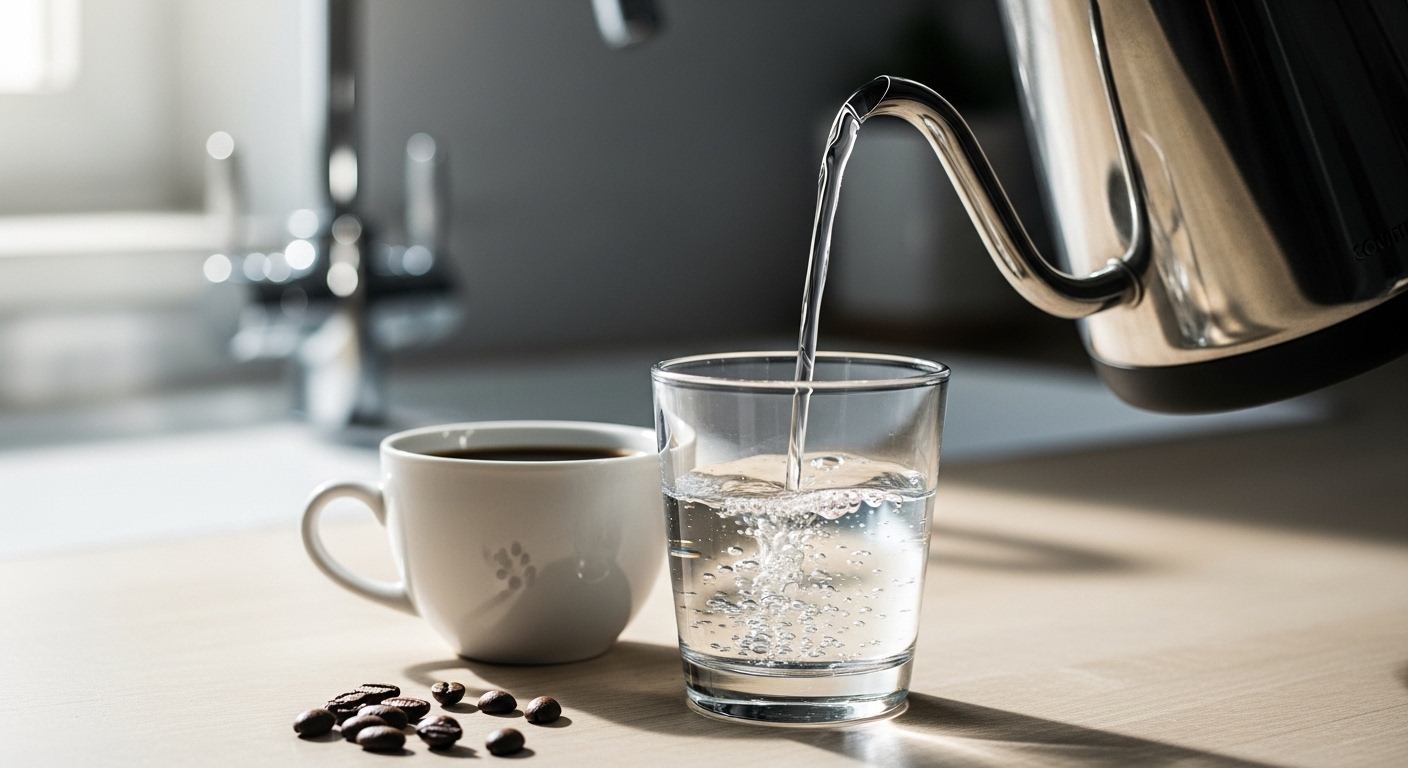
Quick Answer: Does water really change how coffee tastes?
Yes—more than most people realize. Coffee is mostly water, so if your water tastes bad, smells strongly of chlorine, feels extremely hard, or leaves a strange aftertaste on its own, it can absolutely ruin good beans. Even when your beans are fresh and your grind is right, poor water can make coffee taste flat, harsh, chalky, muted, or strangely empty. The good news is that you usually do not need a complicated setup to improve it. For many people, a simple filter or just avoiding the worst water problems already makes a noticeable difference.
If your coffee tastes disappointing and you have already checked freshness, grind size, and ratio, water is one of the smartest next things to examine.
Why water matters so much in coffee
People obsess over beans because beans are exciting. They have origin stories, tasting notes, roast dates, and beautiful packaging. Water gets ignored because it feels boring and invisible. But in the cup, water is doing most of the work. It is the thing that actually dissolves and carries coffee flavor to you.
That means water affects two huge parts of the coffee experience at once:
- Extraction: how efficiently flavor is pulled out of the grounds
- Taste: what the final liquid feels like in your mouth
If your water is poor, you can lose sweetness, clarity, and aroma even with excellent beans. This is why someone can buy a beautiful bag of coffee, brew carefully, and still think, “Why does this taste average?” Sometimes the answer is not the coffee at all. It is the water.
What “bad water for coffee” usually means
When people say their tap water is bad for coffee, they are usually dealing with one or more of these problems:
- Strong chlorine smell or taste
- Very hard water with heavy mineral content
- Very soft or “empty” water that extracts strangely
- Off flavors from pipes, storage tanks, or local supply issues
- Visible scale buildup in kettles and machines
You do not need to become a water chemist to fix coffee at home. But you do need to understand that “drinkable” water is not always “great coffee” water.
The easiest first test: taste the water by itself
This sounds almost too simple, but it works. Before you think about TDS, minerals, or filtration systems, just taste your water plain. If the water tastes unpleasant by itself, there is a strong chance it will also make coffee taste worse.
Ask these questions:
- Does it smell strongly like chlorine?
- Does it taste metallic, dusty, or stale?
- Does it leave a chalky feeling in the mouth?
- Does it seem weirdly “empty” or flat?
If the answer is yes to any of those, do not expect your coffee to magically become beautiful when brewed with it.
How tap water can ruin coffee in different ways
Problem 1: Chlorine kills clarity
If your tap water has a noticeable chlorine smell, that can interfere with aroma and flatten delicate flavor notes. Coffee that should smell sweet or lively may end up feeling muted or vaguely chemical.
This is especially painful with lighter or more aromatic coffees, because those subtle notes are easier to damage.
Problem 2: Hard water can make coffee taste dull or rough
Hard water contains more dissolved minerals. Some minerals are useful for extraction, but if your water is very hard, the result can be a cup that feels heavy, muted, or less sweet. Hard water can also cause scale buildup in kettles, drip machines, and espresso equipment, which creates maintenance problems on top of taste issues.
If your kettle constantly develops white crust or chalky deposits, your water is already telling you something.
Problem 3: Very soft water can make coffee taste weak or strange
Some people assume softer is always better. Not necessarily. Water that is too low in useful minerals can extract coffee in a disappointing way. The cup may feel oddly thin, less structured, or just “not right.”
This is why distilled water is usually a bad idea for coffee. It sounds “pure,” but pure is not the same as ideal for brewing.
Problem 4: old kettles and machines make water worse
Sometimes the water source is only part of the problem. If your kettle, drip machine, or brewer has scale buildup or stale residue, it can add off flavors to the water before it ever touches the coffee. That means you can improve water quality and still get bad cups if your gear is neglected.
This is why water quality and gear maintenance often go together.
The good news: easy fixes usually help a lot
You do not need a dramatic, expensive water station to brew better coffee at home. For many people, one of these simple solutions is enough:
- use a basic household water filter
- let chlorinated tap water sit briefly before use if smell is the main issue
- use a trusted bottled water that tastes balanced and neutral
- clean and descale the kettle regularly
The smartest move is to fix the obvious problem first, not to over-engineer everything from day one.
Should you use bottled water for coffee?
Sometimes, yes. Bottled water can be a practical solution if your tap water tastes bad, smells strongly chlorinated, or causes obvious scale problems. But not all bottled water is ideal. Some are too mineral-heavy. Others are so “purified” that they feel flat and strange in coffee.
The easiest rule is simple: choose water that tastes clean and neutral, not aggressively mineral, salty, metallic, or lifeless. If the bottled water tastes pleasant by itself, it is much more likely to help than hurt your coffee.
It can also be a useful experiment. Brew the same coffee once with your normal tap water and once with a cleaner-tasting bottled water. If the cup improves immediately, you found a big part of the problem.
Should you filter tap water?
For many home brewers, yes. A basic filter is often one of the best low-effort improvements available. It can reduce chlorine taste and improve the overall neutrality of the water without requiring you to rethink your whole setup.
If your local tap water is already good, the difference may be small. But if your water has obvious smell or taste issues, a filter can create a surprisingly noticeable improvement.
This is one of those upgrades that is not glamorous, but it directly affects every cup you brew.
What water should you avoid for coffee?
These are the main water choices that tend to create problems:
- very strongly chlorinated tap water
- distilled water used by itself
- water with obvious off smells or tastes
- extremely hard water that causes fast scale buildup
If the water is unpleasant enough that you do not enjoy drinking it plain, it is usually the wrong choice for specialty coffee.
How water affects different brew methods
Pour-over / V60
Pour-over often reveals water problems the most clearly because it emphasizes clarity and structure. If your water is bad, V60 coffee can feel flat, hollow, or strangely rough even when your technique is solid.
French press
French press is fuller-bodied, so some water issues can be a little less obvious at first. But bad water still damages aroma and sweetness. The cup may feel heavy but not satisfying.
Drip coffee
Drip machines can amplify water problems because the machine itself may also have scale or residue. If your drip coffee tastes consistently mediocre no matter what beans you buy, check both the water and the machine.
Iced coffee
Iced coffee can make water issues feel even more obvious because cold serving changes how flavor is perceived. Weak structure or strange mineral character can show up clearly, especially once ice dilution enters the picture.
If your iced coffee tastes flat and boring, water may be part of the problem—not only your recipe.
The easiest home experiment: same coffee, different water
If you want proof without overthinking it, run this simple test:
- Use the same coffee, same grind, and same ratio.
- Brew one cup with your usual tap water.
- Brew one cup with filtered or better-tasting bottled water.
- Taste them side by side after they cool slightly.
This is one of the fastest ways to learn whether water is actually holding your coffee back. If the better-water cup tastes sweeter, clearer, or cleaner, then your water was never “neutral.” It was part of the flavor problem.
Do you need to obsess over water chemistry?
No—not unless you want to. Water chemistry matters, but most home brewers do not need to become mini-laboratories. The practical version is enough for most people:
- use water that tastes good on its own
- avoid obviously problematic water
- keep your kettle and brewers clean
- filter your water if chlorine or off flavors are noticeable
That gets you most of the benefit without turning coffee into a chemistry project.
Common water mistakes people make
Mistake 1: assuming “drinkable” means “ideal for coffee”
Water can be safe and still be poor for brewing. Chlorine taste, hard water, and off flavors do not need to be dangerous to be bad for coffee.
Mistake 2: using distilled water by itself
Distilled sounds pure, but pure is not always good for extraction. Coffee generally needs water with some useful mineral structure, not completely empty water.
Mistake 3: ignoring scale in the kettle
If your kettle has mineral buildup, your water situation is already affecting your gear. Waiting longer only makes both flavor and maintenance worse.
Mistake 4: blaming beans too quickly
Sometimes the beans are fine. If multiple coffees all taste vaguely disappointing, water becomes a prime suspect.
A practical everyday setup that works for most people
If you want a sensible, low-stress approach, here is a great everyday routine:
- use filtered tap water if your local tap water is inconsistent or chlorinated
- keep the kettle clean and descale when needed
- brew with a consistent ratio
- only start chasing advanced water ideas if the basics are already solid
That setup is enough to improve a lot of home coffee dramatically without getting weird about it.
FAQ
Can bad tap water really ruin expensive beans?
Yes. If your water carries chlorine, harsh minerals, or off flavors, it can flatten or distort even very good coffee.
What’s the easiest fix for bad water at home?
Usually a basic filter or switching temporarily to a cleaner-tasting bottled water for comparison. Start with the simplest fix before spending heavily.
Is bottled water always better than tap water for coffee?
No. Some bottled waters are great, others are too mineral-heavy or strangely flat. Taste matters. Use water that tastes clean and neutral.
Conclusion: great coffee needs water that gets out of the way
The best coffee water is not water that “adds magic.” It is water that lets the beans speak clearly. If your tap water tastes bad, smells strongly, or leaves heavy mineral buildup, it can absolutely hold your coffee back. Start with the simplest fixes—better-tasting water, basic filtration, and clean equipment—and you may be surprised how much more your beans can do once the water stops getting in the way.

Passionate about coffee and brewing, our author shares simple, practical tips to help coffee lovers improve their skills. From home brews to barista basics, each post is crafted to make your coffee journey easier and more enjoyable.