
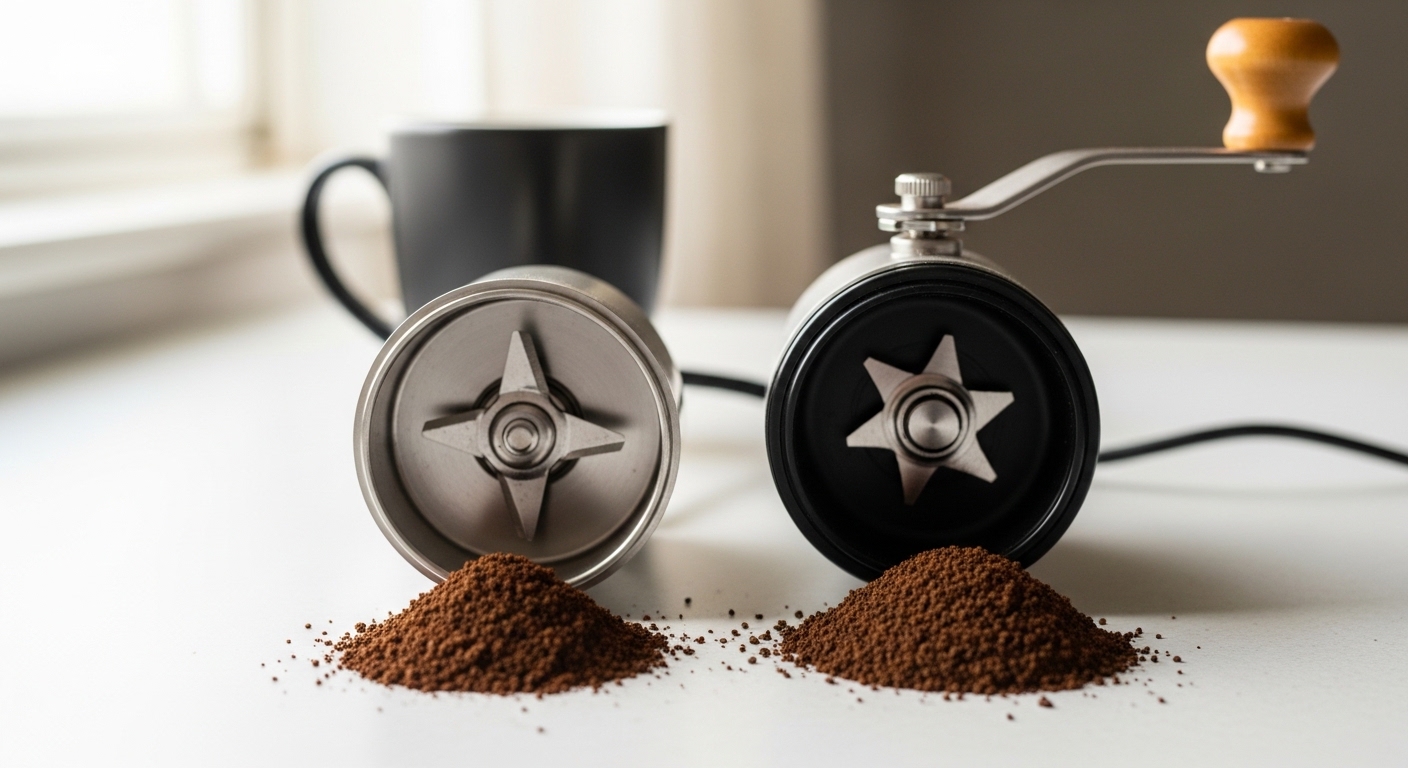
Quick Answer: Is a burr grinder really better than a blade grinder?
Yes—a burr grinder is usually much better than a blade grinder if you care about coffee quality, consistency, and control. The main reason is simple: a burr grinder crushes coffee into more uniform particles, while a blade grinder chops coffee unevenly. That difference affects extraction directly. More even particles usually lead to more balanced coffee. More uneven particles often lead to cups that taste confusing, sour, bitter, muddy, or all of those at once.
If you are trying to make better coffee at home and wondering whether a burr grinder is genuinely worth it or just another expensive coffee-world obsession, this guide will help you understand the real difference—and whether upgrading actually matters for the way you brew.
Why this question matters more than most beginners expect
A lot of people think coffee quality starts mainly with the beans. The beans matter, of course. But once the coffee enters your kitchen, one of the biggest factors shaping the cup is the grinder. That is why two people can buy the same coffee and get very different results. One has a grinder that produces reasonably even particles. The other has a grinder that turns the beans into a chaotic mix of dust and chunks. The same coffee suddenly behaves like two different products.
This is also why people sometimes feel like they are “bad at brewing” when the real problem is not their effort. It is their grinder. If the grind is inconsistent, every other brewing decision gets harder. Ratio becomes harder to judge. Pour-over becomes less stable. French press gets muddier. Espresso becomes much more frustrating. A bad grinder quietly makes all of coffee harder to understand.
So this is not a gear-snob conversation. It is a quality-of-life conversation. The grinder changes how understandable your coffee becomes.
What a blade grinder actually does
A blade grinder uses spinning blades to chop coffee beans. That sounds simple and practical, and in a basic mechanical sense, it is. The problem is that chopping is not the same as grinding evenly. The blade hits different pieces differently depending on where the beans move, how long they stay near the blade, and how long the grinder runs.
The result is usually a messy distribution of particle sizes. Some pieces become too fine very quickly. Others stay much larger. So instead of getting one clear grind size, you often get a chaotic mix: powder, medium particles, and larger chunks all in the same batch.
This matters because water does not extract all those pieces the same way. Fine particles extract faster and more aggressively. Bigger pieces extract more slowly and often less completely. That means the brew can become uneven by design before you even add water.
What a burr grinder does differently
A burr grinder works by crushing beans between two burrs rather than randomly chopping them with a blade. The key advantage is control. The burrs are set to a specific distance, which helps produce a more consistent target particle size. That means fewer random giant chunks and fewer unnecessary dust-like fines compared with a typical blade grinder.
This does not mean every burr grinder is perfect. Some are much better than others. But the basic grinding principle is more suitable for coffee because it is trying to create a controlled result rather than just smashing beans until you stop the machine.
That one difference—controlled crushing instead of random chopping—is why burr grinders usually make better coffee and why they are taken more seriously in both cafés and home brewing.
Why particle consistency matters so much in the cup
Coffee brewing depends on extraction. Water has to pull flavor from the grounds in a balanced way. If the grounds are very uneven, extraction becomes uneven too. The finer pieces may over-extract and taste bitter, harsh, or drying. The larger pieces may under-extract and taste sour, weak, or hollow. When those flavors land in the same cup, the result often feels messy and hard to diagnose.
This is one reason people describe bad coffee as both sour and bitter at the same time. That usually sounds contradictory, but it is often just uneven extraction. The grinder quietly caused different particles to behave differently, and your mouth experiences the confusion all at once.
So when coffee tastes “off,” the issue is not always the beans or the brewing recipe. Sometimes the grinder created a problem no recipe could fully rescue.
The biggest real-world difference: burr grinders make brewing easier to control
This may be the most practical point in the whole article. A burr grinder does not just improve flavor in theory. It makes brewing easier to control in reality. When you adjust grind size on a burr grinder, the coffee usually responds in a more understandable way. If you go slightly finer, extraction typically increases in a way you can actually notice. If you go slightly coarser, the brew often opens up or speeds up in a more predictable way.
With a blade grinder, changes are much harder to read. You may grind longer, but you are not simply making the coffee finer in a clean, consistent way. You may just be creating more fines while still leaving larger pieces behind. That makes brewing feedback much less trustworthy.
In other words, a burr grinder helps your adjustments mean something. That is a huge advantage for learning coffee well.
Why blade grinders frustrate pour-over users especially fast
Pour-over methods like V60 reward grind consistency strongly. Flow rate, drawdown speed, and extraction clarity all respond to the grind. If your grinder produces too many fines, the brewer may clog or slow down unpredictably. If it leaves too many larger pieces, the cup may run too fast and taste weak or sour. When both happen together, you get a confusing brew that feels impossible to dial in.
This is why blade grinders often make pour-over feel unstable. One day the brew tastes okay. The next day it tastes weird even though you did “the same thing.” The issue is not always your pouring. It may be that the grind itself is not repeatable enough.
If someone tells you V60 is difficult, sometimes what they really mean is that V60 is unforgiving of bad grinding.
Why French press still benefits from a burr grinder
People sometimes assume French press is so forgiving that grinder quality does not matter much. That is only partly true. French press is more forgiving than espresso and often more forgiving than pour-over, but it still benefits from a more even coarse grind. A blade grinder tends to create too many fines, and those fines can slip through the metal filter or over-extract during steeping. That leads to muddy, silty cups with more bitterness than necessary.
A burr grinder usually gives French press a cleaner, more stable texture and a better chance at tasting full-bodied without turning swampy. The difference may not be as dramatic as in espresso, but it is still very real—especially if you care about clarity and less sludge at the bottom of the cup.
So yes, French press can work with a blade grinder. But “it can work” and “it works well” are not the same standard.
Espresso is where the gap becomes brutal
If you are trying to make espresso, the difference between burr and blade grinders is not subtle. Espresso is one of the least forgiving brewing methods because it depends on very precise grind size and fairly consistent particles. A blade grinder usually cannot give you the control espresso demands. The result is often shots that run far too fast, far too slow, or behave inconsistently from one attempt to the next.
This is why people trying to make espresso with a blade grinder often feel like the machine is broken or that espresso itself is impossible. The machine may not be the real problem. The grinder is simply not designed to support that level of precision.
So if you are asking whether a blade grinder is enough for espresso, the honest answer is that it will usually make your life much harder than it needs to be.
What blade grinders do win on
To be fair, blade grinders do have a few advantages. They are usually cheaper. They are simple. They are often smaller. And for someone who only wants basic coffee convenience and is not trying to improve much, a blade grinder may feel “good enough.”
This matters because not everyone needs café-level precision. If someone drinks coffee casually, uses one forgiving brew method, and does not care much about dialing in, a blade grinder may still be a practical entry point. It is not useless. It is just limited.
So the choice is not moral. It is about expectations. A blade grinder can make coffee. A burr grinder usually makes learning, consistency, and quality much better.
When a burr grinder is absolutely worth it
A burr grinder is especially worth it if:
- you brew pour-over often
- you want more consistent coffee day to day
- you are tired of sour and bitter flavors showing up together
- you want to adjust grind size intentionally
- you care about getting more out of better beans
- you are making espresso or plan to
In all of those situations, the burr grinder is not just a nicer tool. It is a more appropriate tool for the job. The value comes not only from better cups, but from less confusion and frustration.
When a blade grinder might still be enough
A blade grinder may be enough if:
- you are on a tight budget
- you only brew coffee casually
- you use a forgiving method and do not mind some inconsistency
- you want something better than pre-ground but are not ready to invest more yet
That is a legitimate place to start. The mistake is pretending the blade grinder and the burr grinder are basically equal when the actual cup quality and control are clearly different. A blade grinder can be a stepping stone. It just should not be mistaken for the destination if you want to improve meaningfully.
Can you make a blade grinder work a little better?
Yes, a little. If you are stuck with a blade grinder for now, you can still improve the result somewhat by grinding in short pulses instead of long continuous runs, shaking the grinder gently between pulses, and paying attention to how the coffee looks so you do not keep turning one part into powder while larger pieces remain. None of this turns it into a burr grinder, but it can reduce some of the chaos.
That said, even the best blade-grinder habits are still compensation strategies. They help around the edges. They do not solve the core limitation: the device is chopping, not producing a truly controlled grind distribution.
So use the blade grinder as intelligently as you can, but do not let that convince you the underlying issue disappeared.
Why burr grinders feel like a “bigger upgrade” than people expect
Many coffee upgrades improve things slightly. A burr grinder often improves several things at once. It usually improves clarity, consistency, repeatability, and your ability to troubleshoot. That creates a compound effect. Suddenly your V60 drains more predictably. Your French press gets cleaner. Your recipes make more sense. Your good beans finally feel like they are worth what you paid for them.
This is why people often describe the switch from blade to burr as a turning point rather than a minor improvement. It changes the whole brewing relationship. Coffee becomes less random and more teachable.
That is a bigger benefit than “slightly better taste.” It is better understanding.
A practical decision guide
If you want the simplest answer possible, use this:
- Choose a burr grinder if you want better flavor, consistency, and actual grind control.
- Use a blade grinder only if budget or simplicity matters more than brewing precision.
- Upgrade to burr as soon as coffee quality starts mattering enough that inconsistency annoys you.
That is the real dividing line. Once inconsistency starts bothering you, the burr grinder becomes much easier to justify.
Common mistakes people make
Mistake 1: Thinking “ground is ground”
It is not. Particle consistency changes extraction dramatically, and that changes flavor directly.
Mistake 2: Blaming the beans when the grinder is the real problem
Even great beans cannot fully rescue a grind that is wildly uneven.
Mistake 3: Trying to do espresso with a blade grinder
That usually creates frustration because espresso needs a level of grind precision blade grinders rarely provide.
Mistake 4: Assuming all burr grinders are luxury products
You do not need the most expensive grinder on earth to benefit from burr grinding. The main win is the grinding principle itself.
FAQ
Can a blade grinder still be better than pre-ground coffee?
Sometimes yes, especially for freshness. Grinding right before brewing can still help. But the inconsistency remains a major limitation.
Is a burr grinder worth it for French press only?
Usually yes, if you care about cleaner cups and less sediment. The improvement may not be as dramatic as espresso, but it is still meaningful.
Do I need an expensive burr grinder to notice a difference?
No. You do not need the most expensive one. A reasonably solid burr grinder can already be a major step up from a blade grinder.
Conclusion: burr grinders usually win because they make coffee make more sense
A burr grinder usually makes better coffee than a blade grinder because it creates a more consistent grind, and that leads to more balanced extraction. The result is not only better flavor. It is better repeatability, better control, and less confusion when something tastes wrong. Blade grinders still have a place for convenience and budget, but if you want coffee that is easier to improve and easier to understand, a burr grinder is one of the clearest upgrades you can make.

Passionate about coffee and brewing, our author shares simple, practical tips to help coffee lovers improve their skills. From home brews to barista basics, each post is crafted to make your coffee journey easier and more enjoyable.