
Quick Answer: Do you really need a coffee scale?
Yes—if you want more consistent, repeatable, and better-tasting coffee, a coffee scale is one of the most useful tools you can own. You do not need a scale to make drinkable coffee, but you do need one if you want to stop guessing and start controlling your results. A scale helps you measure how much coffee and how much water you are using, which makes it much easier to build a balanced recipe and fix problems when the cup tastes wrong.
In plain terms, a scale removes one of the biggest sources of chaos in home brewing: “that looks about right.”
Why a coffee scale matters more than many beginners expect
A lot of people assume coffee scales are just another piece of specialty coffee theater. They imagine the scale is for obsessive people who want to feel scientific while making a simple drink. That assumption makes sense—until you realize how much inconsistency comes from not measuring anything properly.
If you use scoops, spoons, or visual guesses, your coffee can change from day to day without you noticing. One scoop may be packed tightly one morning and loosely the next. One bean may be denser than another. One dark roast may weigh less than a light roast even when it takes up the same space. All of that means “one scoop” is often not a real measurement at all. It is just a rough habit.
That rough habit may be good enough if you do not care about repeatability. But if you want to understand why your coffee tasted amazing yesterday and disappointing today, a scale becomes one of the simplest and smartest tools you can use.
The biggest problem a scale solves: inconsistency
The main value of a coffee scale is not that it makes coffee “fancier.” It makes coffee repeatable. That matters because repeatability is how you improve. If today’s coffee tastes great, you want to know what you actually did. If today’s coffee tastes sour, weak, or bitter, you want to know what can be adjusted logically.
Without a scale, you are guessing at the most important basic variable in brewing: how much coffee and water went into the cup. And if you are guessing there, everything else becomes harder to understand. A grinder change may not actually be the issue. The ratio may have drifted. The brew may not be “bad coffee.” It may just be a badly measured cup.
This is why scales are so useful. They do not make you a better taster automatically, but they make your brewing easier to understand.
Why scoops are not reliable enough
Scoops feel convenient, but they are much less reliable than people think. Coffee beans vary in size, density, roast level, and shape. Pre-ground coffee settles differently depending on grind size and how it was stored. That means a scoop is measuring volume, not actual coffee mass. And volume is a poor way to control coffee precisely.
For example, two coffees can look like the same amount in a scoop but weigh differently. A darker roast often takes up more space at the same weight than a denser lighter roast. So if you always use “two scoops,” the strength of your coffee may quietly change bag to bag even when you believe you are being consistent.
This is one reason people think some coffees are mysteriously harder to brew. Sometimes the coffee is not mysterious. The scoop method is.
What a coffee scale actually measures
A coffee scale helps you measure two practical things:
- the weight of the coffee dose
- the weight of the water used for brewing
Those two numbers create the foundation of your brew recipe. Once you know them, you can repeat good cups more easily and troubleshoot bad cups more intelligently. That is the entire point. A scale gives you a stable base.
This is especially useful in methods like V60, AeroPress, and espresso, where small differences can matter a lot. But even automatic drip coffee gets better when the recipe stops being random.
Why coffee scales matter for pour-over the most
Pour-over brewing benefits enormously from a scale because pour-over depends on control. You are often deciding the dose, the water amount, the pour structure, and sometimes even the timing. If one of those things drifts, the cup may drift too. Using a scale immediately reduces that chaos.
For example, if your V60 tastes weak, the issue may be grind size—but it may also be that you used too much water without realizing it. If your brew tastes heavy and bitter, maybe the grind is too fine, or maybe your ratio became too strong. A scale does not solve all those questions by itself, but it prevents one of the most common causes of confusion.
This is why many people feel their pour-over gets better almost immediately after they start measuring. The brewer did not suddenly become easier. It just became more honest.
Do you need a scale for French press?
Technically, no. Practically, yes—if you care about consistency. French press is forgiving compared with espresso or V60, so you can make decent coffee without a scale. But “decent” and “repeatably good” are not the same thing.
French press still benefits from a sensible and measured ratio. If your coffee feels too muddy, too weak, or heavier than you want, a scale makes it easier to know whether the problem is dose, grind, or steeping style. Without measurement, you may keep changing the wrong variable.
So no, French press does not force you to use a scale. But using one still makes your life easier if you want predictable results.
Do you need a scale for drip coffee makers?
Again, technically no—but it helps more than many people realize. Drip coffee often gets brewed casually because the machine feels simple. People toss in random scoops, fill the reservoir roughly, and then wonder why the coffee tastes different every time.
A scale helps drip coffee become much more stable. Once your ratio is measured, you can actually judge whether the machine, the grind, or the water is the issue. Without that, the coffee may change day to day simply because the inputs keep drifting.
For most home users, the scale does not make drip coffee complicated. It makes drip coffee more reliable.
Do you need a scale for espresso?
Yes—much more strongly. Espresso is one of the least forgiving brew methods, and a scale is extremely helpful for both dose and output. Since espresso is highly sensitive to grind, puck prep, and yield, guessing makes things much harder than they need to be.
If a shot tastes sour, bitter, thin, or harsh, you need to know what actually happened. A scale helps you understand how much coffee went in and how much liquid came out. That gives you real information instead of emotional impressions.
So while many brew methods benefit from scales, espresso is the clearest case where a scale is not just “nice to have.” It is one of the smartest tools in the workflow.
What features actually matter in a coffee scale?
You do not need the most elite coffee scale on earth. Most people only need a few practical things:
- good accuracy
- stable readings
- a tare function
- reasonable size for your brewer
- optional timer if you like using one
The tare function matters because it lets you zero the scale with the brewer or cup already on it. That makes measuring much easier. A timer is useful, especially for pour-over and espresso, but it is not mandatory if you already time brews another way.
The mistake many people make is assuming they need a premium coffee-branded scale before they are “allowed” to measure properly. You do not. You need a scale that is reliable and practical.
How a scale helps you troubleshoot bad coffee
Imagine your coffee tastes weak. Without a scale, you may assume the beans are bad, the grinder is wrong, or the brewer is flawed. But maybe you just used too much water. Or maybe your “usual scoop” was lighter than normal today. A scale removes those blind spots.
Now imagine the coffee tastes too intense. Same story. Maybe the grind is too fine. Or maybe your dose drifted upward and the ratio changed. When you measure, you can separate variables much more effectively.
This is why scales help not only with making good coffee, but also with fixing bad coffee faster. They reduce the number of things you have to guess about.
The emotional benefit nobody talks about
A coffee scale does something else valuable: it makes brewing calmer. When you measure, the process becomes clearer and less chaotic. You are not standing there wondering if the coffee looks right. You know how much coffee is there. You know how much water you are adding. That clarity is mentally useful.
For people who feel overwhelmed by coffee advice, a scale is actually simplifying. It takes one huge area of uncertainty and turns it into something concrete. That makes the rest of the learning curve much less frustrating.
So yes, a scale is a technical tool. But it is also an anxiety-reduction tool for anyone trying to brew more intentionally at home.
What if you really don’t want to use a scale?
Then you can still make coffee. Plenty of people do. But you should be honest about the trade-off. You are choosing convenience over control. That is fine if you are satisfied with broad consistency and do not mind some variation.
The problem is when people reject the scale but still want café-level repeatability. That is harder. You can get lucky, you can build habits, and you can improve through repetition—but you are still working without one of the easiest tools for controlling the outcome.
So the answer is not “everyone must use a scale or they are doing coffee wrong.” The answer is “if you want better repeatability, a scale is one of the smartest shortcuts available.”
A beginner-friendly way to start using a coffee scale
If you are new, keep it simple:
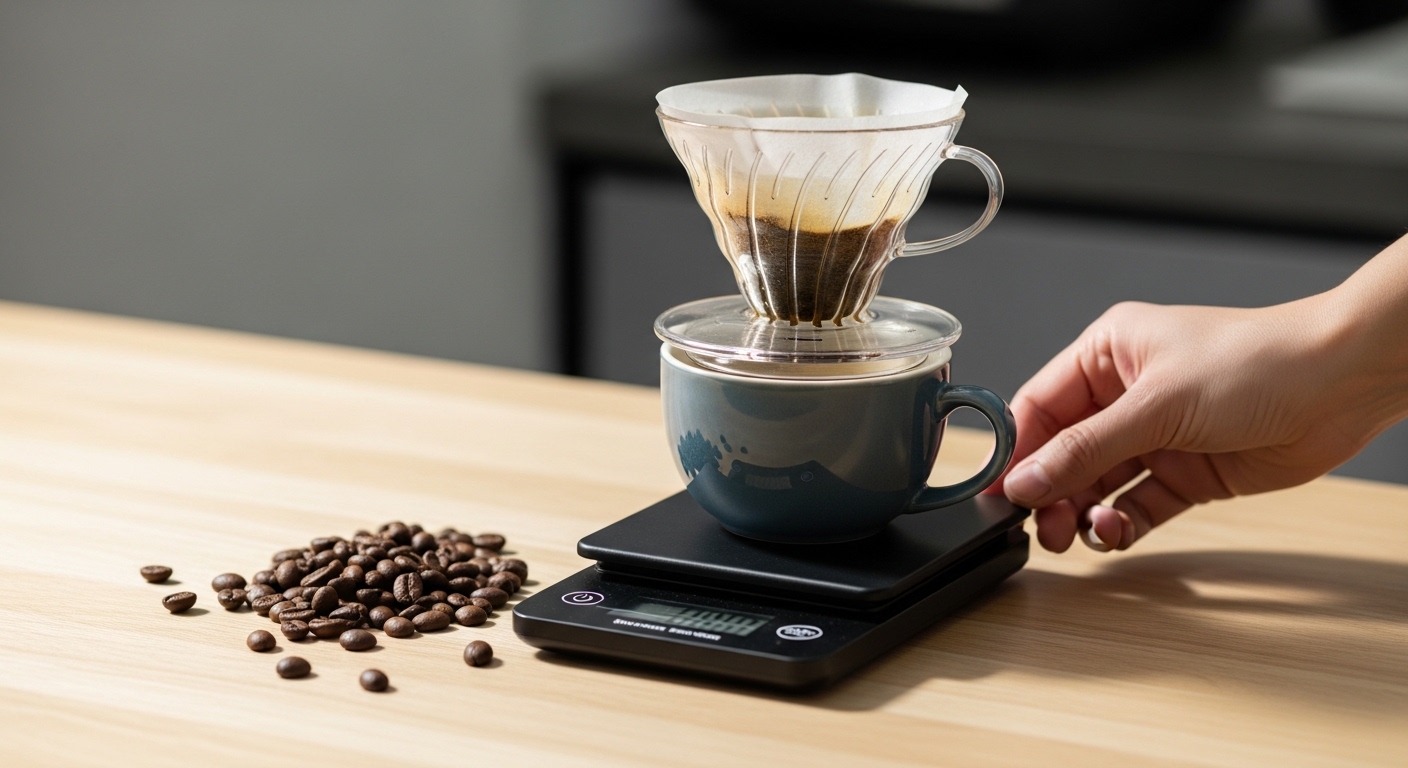
- Place your brewer or cup on the scale.
- Zero it out using tare.
- Measure your coffee dose.
- Zero again if needed.
- Measure the water as you brew.
That is it. You do not need to become robotic. You just need to create a repeatable base. Once you do that for a few days, the workflow starts feeling normal very quickly.
The smartest mindset: use the scale to learn, not to obsess
The goal is not to become neurotic about every gram forever. The goal is to use the scale to build understanding. Once you know what ratios and doses work for your taste, you become much more confident. Then the scale stops feeling like a strict teacher and starts feeling like a useful reference point.
This matters because some people reject scales because they think measurement kills enjoyment. Usually the opposite happens. Better consistency makes coffee more enjoyable because it reduces pointless failure.
So use the scale as a learning tool and a clarity tool—not as a way to turn coffee into a joyless math exercise.
Common mistakes people make
Mistake 1: Thinking a scoop is “close enough” for consistent results
It may be close enough for casual coffee, but it is usually not close enough for repeatable coffee.
Mistake 2: Buying better beans without measuring anything
Good beans still need a stable recipe if you want to taste what they can actually do.
Mistake 3: Thinking the scale is only for coffee nerds
In reality, a scale is one of the simplest tools for making coffee less confusing.
Mistake 4: Measuring coffee but not water
Both sides of the recipe matter. Dose without water control still leaves a major variable loose.
FAQ
Can I use a normal kitchen scale instead of a coffee scale?
Yes, as long as it is accurate enough and practical for your brewing setup. A dedicated coffee scale is nice, but not always necessary.
Do I need a scale if I only use a drip machine?
No, but it still helps a lot if you want the coffee to taste more consistent from day to day.
What is the biggest advantage of using a scale?
Repeatability. It helps you understand what worked, what failed, and how to make useful adjustments instead of random guesses.
Conclusion: a coffee scale is not about being fancy—it is about being repeatable
If you want better coffee at home, a scale is one of the most practical tools you can add. It helps you measure coffee and water properly, reduce randomness, repeat good cups, and troubleshoot bad ones with much more confidence. You do not need a scale to make coffee, but if you want coffee that is more stable, more understandable, and more consistently enjoyable, using one is a very smart move.
