
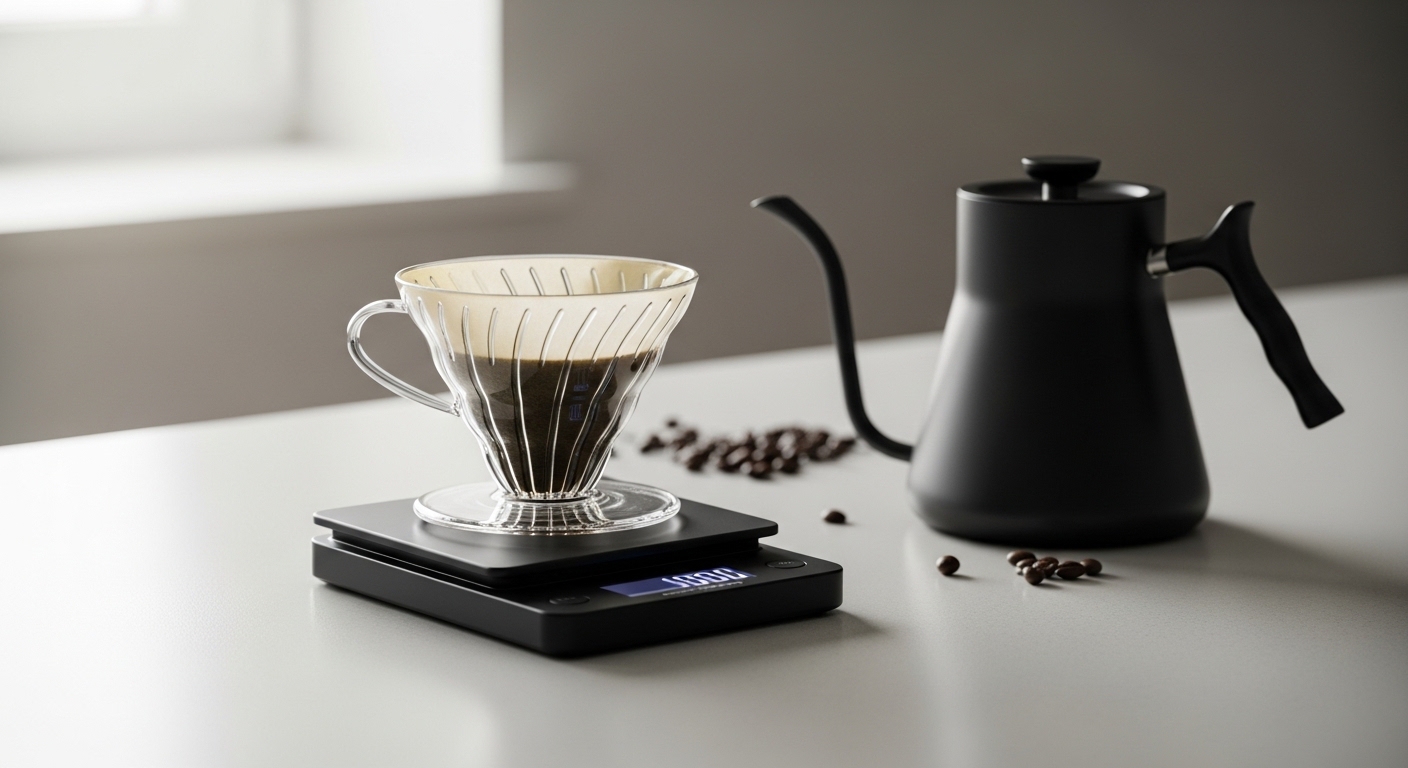
Quick Answer: Do you really need a coffee scale?
If you want coffee that tastes consistent, a coffee scale is one of the easiest upgrades you can make. You do not need a scale to make coffee at all, but if you are tired of cups that randomly taste too weak, too bitter, too sour, or just “not as good as yesterday,” measuring by weight fixes a huge part of that problem. Scoops are convenient, but coffee beans vary in size, roast level, density, and freshness. A scale removes that guesswork and gives you a repeatable starting point every time.
In simple terms: a coffee scale helps you use the same amount of coffee and water every time, so your recipe becomes predictable instead of random.
Why coffee tastes inconsistent when you “just eyeball it”
A lot of people make coffee using a spoon, scoop, or pure instinct. Sometimes that works. Sometimes it does not. The reason is that a “tablespoon of coffee” is not actually a reliable unit when the beans change. A dark roast often weighs less by volume than a light roast because the beans are less dense. Some coffees are larger, some are smaller, and some grinders create different amounts of retained coffee. So the scoop that worked yesterday can quietly become the wrong amount today.
Water is just as important. If you pour water by eye, your brew strength shifts without you noticing. One day the cup tastes rich and sweet. The next day it tastes thin. You might blame the beans, the grinder, or the weather, when the real issue is simply that you used different amounts without realizing it.
This is why a scale matters so much: it replaces “close enough” with actual repeatability.
What a coffee scale actually does for you
A coffee scale is not magic. It does three practical things:
- It measures coffee dose accurately
- It measures water amount accurately
- It makes recipes repeatable
That third point is the big one. Once a cup tastes great, you want to be able to make that same cup again. A scale helps turn “I got lucky” into “I know what I did.”
It also makes troubleshooting easier. If the cup tastes sour, you can change one variable while keeping everything else the same. Without a scale, you might be changing three things at once and not realize it.
The biggest misconception: “A scale is only for coffee nerds”
This is wrong. A scale is actually most useful for people who are not trying to be obsessive. Why? Because it makes coffee easier. You stop guessing. You stop wondering why your French press tastes strong one day and watery the next. You stop overcorrecting with random extra scoops.
If you only want one “serious” habit that makes home coffee simpler, a scale is a great candidate. It is much easier to use a basic recipe with a scale than to develop “coffee intuition” through endless inconsistency.
Why weighing is better than using scoops
Scoops measure volume. Scales measure weight. Weight is much more reliable because coffee beans do not all occupy space the same way. Light roast beans and dark roast beans can fill a scoop differently. Whole beans and ground coffee behave differently. Even humidity and how the grounds settle can change the scoop result.
With a scale, 20 grams is 20 grams. It does not care whether the coffee is dark, light, dense, fluffy, expensive, or cheap. That is why serious recipes are written in grams, not in spoons.
Once you understand that, it becomes obvious why your coffee gets easier to control when you stop measuring by volume.
The most important concept: coffee-to-water ratio
A coffee scale becomes powerful when you pair it with a ratio. Ratio is simply the relationship between how much coffee you use and how much water you use.
A common starting range for many brew methods is somewhere around 1:15 to 1:17. That means 1 gram of coffee for every 15 to 17 grams of water. For example:
- 20 g coffee + 300 g water = 1:15
- 20 g coffee + 340 g water = 1:17
Those are not universal “perfect” recipes, but they are excellent starting points. Once you find a ratio you like, the scale lets you repeat it exactly.
How to start using a coffee scale without making your routine annoying
Some people buy a scale and then overcomplicate everything immediately. Don’t do that. Keep it simple. Your first goal is not becoming a coffee scientist. Your first goal is making the same decent cup on purpose.
Here is the easiest beginner workflow:
- Put your brewer or mug on the scale.
- Press tare/zero.
- Add your coffee until you hit your target weight.
- Press tare again if needed.
- Add water until you reach the target amount.
That’s it. You do not need to track ten metrics. Just dose coffee and water consistently.
What kind of scale do you need?
You do not need an ultra-expensive scale to start. A good beginner coffee scale should do these things well:
- measure in grams
- have a tare/zero function
- be reasonably fast and responsive
- fit your brewer or cup comfortably
A built-in timer is nice, especially for pour-over, but not essential at first. Accuracy, simplicity, and reliability matter more than fancy features.
If your setup includes a V60, server, or kettle, make sure the scale surface is large enough and stable. A tiny scale that feels cramped will annoy you every morning.
How a scale helps different brew methods
French press
A scale helps French press users avoid the “too strong one day, too weak the next” problem. Because French press is forgiving, many people get lazy with measurement. Then they wonder why the cup changes so much. A fixed dose and water amount instantly improve consistency.
V60 / pour-over
Pour-over benefits even more because it is sensitive to both total water and pouring stages. A scale helps you hit your bloom water, total brew water, and recipe target precisely. Without one, it is much easier to drift.
Drip machine
A scale makes drip coffee much more reliable. Instead of guessing with scoops, you can measure the coffee and water and get a cup that tastes much more stable over time.
Espresso
Espresso is where scales become almost essential. Small changes in dose and yield matter a lot. If you are serious about espresso, weighing both the input and output quickly becomes normal.
The hidden benefit: a scale saves coffee
People think a scale is an “extra step,” but it can actually reduce waste. When you are guessing, you often use too much coffee trying to avoid weak cups. Or you brew bad cups and throw them away. A scale helps you get closer to the target immediately, which means fewer wasted beans and fewer “I’ll just make another one” mornings.
So even though a scale looks like a precision tool, it often becomes a practical money-saving tool too.
Common beginner mistakes with a coffee scale
Mistake 1: using a scale once, then ignoring ratio
Some people weigh the coffee once and then go back to eyeballing the water. That defeats half the purpose. Coffee and water need to be measured together if you want consistency.
Mistake 2: changing too many variables at once
A scale gives you more control, but only if you use it calmly. If you change the grind, the roast, the ratio, and the water temperature all at once, the scale cannot save you from confusion.
Mistake 3: chasing “perfect” instead of “repeatable”
Your first goal should be repeatable coffee, not mythical perfection. Start with a decent recipe and make it stable. Then adjust slowly based on taste.
Mistake 4: forgetting to tare
This sounds obvious, but everyone does it at least once. Put the brewer on the scale, then tare. Add coffee, then tare if needed. It makes the whole process cleaner and easier.
A simple beginner recipe to try today
If you want one easy starting point for manual brewing, try this:
- 20 g coffee
- 320 g water
- adjust grind for your method
- taste and change one thing at a time next brew
This is not the perfect recipe for every bean or every brewer, but it is a strong baseline. More importantly, it is measurable. That means you can learn from it.
How a scale makes troubleshooting easier
Imagine your coffee tastes sour. If you are not using a scale, you do not know if you used too little coffee, too much water, the wrong grind, or some random combination. If you are using a scale, you can keep the ratio fixed and adjust only the grind. Now the result teaches you something.
This is why scales are so useful in real life. They reduce the number of unknowns. And when the number of unknowns drops, improvement happens much faster.
Do casual coffee drinkers need a scale?
Need? No. Benefit from one? Often yes. If you are perfectly happy with your routine and do not care about consistency, skip it. But if you have ever said, “Why did this taste better yesterday?” then a scale would probably help more than you think.
A scale is not about becoming obsessive. It is about removing randomness. That is a very practical upgrade.
FAQ
Can I use a kitchen scale instead of a coffee scale?
Yes, if it measures in grams, has a tare function, and is reasonably responsive. A dedicated coffee scale may be more convenient, but a basic kitchen scale can absolutely work.
Do I need a timer built into the scale?
No. It is useful for pour-over, but not required. Accuracy and ease of use matter more than extra features when you are starting out.
What matters more first: scale or grinder?
Both matter, but if your grind is wildly inconsistent, the grinder can be the bigger upgrade. The scale is often the simplest and cheapest way to improve consistency quickly, while the grinder affects extraction quality more deeply.
Conclusion: a scale turns good guesses into repeatable coffee
A coffee scale helps because it makes your dose and water measurable, your ratio repeatable, and your troubleshooting much easier. You do not need one to enjoy coffee, but if you want fewer random cups and more control over flavor, it is one of the smartest low-friction upgrades you can make. Once you start using a scale, you usually stop wondering why your coffee changes so much—and start adjusting with purpose instead of luck.
