
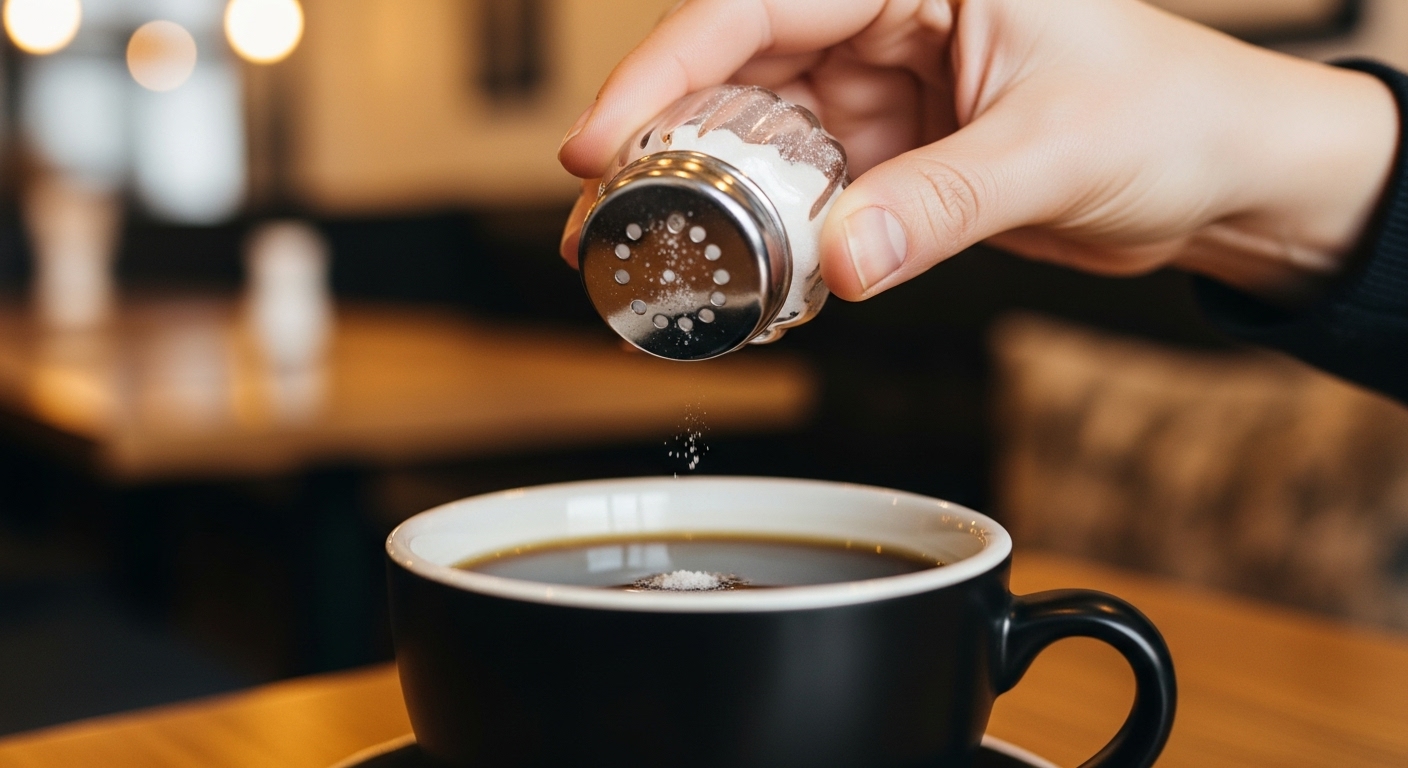
Quick Answer: Does salt in coffee really reduce bitterness?
Yes – adding a tiny pinch of salt can make coffee taste less bitter. It doesn’t “fix” bad coffee, but it can soften harshness by changing how your taste buds perceive bitterness. The trick only works in very small amounts; too much salt will flatten the flavor and make your cup taste strange.
If your coffee is consistently bitter, you’ll get a much bigger improvement by adjusting grind size, brew ratio, and water temperature. Think of salt as a last-mile tweak, not a rescue plan.
Why this “salt in coffee” trick is going viral
People love simple hacks especially ones that feel slightly rebellious. Adding salt to coffee sounds wrong, which makes it clickable. But unlike many internet “hacks,” this one has a real explanation: salt can reduce the perception of bitterness in foods and drinks when used in very small amounts.
That said, the viral versions often oversell it. If your coffee tastes bitter because it’s over-extracted, stale, or burned by high heat, salt might hide the problem a little – but it won’t turn a bad brew into a great one. The good news is you can fix bitterness at the source with a few small adjustments.
What bitterness in coffee really means
Bitterness is a normal part of coffee, but too much bitterness usually means your cup is out of balance. Great coffee typically has a mix of sweetness, acidity, and pleasant bitterness like dark chocolate. When bitterness dominates, you lose clarity and sweetness, and the aftertaste can feel dry, harsh, or “burnt.”
Most bitterness problems come from one of three buckets:
- Extraction issues (grind too fine, brew too long, water too hot)
- Bean issues (very dark roast, low-quality beans, stale coffee)
- Recipe issues (wrong ratio, uneven pouring, inconsistent technique)
Salt can slightly change how your tongue interprets bitterness. But if your coffee is bitter because the brew is fundamentally off, you’ll be happier fixing the root cause. That’s also how you get consistent results – day after day, bag after bag.
How salt changes the taste (without “fixing” the coffee)
In many foods, a small amount of salt can make flavors taste sweeter and reduce sharp edges. With coffee, the idea is similar: the right micro-dose of salt can take the edge off bitterness and make the cup feel smoother.
But there’s a catch: coffee has delicate aromas and layered flavors. Too much salt can mute those layers, making the coffee taste flat. So the goal is not to taste the salt – it’s to use an amount so small you barely notice it, except that the bitterness feels toned down.
The correct way to try salt in coffee (tiny doses only)
If you want to test the hack, do it like an experiment. Make your coffee normally, then adjust in tiny steps. That way you’ll learn what works for your taste and your brewing method.
Option A: Add salt to the brewed coffee (best for control)
This is the easiest method because you can stop as soon as it tastes right.
- Brew a cup as usual.
- Add one or two grains of table salt (or a tiny pinch) and stir.
- Taste. If needed, add one more grain and taste again.
Most people who like this trick end up using a truly tiny amount – far less than “a pinch” in the way most people pinch salt. If you can taste saltiness, you’ve almost certainly used too much.
Option B: Add salt to the grounds (convenient, but easier to overdo)
This can work, but it’s harder to dial in because you won’t know if you overdid it until the cup is brewed.
- Use less than 1/16 teaspoon for a full brew (and that may still be too much).
- Mix it evenly into the grounds before brewing.
- If it tastes flatter or slightly “savory,” cut the salt in half next time.
If you’re serious about improving coffee, Option A is better because it teaches you how your palate responds and gives you more control.
What kind of salt should you use?
Regular fine salt is best because it dissolves instantly and is easier to dose in microscopic amounts. Flaky salts are harder to measure consistently, and flavored salts can add weird side-notes. Keep it simple.
When salt helps – and when it won’t
Salt can help if your coffee is just a little too bitter, especially with dark roasts or slightly over-extracted brews. It may make the cup feel smoother and more drinkable.
But salt won’t solve these common problems:
- Stale beans that have lost aroma and sweetness
- Over-roasted coffee that tastes smoky or burnt
- Severely over-extracted brews (too fine + too long)
- Bad water (very hard, chlorinated, or off-tasting)
If your cup tastes like ash, salt isn’t the answer. You’ll get better results by improving your technique or choosing different beans.
The real causes of bitter coffee (and how to fix each one)
If you want coffee that tastes better every day – not just coffee that tastes “less bitter” – use this checklist. These are the adjustments that actually move the needle.
1) Your grind is too fine
A too-fine grind increases surface area, which makes extraction happen faster. That often leads to bitterness, especially in methods that already extract strongly (like espresso-style brews or long immersion).
Fix: Go one step coarser and keep everything else the same. If you’re using a blade grinder, consider switching to a burr grinder eventually – consistency matters more than most people think.
2) Brew time is too long
Over-steeping or slow drawdown can push your brew past the sweet spot. This is common with pour-over when the grind is too fine or when the filter gets clogged.
Fix: Shorten brew time slightly, or adjust grind coarser to speed up flow. Aim for repeatable timing rather than “winging it.”
3) Water is too hot
Very hot water can pull bitter compounds faster. Dark roasts are especially sensitive because they extract easily.
Fix: If you’re using boiling water, let it sit 30–60 seconds before brewing – especially for dark roasts. You’re not trying to make the coffee “weaker,” you’re trying to make extraction cleaner.
4) Your coffee-to-water ratio is off
If you use too little coffee for the amount of water, you may end up over-extracting the grounds to get enough strength, which can push the cup into bitterness.
Fix: Start with a simple baseline: about 1 gram of coffee for every 15–17 grams of water (roughly 1:15 to 1:17). Then adjust to taste.
5) Your beans (or roast level) aren’t a fit for your taste
Some people simply don’t enjoy very dark roasts because they emphasize smokiness and bitter notes. If you’re constantly trying to “hack” the bitterness away, it may be smarter to change the beans.
Fix: Try a medium roast from a reputable roaster, and pay attention to the tasting notes. If you want more sweetness and less bitterness, choose coffees described as chocolatey, nutty, or caramel rather than intensely smoky or “bold.”
Does salt work better in some brewing methods?
It tends to be most noticeable in methods that produce a heavier, bolder cup – like drip-style coffee, immersion brews, and darker roasts. In very bright, delicate pour-overs, adding salt can sometimes mute the clarity you’re trying to highlight.
If you’re brewing a clean, floral coffee and it tastes harsh, it’s usually better to adjust extraction than to add salt. Salt is more of a “make this more drinkable” trick than a “make this more precise” technique.
A simple bitterness troubleshooting checklist
If you want a fast, practical checklist, use this order. Change one thing at a time:
- Use fresher beans (or confirm the roast date).
- Grind slightly coarser.
- Lower water temperature a bit (especially for dark roasts).
- Adjust brew ratio (try 1:16 as a baseline).
- Only then test a micro-pinch of salt in the cup.
This order works because it fixes the most common causes first, and it saves salt for the end – where it belongs.
FAQ
Will salt make coffee less acidic?
Not exactly. Salt mainly affects perceived bitterness. If your coffee tastes sour or sharply acidic, that’s usually a sign of under-extraction. In that case, you’re better off grinding slightly finer, using hotter water, or extending brew time a bit.
Can I add salt to espresso?
You can, but be careful. Espresso is concentrated, so even a tiny amount of salt can show up quickly. If your espresso is bitter, it’s usually more effective to adjust dose, grind, yield, or shot time.
Is salted coffee a real thing in any cultures?
Yes – there are regional traditions of adding salt to coffee in some places, often tied to local taste preferences or specific brewing styles. The modern “viral hack” is more about bitterness control than tradition, but the idea isn’t entirely new.
How much salt is too much?
If you can taste saltiness, it’s too much for most people. The goal is a subtle smoothing effect, not a savory cup. Start with one or two grains, taste, and stop early.
Does salt ruin the health benefits of coffee?
In the tiny amounts used for this trick, salt won’t meaningfully change anything. The bigger concern is taste and balance – too much salt can make your coffee less enjoyable, which defeats the point.
Conclusion: Use salt as a tiny tweak, not a crutch
Salt in coffee can work – if you treat it like seasoning, not a magic fix. A microscopic amount may soften bitterness and make a cup feel smoother. But if bitterness is a repeat problem, the best improvements come from fresher beans, better extraction, and a solid brew recipe.
If you want consistently better coffee, focus on the fundamentals first. Then, if you’re still curious, try the salt trick as a controlled experiment.
