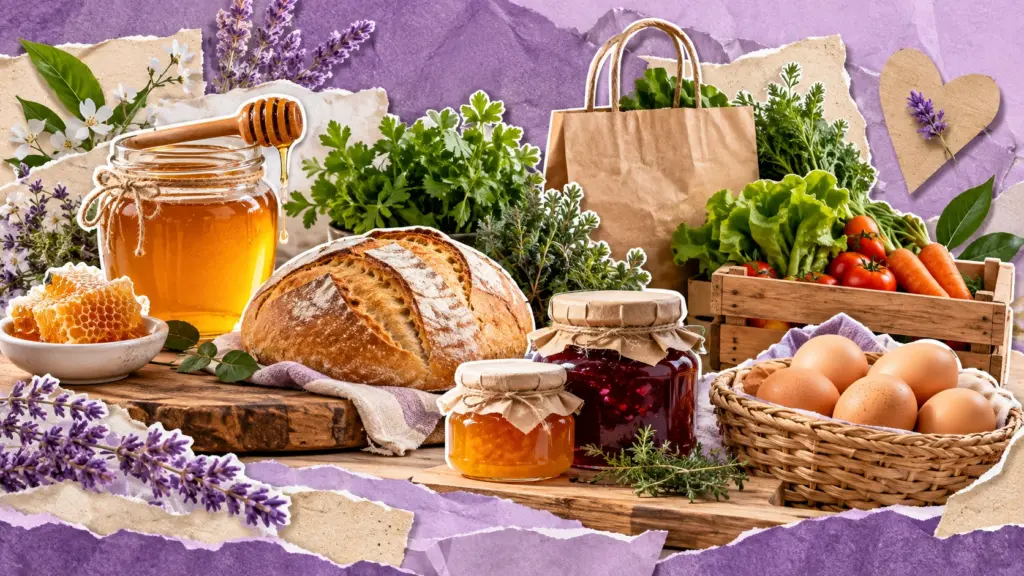
6 ideas for selling food in front of your house
From honey to homemade products: discover simple ways to transform your space, production, and routine into extra income.
I WANT TO SEE THE 6 IDEAS ➜ SHOW ME WHAT I CAN SELL ➜ I WANT TO START AT HOME ➜Continue reading to understand how to choose a product, set up a simple point of sale, and get started without complications.
A simple space can become a small income opportunity.
Those who live in rural areas, residential neighborhoods, or busy streets can look at the front of their house in a different way. A porch, garage, gate, or small covered space can serve as a base for selling artisanal foods, local products, or simple items made on a small scale.
Honey, jams, bread, eggs, spices, vegetables, and other everyday consumer products can attract attention precisely because of their proximity. Many people like to buy close to home, talk directly to the producers, and find items that don't seem industrialized or generic.
The best start is often small.
A common mistake is thinking that selling food requires starting with a large operation. That's not always the case. Those testing an idea can begin with a few products, observe what generates interest, and gradually increase production as demand grows.
This reduces waste, avoids excessive investment, and helps to better understand the profile of those passing through the region. In an area with families, for example, bread, cakes, and eggs may sell well. In rural or transit areas, honey, jams, cheeses, vegetables, and artisanal products may make more sense.
Before choosing a product, consider your current situation.
A good business idea doesn't just depend on what you know how to do. It also needs to be a good fit for the location, the local routine, and the target audience.
- Watch the street activity: Are there people passing by on foot, in cars, or on bicycles?
- Please note the times: Morning, lunch, late afternoon, or weekend can all involve different behaviors.
- Consider what already exists nearby: If everyone is selling the same product, perhaps it's better to look for something different.
- Think about what you can consistently produce: There's no point in selling a lot one week and then disappearing the next.
- Calculate storage and shelf life: Some foods require more care than others.
This simple approach avoids choosing a product just because it looks interesting. Ideally, you should combine what you know how to produce with what actually has a chance of being purchased.
Rural and artisanal products have an important distinguishing feature.
Items such as honey, eggs, vegetables, jams, breads, and spices can convey a sense of proximity and local production. This can be an important differentiator, especially when the product has a good presentation and the point of sale is clean and organized.
But it's important not to confuse "homemade" with improvised. Clean packaging, proper storage, clear product information, and attention to hygiene make a big difference in customer confidence.
Low price shouldn't be the only strategy.
Those who start selling from home sometimes try to charge as little as possible to attract customers. The problem is that this can erase real costs: ingredients, gas, energy, packaging, transportation, losses, and labor time.
A small business needs to make sense for both the buyer and the seller. Therefore, before setting a price, it's worth noting the costs and understanding how much is actually left over after the sale.
Quick questions before we begin.
No. Starting with fewer options makes it easier to test demand and better control costs.
It can be interesting when it comes from a reliable source, is well preserved, and properly presented.
The space can serve as a simple meeting point, provided it is suitable, organized, and compliant with local regulations.
It might be worthwhile, especially if that's the busiest time of year in the area.
Yes. Depending on the product and the city, there may be hygiene, licensing, labeling, or storage requirements.
On the next page, you'll see 6 practical food ideas to sell, simple ways to organize your sales point, and a step-by-step guide to get started more confidently.