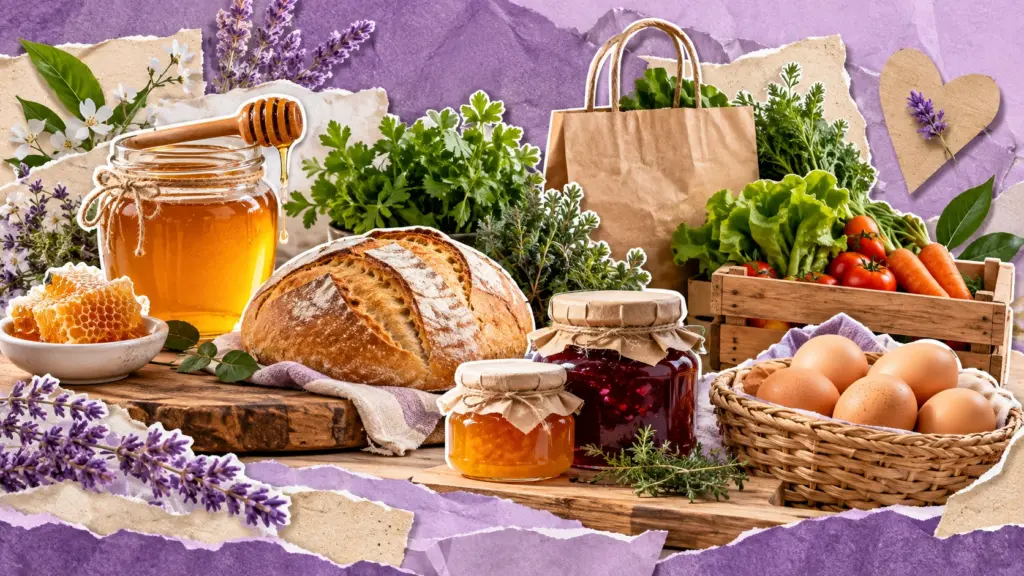
6 ideas for selling food in front of your house
Check out these 6 ideas, choose the one that makes the most sense, and discover how to get started with a simple structure.
See the 6 ideas How to get started at home How to organize the point I WANT TO SEE THE 6 IDEAS ➜6 food ideas to sell in front of your house
The best option depends on your region, what you can produce or buy with good provenance, and how you intend to organize sales. The ideas below serve as a starting point for thinking about a small rural or urban business.
1. Honey and related products
Honey is a product that lends itself well to local and artisanal sales, especially in regions where there are producers nearby. It takes up little space, can be presented in jars of different sizes, and tends to attract the attention of those who value foods of known origin.
If you don't produce the product yourself, the main concern is working with a reliable supplier and verifying the product's consistency. It's also important to keep containers tightly sealed, clean, and protected from excessive heat and direct sunlight.
Depending on the origin and what is permitted in your region, related products, such as propolis or its derivatives, can expand the mix. Ideally, don't overdo it at the beginning: a few well-presented options usually work better.
2. Eggs and products from small-scale rural production
Eggs are frequently consumed and can attract repeat buyers. For those living in rural areas or who have access to small producers, this can be a simple product to work with.
Presentation matters a lot. Clean packaging, well-selected items, and proper storage convey an image of care. If there are other locally produced items, such as seasonal vegetables, herbs, or fruits, they can complement the offering.
3. Homemade breads, cakes and cookies
Baked goods have a key advantage: they quickly pique desire. Fresh bread, simple cakes, sweet breads, cornbread, cookies, and other items can work very well in residential neighborhoods.
The challenge is controlling production and surplus. Therefore, it might be best to start with a few flavors and smaller quantities. Over time, you'll discover which items sell best and on which days there's the highest demand.
It can also be useful to work with orders. This way, part of the production already has a specific destination and waste is reduced.
4. Homemade jams, preserves and sauces
Jams and other products in jars are eye-catching and easy to organize on a small countertop. They also allow you to take advantage of seasonal fruits and traditional recipes.
But here, even greater care must be taken with preparation, preservation, hygiene, and shelf life. Some types of preserves require specific technical controls to be safe. Therefore, never improvise preservation processes just to increase shelf life.
If you decide to enter this category, work only with appropriate recipes and processes, and verify the applicable sanitary requirements.
5. Fresh vegetables, spices and herbs
Anyone with a vegetable garden or access to nearby produce can set up a simple stall with lettuce, herbs, chives, parsley, basil, kale, peppers, and other fresh items.
This type of product works well when the presentation conveys freshness. Clean crates, organized baskets, and small quantities replenished throughout the day usually work better than leaving everything exposed for many hours.
Another advantage is repeat business. Those who like the product may come back every week.
6. Local product combos
An interesting idea is to combine two or three items that make sense together. For example: artisanal bread with jam, honey with biscuits, a basket with eggs and vegetables, or a small spice kit.
Offering combo deals makes it easier for customers to choose and can increase the average purchase value without needing to expand the variety too much.
But the secret remains simplicity. Don't try to put together ten combinations right from the start. One or two are enough to test interest.
How to start working from home without investing too much.
Starting small allows you to test the idea before committing a lot of money. Instead of setting up a complete structure, think first about a clean, organized, and visible space.
- Choose one or two products: Keep the beginning simple.
- Calculate the actual cost: Include ingredients, packaging, transportation, and losses.
- Set days and times: Regular contact helps the customer remember you.
- Test small amounts: Avoid producing too much before you know the demand.
- Pay attention to what sells: Make a note of which products sell the most.
- Reinvest part of the profits: Improve packaging, organization, or variety gradually.
This simple process helps transform an idea into something more predictable. You don't need to get everything right on the first day. The important thing is to observe and adjust.
How to set up a simple point in front of your house.
The appearance of the business greatly influences the confidence of passersby. Even a small desk can look professional when it is clean, well-organized, and free of clutter.
- Use a sturdy table or countertop;
- Keep the products protected from sun and rain;
- Avoid direct contact with dust and animals;
- Separate raw foods from ready-to-eat products;
- Use clean, food-grade packaging.
- Keep your surroundings organized;
- Remove any product that appears inappropriate immediately.
Simple organization conveys care. And in small businesses, trust is one of the most important assets.
How to advertise without spending a lot of money
Having a physical location helps, but advertising can greatly expand your reach. A message in neighborhood groups, contact lists, social networks, or messaging apps can let people know when fresh produce is available.
Simple, well-lit, and realistic photos usually work better than trying to look like a large company. Show the product, state sales days, and make it easy to contact them.
It's also worth encouraging pre-orders. When customers reserve in advance, you can produce with more predictability and reduce waste.
What can make this small business grow?
- Consistent quality: The customer needs to find the same pattern when they return.
- Good presentation: Packaging and organization reinforce trust.
- Regularity: Predictable days and times help create shopping habits.
- Simple and friendly service: Proximity is an advantage of local businesses.
- Cost control: Selling well but not knowing how much is left over can hide losses.
It's common to think that growth depends on having many products. In practice, a small business usually becomes stronger when it sells a few things with quality and consistency.
Don't ignore the rules for food.
Before selling, check the requirements applicable to your specific case. Depending on the food, there may be rules regarding preparation, storage, packaging, labeling, expiration date, origin, and place of sale.
There may also be differences between fresh produce, prepared foods, animal products, and packaged goods. Therefore, it's worth consulting local authorities before investing in a larger operation.
This step may seem bureaucratic, but it helps protect both the seller and the buyer.
One or two well-chosen products, good presentation, and consistency are enough to test if there is demand in your region.
I WANT TO START AT HOME ➜Frequently asked questions about selling food in front of your house.
It depends on your region and your infrastructure. Simple products that are in high demand and that you can maintain in terms of quality are usually better for testing.
No. A small, well-organized location may be enough to validate the idea before investing more.
It can be, especially when there is good provenance, proper presentation, and an audience interested in local products.
Start with small quantities, monitor demand, and consider working with pre-orders.
This may be possible, but it's important to know the origin and check the rules applicable to that type of food.
Initially, no. Few options facilitate control over inventory, cost, quality, and waste.
Yes. The requirements vary depending on the city, the type of food, the method of preparation, and the way it is sold.
Choose a few products, pay attention to presentation, monitor costs, and learn from the demand in your own region. Growing gradually is usually safer than trying to start big.
REVIEW THE 6 IDEAS ➜