
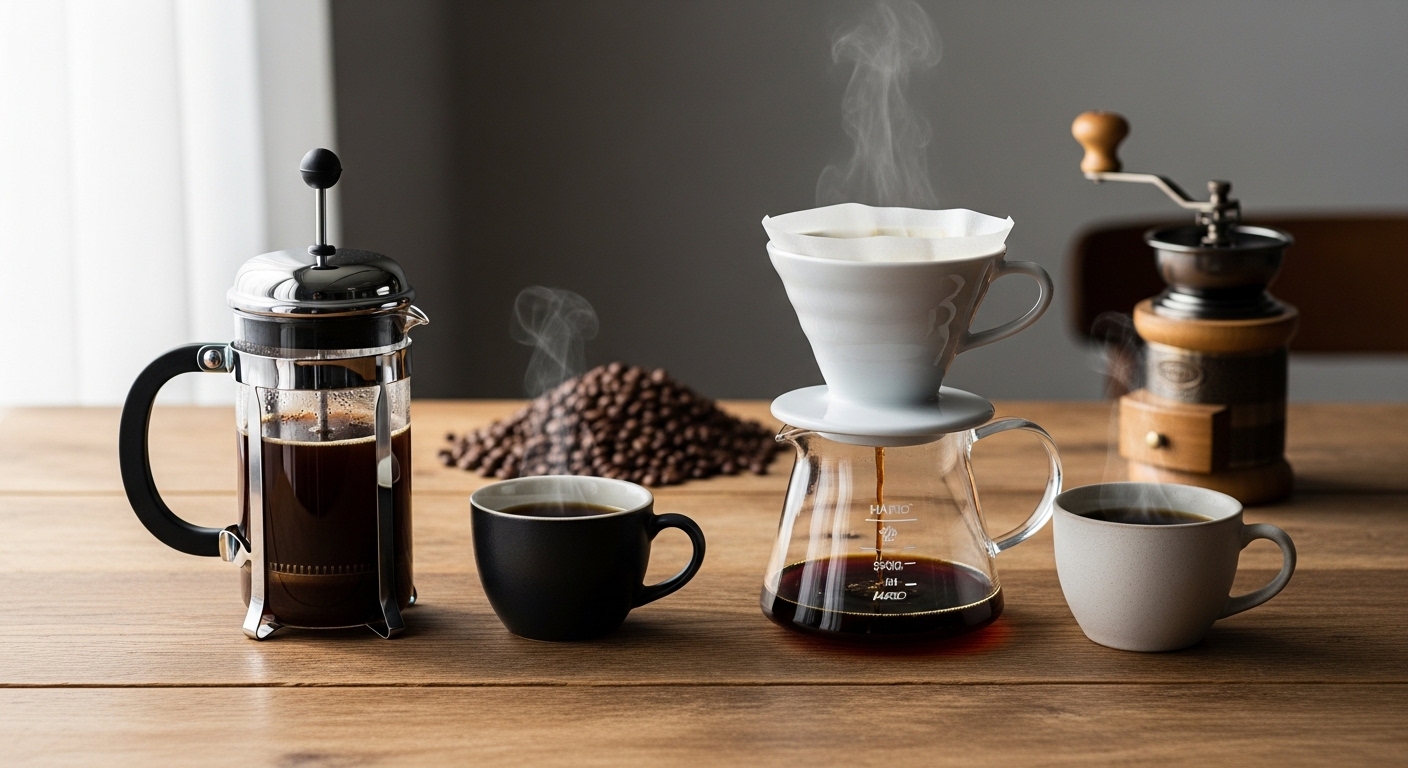
Quick Answer: French Press vs V60—what’s better?
Neither method is “objectively” better—it depends on the flavor you want. A French press usually makes a richer, heavier cup with more body and oils. A V60 typically produces a cleaner, brighter cup with more clarity and distinct flavor notes. If you like bold and smooth coffee, French press is often the winner. If you like crisp, nuanced coffee (and you enjoy dialing in technique), V60 usually shines.
The good news: you can get excellent coffee from either one if you use fresh beans, the right grind size, and a consistent recipe.
Why this comparison matters (it changes everything you taste)
People often blame beans when the real difference is the brewing method. French press and V60 extract coffee in totally different ways. That affects body, clarity, sweetness, bitterness, and how noticeable the coffee’s aroma feels.
If you’ve ever tried the same beans and thought, “Why does this taste completely different?”—this is usually why. Understanding the strengths of each method helps you pick the right tool for your preferences and stop wasting money chasing the “perfect” bag of coffee.
French Press vs V60 at a glance
Here’s the simplest way to understand the difference:
- French press: immersion brewing (grounds steep in water), metal filter, more oils and fine particles → more body.
- V60: pour-over brewing (water flows through grounds), paper filter, cleaner filtration → more clarity.
One isn’t “better.” They’re different experiences. Think of it like music: some people want bass and warmth, others want separation and detail.
Flavor profile: body vs clarity
French press flavor: rich, round, and heavy
French press coffee often feels thicker and more “mouth-coating” because the metal filter lets more oils through. You may also get a little sediment at the bottom of the cup. Many people love this because it tastes bold, smooth, and satisfying—especially with chocolatey, nutty coffees.
V60 flavor: clean, bright, and detailed
V60 coffee tends to taste clearer and more articulate. Paper filters trap oils and fine particles, which can make flavors feel more precise. If you enjoy fruity or floral notes, V60 often makes those easier to taste—especially with lighter roasts.
If you want to taste the “tasting notes” on a bag, V60 usually gives you a better shot at finding them.
Ease of use: which one is more beginner-friendly?
For most people, French press is easier to learn because it’s forgiving. V60 can be simple, but it rewards technique and consistency.
- French press is forgiving because immersion brewing extracts more evenly as long as your grind and time are reasonable.
- V60 is sensitive to grind size, pour speed, and technique—small changes can noticeably change the taste.
If you want “great coffee with minimal fuss,” French press is often the better first method. If you enjoy tinkering and chasing clarity, V60 is a fun rabbit hole.
The biggest deal-breaker: grind quality
Grind quality matters for both methods, but it can matter even more for V60. If your grind is inconsistent (lots of dust and boulders), you’ll often get both bitterness and sourness in the same cup—especially in pour-over.
French press is more tolerant of imperfect grind consistency, though it still improves a lot with a good burr grinder.
Best beans for French press vs best beans for V60
You can brew any coffee with either method, but some pairings are easier wins:
- French press: medium roasts, chocolate/nut/caramel notes, fuller-bodied coffees, many espresso blends (even when brewed as filter).
- V60: light to medium-light roasts, washed or honey process coffees, fruity/floral notes, coffees where clarity matters.
If you’re still deciding on beans, start with a balanced medium roast and then explore brighter coffees once your technique is consistent.
French press recipe (simple baseline that tastes great)
This is a clean, repeatable recipe that works for most medium roasts.
- Ratio: 1:15 to 1:16 (example: 30g coffee to 450–480g water)
- Grind: medium-coarse (like coarse sand)
- Water temperature: just off boiling, slightly cooler for dark roasts
- Total time: about 4 minutes (plus a short settle)
Step-by-step:
- Add coffee grounds to the French press.
- Pour in hot water evenly and stir gently.
- Put the lid on (don’t press yet) and steep for about 4 minutes.
- Press slowly and steadily.
- Pour immediately (don’t let coffee sit on the grounds).
Pouring immediately is a simple pro tip. If coffee sits with the grounds, it keeps extracting and can turn bitter.
V60 recipe (a beginner-friendly method that’s still excellent)
This recipe is built for consistency. Once it tastes good, you can start experimenting.
- Ratio: 1:16 to 1:17 (example: 20g coffee to 320–340g water)
- Grind: medium-fine (like table salt)
- Water temperature: hot (adjust cooler for dark roasts)
- Total time: roughly 2:30 to 3:30 (varies by grind and coffee)
Step-by-step:
- Rinse the paper filter with hot water (removes paper taste and warms the brewer).
- Add coffee grounds and level the bed.
- Bloom: pour enough water to wet all grounds, wait about 30–45 seconds.
- Continue pouring in slow circles until you reach your total water amount.
- Let it draw down completely, then taste and adjust.
If it tastes bitter and harsh, go a bit coarser or pour a little faster. If it tastes sour and weak, go a bit finer or extend brew time slightly.
Common mistakes (and quick fixes)
French press mistakes
- Muddy cup: grind too fine → go coarser.
- Bitter cup: steep too long or coffee sitting after pressing → shorten time and pour immediately.
- Weak cup: use more coffee or steep slightly longer.
V60 mistakes
- Bitter cup: grind too fine or slow drawdown → go coarser.
- Sour cup: under-extraction → go finer or use hotter water.
- Inconsistent cups: inconsistent pouring or grind quality → slow down and standardize your pours.
If you’re fighting bitterness no matter what, freshness might be the hidden issue.
Which one should you buy?
Use this quick decision guide:
- Buy a French press if you want rich body, easy brewing, and consistent results with minimal technique.
- Buy a V60 if you want clean clarity, you enjoy experimenting, and you want to taste subtle notes in lighter roasts.
Either way, the biggest improvement still comes from fresh beans and good storage. The method is the “lens,” but the coffee itself is the “subject.”
FAQ
Which method makes the strongest coffee?
“Strong” can mean different things. French press often tastes stronger because it has more body and oils. But strength (concentration) depends more on ratio and recipe than the device.
Which is better for beginners?
French press is generally more beginner-friendly because it’s forgiving. V60 can be beginner-friendly too, but it’s easier to get inconsistent results until your grind and pouring are consistent.
Can I use the same grind size for both?
Not ideally. French press usually likes medium-coarse. V60 usually likes medium-fine. Using the same grind for both often leads to bitterness in V60 or weak coffee in French press.
Why does my V60 taste bitter sometimes and sour other times?
That often comes from inconsistent grind distribution and uneven pouring. Try a slightly coarser grind, keep a steady pour, and standardize your recipe. Consistency beats perfection.
Conclusion: Choose your flavor goal—then pick the method
French press and V60 are both excellent. French press is rich, forgiving, and satisfying. V60 is clean, nuanced, and rewarding when you dial it in. Choose based on the experience you want, then use a repeatable recipe—and don’t ignore freshness and storage, because they can make or break both methods.
