
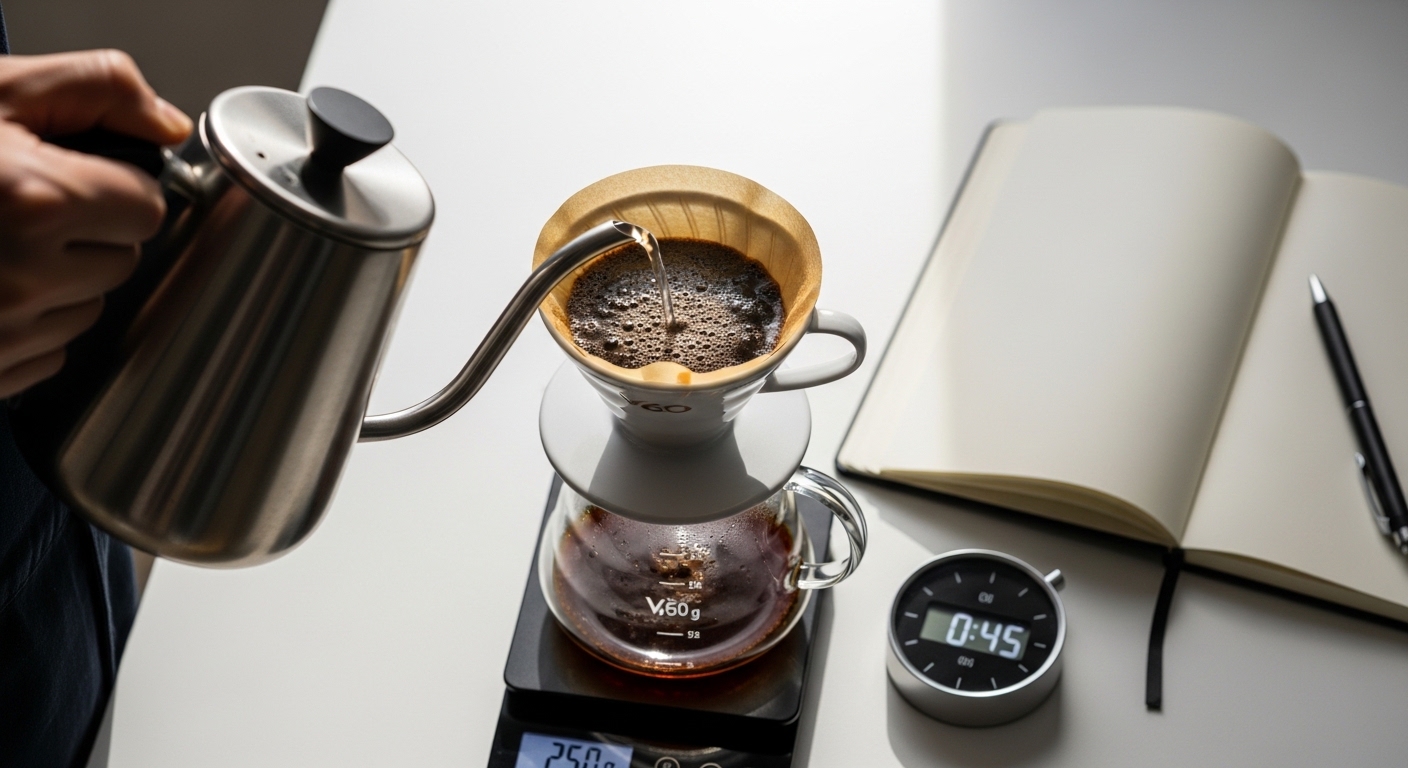
Quick Answer: What does “dialing in” pour-over coffee actually mean?
Dialing in pour-over coffee means adjusting your brew until it tastes balanced, sweet, and clear instead of sour, weak, bitter, or flat. In practice, that usually means changing one variable at a time—most often grind size, then sometimes ratio, water temperature, or pour structure. The biggest beginner mistake is trying to fix everything at once. The smartest method is much simpler: keep most things stable, change one thing, taste carefully, and repeat.
If your V60 feels confusing, that does not mean you are bad at coffee. It usually means you need a calmer process, not more complicated advice.
Why V60 feels “hard” to beginners
V60 has a reputation for being tricky because it is more transparent than many other brew methods. That transparency is beautiful when everything is working: the coffee can taste clean, expressive, and almost elegant. But that same transparency also means your mistakes show up clearly. If your grind is off, you taste it. If your pour is sloppy, you taste it. If your ratio is weird, you taste it.
That does not mean V60 is impossible. It means V60 is less forgiving than French press. Once you stop trying to make it “perfect” and instead try to make it repeatable, the method becomes much easier to understand.
The goal is not “coffee mastery” on day one. The goal is building a stable recipe that gives you a good cup most of the time.
The biggest mindset shift: stop changing everything
Most V60 frustration comes from chaos. Someone makes a bad cup, then changes grind size, water temperature, coffee dose, total water, bloom time, pouring speed, and kettle height all in one morning. Then the next cup is different, but they have no idea why.
That is not dialing in. That is improvising wildly.
The better system is simple:
- keep the same coffee
- keep the same ratio
- keep the same water
- keep the same basic pouring pattern
- change one thing
That one rule will save you more coffee than almost anything else.
Your “default” V60 recipe (a calm starting point)
Before you dial in anything, you need a baseline. Here is a very practical starting recipe that works well for many coffees:
- 20 g coffee
- 320 g water
- medium-fine grind
- simple bloom + 2 to 3 pours
This is not the perfect recipe for every bean on earth. It is a stable baseline. That matters more. Once you have a stable baseline, your adjustments start to make sense.
If you already have a recipe that is close to this and sometimes works, keep it. The point is not copying internet coffee rituals exactly. The point is removing randomness.
What to adjust first: grind size
In most cases, grind size is the first and most important adjustment in V60. That is because it directly changes how fast water moves through the coffee bed and how much flavor gets extracted. It is usually the fastest route to solving sour or bitter cups.
Use this simple guide:
- Sour, sharp, weak, watery? Go slightly finer.
- Bitter, harsh, drying, muddy? Go slightly coarser.
The word slightly matters. One step finer or one step coarser is usually enough for a meaningful test. Huge grind jumps often create a new problem instead of solving the old one.
How to read the cup correctly
If you are going to dial in coffee, you need better language than “good” and “bad.” The easiest way is to classify the cup by the most obvious problem.
Cup problem: sour and weak
This usually points to under-extraction. The water did not pull enough sweetness and depth from the grounds.
Most likely fixes:
- grind a bit finer
- use hotter water
- pour more steadily so the bed extracts more evenly
Cup problem: bitter and rough
This usually points to over-extraction or an aggressive setup that is pulling too many harsh compounds.
Most likely fixes:
- grind slightly coarser
- lower water temperature a little, especially for darker roasts
- reduce over-agitation from overly forceful pouring
Cup problem: flat and boring
This one can be trickier. Flatness can come from stale beans, poor water, a weak ratio, or a brew that technically “worked” but did not extract enough sweetness or aroma.
Most likely checks:
- check bean freshness
- check water quality
- check whether the ratio is too weak
Cup problem: both sour and bitter
This often means uneven extraction. Some parts of the coffee bed under-extracted while other parts over-extracted.
Most likely causes:
- inconsistent grinder
- messy pouring
- channeling or uneven bed saturation
When that happens, your first improvement may not be a dramatic recipe change. It may be pouring more calmly and consistently.
The bloom: important, but don’t overcomplicate it
The bloom is the first small pour that wets the coffee and allows trapped gas to escape. It matters because dry pockets in the bed can create uneven extraction later. But beginners often turn bloom into a stressful ritual with too many rules.
The practical goal is simple: wet all the grounds evenly. That’s it.
A good bloom does not need to look cinematic. It needs to do its job. If parts of the bed stay dry or you dump the bloom unevenly, the rest of the brew becomes harder to control.
Your pouring pattern: simpler is better
A lot of people think V60 skill means complex spiral choreography with a gooseneck kettle. In reality, a simple, steady pour is more valuable than fancy motion you cannot repeat. Your main goals are:
- wet the bed evenly
- avoid violent pouring that stirs the bed too aggressively
- keep the slurry level reasonably stable
- finish with a bed that drains evenly
If your pours are chaotic, fix that before chasing exotic recipes. A boring, repeatable pour beats a stylish inconsistent one every time.
How water temperature fits into dialing in
Water temperature is a useful adjustment, but not always the first one. A lot of V60 issues can already be solved with grind size and ratio. Temperature becomes especially helpful when the coffee’s roast level suggests a clear direction:
- Light roast: often benefits from hotter water
- Dark roast: may benefit from slightly cooler water
- Medium roast: usually tolerates a broad middle zone well
So yes, temperature matters—but it should support your dialing-in process, not replace it.
Why brew time is useful—but not everything
People love using total brew time as if it were a truth serum. Brew time is useful because it gives you a clue about flow and extraction. But it does not tell the whole story. Two brews can finish at similar times and still taste different if the pours were uneven or the grinder created too many fines.
So use brew time as a reference, not as a religion. If the cup tastes good, the exact number matters less. If the cup tastes wrong and the drawdown is wildly fast or slow, then time becomes a valuable clue.
A 3-step dialing-in system that actually works
Use this process every time you open a new coffee:
- Brew one baseline cup with your standard recipe.
- Diagnose the main flaw: sour, bitter, flat, or uneven.
- Change one variable only, usually grind size first.
Then repeat until the cup tastes balanced. This sounds almost too simple, but it works because it keeps you from spiraling into random changes.
What to do when you switch to a new bag of coffee
New beans often need new settings. That is normal. A fruity light roast from one region may need a different approach than a chocolatey medium roast from another. The mistake is expecting every coffee to behave identically.
But “different” does not mean “start from zero and panic.” Keep the same baseline recipe, brew one cup, then adjust from there. Usually you will only need a small grind change, maybe a temperature tweak, and the coffee will come into focus quickly.
The underrated variable: water quality
Sometimes V60 is not hard. Your water is just bad. Since pour-over highlights clarity, it also highlights water problems more clearly than some heavier methods. If your coffee keeps tasting dull or strange across different beans, water may be the hidden issue.
This is why good dialing-in logic always includes one question: “Am I trying to fine-tune a brew that already has a water problem?” If yes, fix that first.
Common V60 mistakes that create unnecessary confusion
Mistake 1: chasing exact numbers before understanding taste
Numbers are useful. But taste is the point. If you blindly follow a recipe without learning what sour, bitter, weak, and balanced actually mean, you stay dependent on formulas forever.
Mistake 2: pouring too aggressively
Hard pouring can disturb the bed too much and create uneven extraction. Calm, repeatable pouring usually wins.
Mistake 3: using a weak grinder and blaming the recipe
If your grinder creates too many fines and big chunks at the same time, dialing in becomes much harder. The recipe may not be the real problem.
Mistake 4: changing beans constantly before learning your system
Switching coffees every two days makes learning slower. Use one bag long enough to understand how your process affects the cup.
How to know when you’re “done” dialing in
You are done when the cup tastes balanced and enjoyable, not when it becomes theoretically perfect. A lot of people keep tweaking past the point of satisfaction because they think there must be one more magical level hidden behind another tiny adjustment.
That mindset turns a good method into stress. If the cup is sweet, clear, balanced, and something you would happily make again tomorrow, you have already won.
FAQ
What should I adjust first when my V60 tastes bad?
Usually grind size. It is often the most direct fix for sourness or bitterness, especially when your ratio is already sensible.
Why does my V60 taste different every day?
Common causes include inconsistent grinding, inconsistent pouring, changing the ratio without realizing it, or using beans that are aging and changing over time.
Do I need a fancy kettle to dial in V60?
A gooseneck kettle helps with control, but the bigger issue is consistency. Calm, repeatable pouring matters more than owning a beautiful kettle with no stable process behind it.
Conclusion: dialing in gets easier when you stop panicking
V60 becomes manageable when you stop treating every brew like a complicated exam. Start with a stable recipe, read the cup honestly, and change one variable at a time—usually grind size first. That simple process is how you turn pour-over from a frustrating mystery into a method that consistently gives you clear, satisfying coffee.
