
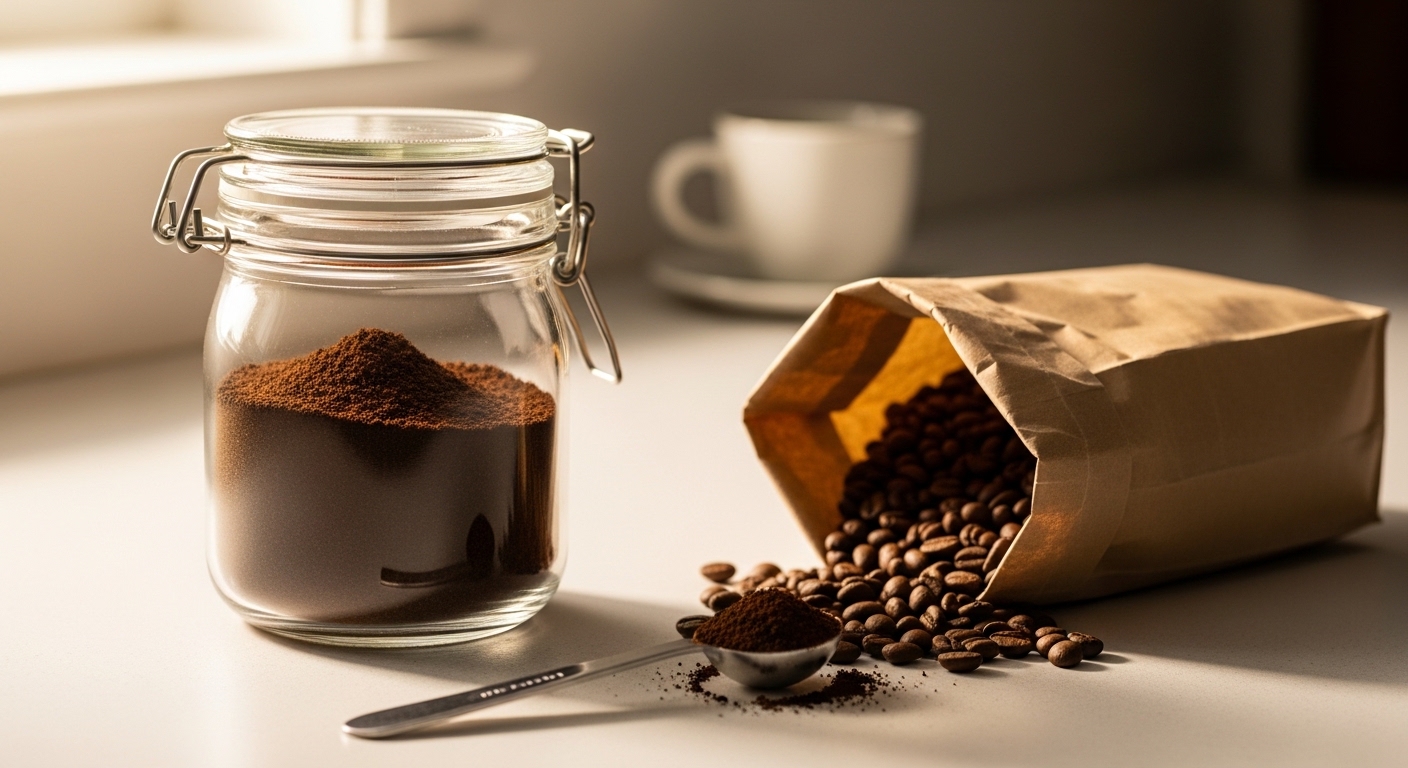
Quick Answer: Can ground coffee stay good if you store it properly?
Yes—but only up to a point. Ground coffee can stay drinkable if stored properly, but it loses freshness much faster than whole beans because far more surface area is exposed to air. That means aroma fades faster, oils oxidize faster, and flavor becomes dull sooner. Proper storage helps slow that decline. It does not stop it completely. If you use pre-ground coffee, the best strategy is simple: keep it airtight, away from heat, light, and moisture, and buy only as much as you can use reasonably quickly.
If you do not grind fresh yet, this guide will help you protect as much flavor as possible and avoid the most common storage mistakes that make ground coffee taste flat, stale, or weak long before it should.
Why ground coffee goes stale so much faster
The biggest difference between whole beans and ground coffee is not convenience. It is exposure. Whole beans keep much of their interior protected. Ground coffee does not. Once coffee is ground, oxygen can reach far more surface area at once, which speeds up oxidation and aroma loss.
That is why ground coffee often smells promising when you first open the bag, then becomes noticeably less exciting within days or weeks depending on the packaging, storage, and environment. This does not mean all ground coffee becomes useless instantly. It means the quality decline starts earlier and moves faster.
If you understand that one point, storage suddenly makes much more sense. You are not “preserving perfection.” You are slowing a decline that has already begun.
The 4 enemies of ground coffee
If you want to store ground coffee properly, remember these four enemies:
- Oxygen
- Heat
- Light
- Moisture
Every storage rule you hear basically comes back to these four things. If your coffee is exposed to too much of them, it fades faster. If you reduce them, the coffee holds on longer.
Enemy #1: Oxygen
Oxygen is the biggest problem for ground coffee. Once the coffee is ground, oxygen gets far more access to the particles, and that speeds up oxidation. Oxidation is one of the reasons coffee begins to smell flat, dusty, or lifeless over time.
What to do: keep ground coffee in a tightly sealed container or a properly closed bag with as little extra air exposure as possible. The less unnecessary opening and closing, the better.
Enemy #2: Heat
Heat accelerates staling. If you store coffee near the stove, next to a sunny window, or in a warm cabinet above appliances, you are speeding up flavor loss. Warm environments do not instantly ruin coffee, but they definitely make it age faster.
What to do: store ground coffee in a cool, stable place—not somewhere that gets hot throughout the day.
Enemy #3: Light
Light, especially direct sunlight, is another staling factor. This is why coffee stored in clear containers on bright counters often looks nice but performs worse than coffee hidden in a darker cabinet.
What to do: keep coffee in opaque packaging or inside a dark cupboard. If you use a storage jar, make sure it is not sitting in direct light all day.
Enemy #4: Moisture
Moisture is a problem because coffee absorbs things from the environment more easily than many people realize. Moisture can damage flavor and create conditions you do not want in stored coffee.
What to do: store coffee somewhere dry, keep wet spoons away from the container, and do not leave the bag open in a steamy kitchen.
What is the best container for ground coffee?
The ideal container is one that is:
- airtight
- opaque or kept in darkness
- clean and dry
- appropriately sized so the coffee is not sitting in a huge air-filled container
This means you do not need an absurdly expensive “coffee vault” to store pre-ground coffee decently. A good airtight container in a cool, dark place already gets you most of the benefit. The key is consistency, not gadget obsession.
That said, if the original bag seals well and you use the coffee fairly quickly, keeping it in the original bag inside a cool dark cabinet can also work fine. The main question is whether the packaging protects it well once opened.
Should you keep ground coffee in the fridge?
Usually, no. The fridge sounds smart because it is cool, but it often introduces moisture and odor problems. Coffee can absorb smells from the environment, and the repeated in-and-out temperature changes can create condensation risk depending on the situation.
For most people, the fridge is not the best everyday storage choice for ground coffee. A cool, dry cupboard is usually safer and simpler.
What about the freezer?
The freezer can be useful in certain situations, but it should be treated as a planned storage strategy—not a casual daily habit. If you buy more ground coffee than you will use soon, freezing in well-sealed portions can help preserve it better than leaving it all in the kitchen for months.
The mistake is opening and re-closing one big frozen bag every day. That creates unnecessary temperature shifts and exposure. If you are going to freeze coffee, it works better when divided into portions that can be thawed and used without repeatedly disturbing the rest.
So yes, freezing can help. But for daily-use coffee, a simple airtight container in a cool cabinet is usually the more practical routine.
How long does ground coffee stay good?
This depends on the coffee, the packaging, and how strict your standards are. Ground coffee can remain usable for quite a while, but “usable” is not the same as “at its best.” The more important truth is this: ground coffee usually loses its most exciting aroma and flavor faster than whole beans.
That is why the better question is not “When is it technically safe?” The better question is “When does it stop tasting like something worth caring about?” For many coffee drinkers, that quality drop shows up sooner than they expect—especially after opening the bag.
If your ground coffee starts tasting flat, dusty, woody, or just boring, storage may be part of the problem even if the coffee is still technically fine to drink.
How to know your ground coffee is losing quality
Ground coffee usually tells you when it is fading. Watch for these clues:
- the aroma becomes weaker each time you open it
- the coffee smells dusty, dull, or lifeless
- the brewed cup tastes flatter than before
- sweetness seems harder to find
- the coffee feels weak even when the ratio is fine
If those signs show up, no storage trick will fully reverse the decline. It can only reduce future damage.
The best strategy if you buy pre-ground coffee
If pre-ground coffee is what fits your life right now, the smartest strategy is not “hope.” It is this:
- Buy smaller amounts more often.
- Keep the coffee tightly sealed.
- Store it away from heat, light, and moisture.
- Use it while it still smells alive.
- Do not buy months of supply unless you have a real storage plan.
This simple approach protects quality much better than one giant bulk bag sitting open in a warm kitchen cabinet forever.
Should you transfer ground coffee out of the original bag?
Sometimes yes, sometimes no. If the original bag has a strong seal and protects the coffee well, keeping it there can be perfectly fine. If the original bag is flimsy, poorly resealable, or awkward to close tightly, transferring the coffee to a better airtight container can be smarter.
The important thing is not the aesthetic choice. It is the seal quality and the storage environment. A beautiful container that is loose, bright, and constantly opened is worse than a plain bag that is tightly sealed and stored well.
How storage mistakes create weak coffee
Many people think storage only affects aroma. It also affects how strong and satisfying the coffee feels. As ground coffee loses freshness, it often tastes flatter and weaker even if the recipe has not changed. This is why someone can say, “I’m using the same amount as always, but the coffee suddenly feels thin.”
The brewing setup may be identical. The coffee simply lost too much of what made it expressive. In that situation, people often overcorrect by adding more coffee, when the real issue started in storage.
The honest limit of storing ground coffee well
Here is the part many people do not want to hear: perfect storage does not make pre-ground coffee equal to freshly ground whole bean coffee. Good storage helps. It matters. But it is still a defensive strategy. You are preserving ground coffee as well as possible, not turning it into something it is not.
That is why fresh grinding remains such a big upgrade. Storage can slow quality loss, but grinding fresh changes the starting point entirely. It gives you more aroma, more control, and a longer window of quality before brewing.
Still, that does not make ground coffee pointless. It just means you should set realistic expectations and treat storage seriously if you want the best result available from it.
Common storage mistakes people make
Mistake 1: leaving the bag loosely folded
If the seal is weak, oxygen wins faster.
Mistake 2: storing coffee near the stove
Heat may feel harmless, but it speeds up staling over time.
Mistake 3: using clear containers in bright kitchens
It may look nice, but light exposure works against freshness.
Mistake 4: buying huge quantities because it seems cheaper
Bulk savings can disappear if the coffee goes dull before you finish it.
Mistake 5: treating the fridge as an automatic solution
Cool does not automatically mean better if moisture and odor become part of the problem.
FAQ
Is an airtight container really worth it for ground coffee?
Yes. Since oxygen is one of the biggest causes of staling, a proper airtight container can help meaningfully—especially once the original bag is opened.
Should I freeze ground coffee?
You can, especially if you have more than you will use soon. But freezing works best in sealed portions, not in one bag that gets opened repeatedly every day.
Can good storage make pre-ground coffee taste like freshly ground coffee?
No. Good storage helps preserve quality, but it does not fully recreate the aroma and control you get from grinding fresh right before brewing.
Conclusion: store ground coffee well, but understand the ceiling
If you use pre-ground coffee, proper storage absolutely matters. Keep it airtight, cool, dark, and dry, and buy only what you can use while it still smells alive. That will protect flavor much better than casual storage in a warm, bright kitchen. But the honest ceiling remains the same: ground coffee is more fragile than whole beans. Good storage slows the decline. It does not erase it. Once you understand that, you can make much smarter decisions about what to buy and how to keep it tasting decent for as long as possible.
