
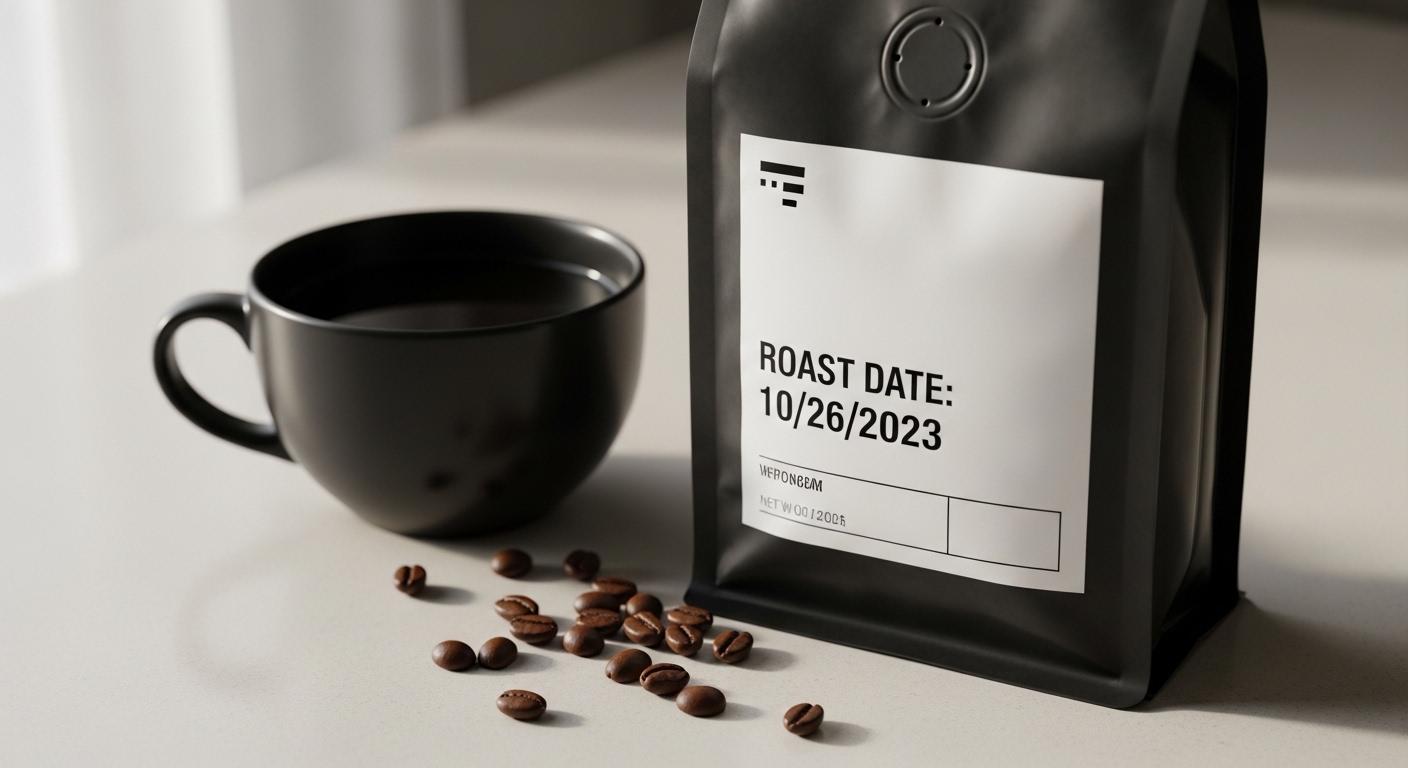
Quick Answer: What does roast date actually tell you?
The roast date tells you when the coffee was roasted, which gives you one of the most useful clues about freshness. In general, fresher coffee is better than old coffee—but “fresh” does not always mean “best on day one.” Coffee often needs a little time after roasting to settle, especially for espresso. That is why the smartest question is not just “Is this fresh?” but also “Is this coffee at a good point for the way I’m going to brew it?”
In simple terms: roast date helps you judge whether the coffee still has life in it, whether it may be too old, and sometimes whether it may still be too fresh for your brewing style.
Why roast date matters more than flashy packaging
A lot of coffee bags are designed to make you feel something before you know anything useful. They might say premium, strong, reserve, or gourmet in huge letters. Those words may sound impressive, but they usually tell you much less than one simple detail: the roast date.
The roast date matters because coffee changes over time after roasting. It releases gases, aroma shifts, sweetness can develop differently, and freshness gradually fades. So if you actually want to judge the coffee in a practical way, the roast date is far more helpful than vague marketing language.
This is one reason specialty coffee buyers care so much about roast dates. They are not trying to be difficult. They just want one real piece of information that helps them understand what stage the coffee is in.
What happens to coffee after roasting?
Right after roasting, coffee is not “frozen in perfect condition.” It keeps changing. One of the biggest things happening is degassing. After roasting, coffee releases carbon dioxide. That is normal. In fact, it is one reason fresh coffee can smell so active and lively.
But that same process is also why some very fresh coffee can behave differently in brewing. In espresso especially, coffee that is extremely fresh can produce a lot of gas and become harder to dial in consistently. In filter brewing, that issue is usually smaller, but the coffee still evolves in the days after roasting.
This is why roast date is not just about avoiding old coffee. It is also about understanding where the coffee sits in its post-roast life cycle.
Can coffee be too fresh?
Yes—depending on the brew method and the coffee. This idea surprises beginners because they assume fresher must always mean better. But coffee is a little more nuanced than that. Some coffees, especially for espresso, can be tricky when they are extremely fresh. They may produce very active crema, unstable shots, and less settled flavor.
For filter coffee, the “too fresh” problem is usually less dramatic. Many people happily brew recently roasted beans without any major issue. But espresso tends to be more sensitive because it is concentrated and pressure-based. That means small freshness-related changes show up more clearly in the cup and in extraction behavior.
So yes, coffee can be too fresh in some situations. That does not mean “fresh is bad.” It means there can be a sweet spot between just-roasted chaos and stale decline.
Why espresso and filter coffee treat freshness differently
This is one of the most useful practical distinctions. For espresso, roast date often matters a lot because espresso is highly sensitive to gas, grind precision, and extraction behavior. Coffee that is only a few days off roast may still be releasing enough gas to make shot behavior less stable than many people want.
For filter methods like V60, drip, or French press, coffee is often more forgiving. Freshness still matters, but the “too fresh” problem is usually less intense. Instead, the bigger concern is usually whether the coffee has gone too far in the other direction and started to lose aroma and liveliness.
This is why two people can talk about the “best time” for the same coffee and mean different things—one may be thinking about espresso, the other about pour-over.
How old is “too old” for coffee?
There is no magical universal deadline where coffee instantly becomes bad. But roast date helps you estimate whether the coffee is likely still lively or whether it is drifting into stale territory. The older the coffee gets, the more aroma and vibrancy it tends to lose—especially once the bag is opened.
That is why roast date should be read together with common sense. If the coffee is old and already smells flat, the roast date confirms what your nose is telling you. If the coffee is not very old and still smells lively, the date supports that too. Roast date is not the only freshness tool, but it is one of the simplest and most useful ones.
It also helps you avoid buying coffee that has been sitting around too long before you even open it. That is one of the biggest advantages of seeing a real roast date on the bag.
Roast date vs best-by date: not the same thing
This is a big one. A roast date tells you when the coffee was roasted. A best-by date tells you a rough commercial shelf-life target, which is much less useful if you actually care about freshness quality.
A bag with only a best-by date may still technically be fine to drink for a long time, but that does not tell you whether it is in a great flavor window. A roast date is much more transparent because it lets you judge age directly. That is why many serious buyers prefer bags that show a roast date clearly.
If a brand hides behind a long best-by date and gives no roast date at all, that usually tells you something too.
What roast date can tell you at the store
When you are standing in front of coffee bags, roast date can help you answer several practical questions:
- Is this coffee likely still fresh enough to be interesting?
- Has it been sitting here a long time?
- Is this a roaster that gives real freshness information?
- Will this fit the brew method I plan to use soon?
This is far more useful than trusting packaging design or emotional branding. Roast date gives you a real timeline. That helps you buy with less guesswork.
It also helps when comparing different brands. If one bag clearly shows a recent roast date and another gives only vague shelf-life language, you already know which one is being more honest with you.
How roast date helps you plan brewing at home
Roast date is not just for buying. It also helps at home. If you know when the coffee was roasted, you can better understand how it may behave over time. Maybe one coffee tastes more lively earlier. Maybe another feels more settled a bit later. Maybe your espresso suddenly gets easier to dial in after a little rest.
This is especially useful if you buy from the same roaster often. You start seeing patterns. You learn how long your favorite coffees tend to feel especially good for your brew style. That kind of awareness makes you much more confident as a home brewer.
Without a roast date, all of that becomes much fuzzier. You are basically trying to interpret freshness in the dark.
Why some coffees seem to “open up” after a few days
People sometimes say a coffee “opened up” after resting a bit. What they usually mean is that the aroma and flavor became more balanced, easier to read, or more stable in brewing. Again, this is often most noticeable in espresso, but it can happen in other methods too.
This is another reason the phrase “fresh is best” can be too simplistic. Fresh is important, yes. But immediate is not always ideal. Some coffees benefit from a little time after roasting before they feel fully settled.
That does not mean you need to become obsessive. It just means roast date can help explain why the same coffee might behave a little differently on different days.
What if a bag has no roast date?
Then you lose one of the best clues about freshness. That does not automatically mean the coffee is bad, but it does mean you have less useful information. In that situation, you have to rely more on other signals:
- how the coffee smells
- how transparent the brand is about origin and roast
- whether the coffee tastes lively or flat
- whether the packaging feels like it is built for real freshness
If two coffees are otherwise similar and one gives you a real roast date while the other does not, the one with the roast date usually deserves more trust.
How roast date connects to aroma and storage
Roast date is only part of the freshness picture. Storage still matters a lot. A nicely dated bag can still lose quality if you keep it open, warm, exposed to light, or badly sealed after opening. Likewise, a reasonably fresh coffee can hold up better if you store it intelligently.
So roast date tells you when the clock started, and storage tells you how well you handled the time afterward. Those two things work together. That is why freshness is not just about what the roaster did. It is also about what you do once the coffee is in your home.
What roast date does not tell you
Roast date is very useful, but it does not tell you everything. A fresh roast date does not guarantee that:
- the coffee was roasted well
- the bean quality is high
- the flavor profile matches your taste
- the grind will be right for your brew method
In other words, roast date is an important clue—not the entire answer. A badly roasted coffee can still be freshly roasted. A coffee with a perfect date can still be wrong for your taste. But if the roast date is missing or very old, that is still valuable information too.
The easiest way to use roast date without overthinking it
You do not need a spreadsheet for this. A simple approach works well:
- Prefer bags with a real roast date.
- Avoid coffee that seems obviously too old for your standards.
- If you brew espresso, remember that very fresh coffee may need a little settling time.
- If the coffee smells flat, trust your nose too.
- Store it properly once opened.
That is enough for most people. The goal is not perfection. The goal is making smarter freshness decisions than the average shopper.
Common mistakes people make
Mistake 1: Thinking “freshest possible” is always the best answer
Fresh matters, but extremely fresh coffee can sometimes be less settled for certain brew methods—especially espresso.
Mistake 2: Ignoring roast date and trusting only branding
Packaging can be persuasive. Roast date is much more informative.
Mistake 3: Treating best-by date as the same thing
Best-by is a shelf-life signal. Roast date is an actual freshness timeline.
Mistake 4: Forgetting that storage still matters after purchase
A good roast date cannot fully save coffee from poor storage habits at home.
FAQ
Should I always choose the newest roast date on the shelf?
Usually fresher is a good sign, but the ideal answer also depends on when and how you plan to brew it. Very fresh coffee is not always the easiest for espresso right away.
Is roast date more useful than best-by date?
Yes. Roast date gives you a real point in time, while best-by date is much broader and less useful for judging peak freshness.
Can coffee still be good without a roast date?
Yes, but you have less useful information. In that case, smell, taste, packaging quality, and brand transparency matter even more.
Conclusion: roast date helps you buy coffee with less guesswork
Roast date matters because it gives you one of the clearest practical signals about freshness. It helps you avoid coffee that is too old, understand why some coffee may behave differently shortly after roasting, and make smarter decisions for your brew method. It does not tell you everything, but it tells you something real—and that already puts it ahead of most packaging language. If you want to buy coffee more intelligently, paying attention to roast date is one of the easiest habits worth building.
