
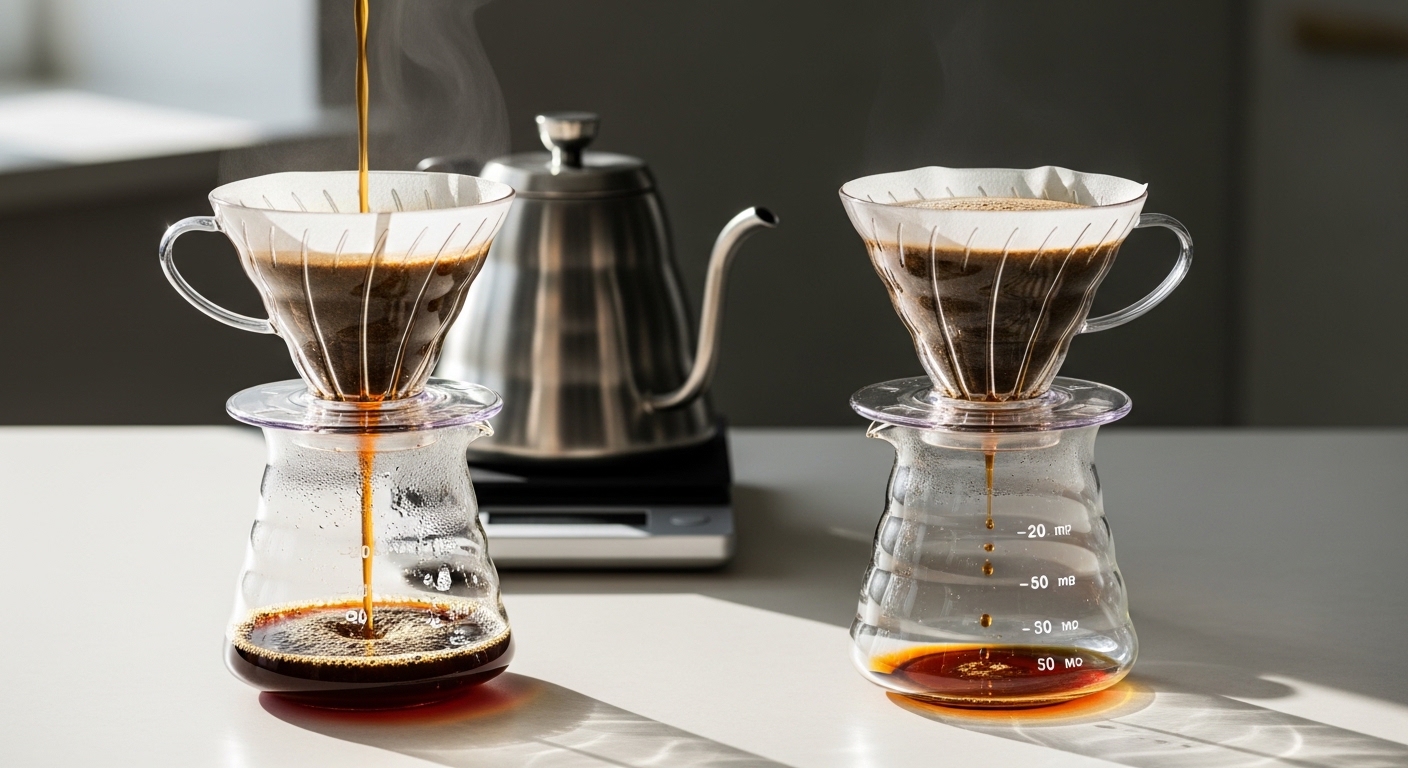
Quick Answer: Why is my pour-over draining too fast or too slow?
If your pour-over drains too fast, the most common causes are a grind that is too coarse, a weak coffee bed, overly aggressive pouring that creates channels, or a brew recipe that does not give the coffee enough resistance. If it drains too slow, the most common causes are a grind that is too fine, too many fines from an inconsistent grinder, a clogged paper filter, or pouring in a way that stirs the bed too much and packs it down. In simple terms: flow speed is one of the clearest signals of what is happening inside the brew bed, and when it is wrong, the flavor usually follows.
If your V60 or pour-over keeps coming out sour, weak, bitter, muddy, or wildly inconsistent, this guide will help you understand what fast and slow drawdown really mean—and how to fix them without turning every brew into a stressful science experiment.
Why drawdown speed matters so much in pour-over
In pour-over coffee, drawdown speed is not just a random visual detail. It tells you how quickly water is moving through the coffee bed, and that strongly affects extraction. If the water moves through too quickly, the coffee often under-extracts and tastes sour, thin, or unfinished. If the water moves too slowly, the coffee often over-extracts and tastes bitter, harsh, or muddy.
That is why so many V60 problems show up through flow first. The cup tastes wrong, and the brew time or draining behavior quietly explains why. But here is the important part: flow speed is a clue, not a religion. A fast brew is not always bad just because it is fast. A slow brew is not always bad just because it is slow. What matters is how the coffee tastes and whether the flow matches the coffee, grind, and method you are using.
Still, if your pour-over is obviously draining too fast or getting stuck and crawling painfully slow, you should pay attention. Those are strong signals that the brew bed is not behaving the way you want.
What “too fast” and “too slow” usually feel like in the cup
Before you fix flow, it helps to connect the visual behavior to taste. This makes troubleshooting much easier.
If the pour-over drains too fast
- coffee often tastes sour or sharp
- body feels thin or watery
- sweetness is weak or missing
- the finish feels short and empty
This is classic under-extraction territory. Water did not have enough contact with the grounds, or it moved through unevenly and failed to pull enough sweetness and depth.
If the pour-over drains too slow
- coffee often tastes bitter or drying
- the cup can feel heavy in a bad way
- clarity disappears
- the finish becomes rough or muddy
This is usually over-extraction or clogged-flow territory. Water spent too much time in contact with the grounds or was forced through a packed bed full of fines.
The 5 most common reasons your pour-over drains too fast
1) Your grind is too coarse
This is the most common reason. Coarser grounds leave bigger gaps between particles, so water falls through more easily. That can be useful when a coffee is over-extracting, but when the grind is too coarse, the bed offers too little resistance. The brew finishes quickly and tastes weak or sour.
Fix: grind one small step finer. Do not panic and jump dramatically. Small adjustments are usually enough.
2) You are pouring too aggressively
If you pour hard and fast from high above the brewer, you can create channels in the coffee bed. That means water finds easy paths through the grounds instead of extracting them evenly. The result is often a brew that drains quickly but tastes confusing—sometimes weak and sour, sometimes sour and bitter at once.
Fix: pour lower, calmer, and more steadily. Fancy spirals matter less than simple, controlled pouring.
3) The coffee dose is too low for the brewer
If the coffee bed is too shallow, it may not create enough resistance for a balanced drawdown. This can happen when people try very light recipes or use a larger dripper with a small amount of coffee.
Fix: check whether your coffee-to-water ratio makes sense for the brewer size and recipe. Sometimes a stronger dose improves both flow and taste.
4) The bloom did not saturate the bed properly
If parts of the coffee bed stay dry during bloom, later pours may flow unevenly through the wettest areas instead of extracting the whole bed. That can speed up drawdown in a bad way.
Fix: make sure the bloom actually wets all the grounds. The goal is not a dramatic bloom show. The goal is even saturation.
5) Your filter or dripper setup is encouraging fast flow
Some paper filters, dripper sizes, and recipes naturally run faster than others. That is not automatically a problem, but if your setup is always racing and the cup is weak, it may be worth checking whether the filter is seated properly and whether the recipe is a good match for the brewer size.
The 5 most common reasons your pour-over drains too slow
1) Your grind is too fine
This is the number one reason for painfully slow drawdown. Fine particles pack together tightly, leaving less space for water to move through. When the grind gets too fine, the brew stalls or crawls, and bitterness usually follows.
Fix: go slightly coarser. Again, one controlled step is better than a dramatic overcorrection.
2) Your grinder produces too many fines
Even if your main grind looks correct, a grinder that creates a lot of dust-like fines can choke the bed and slow the drawdown dramatically. This is one reason inconsistent grinders make V60 so frustrating. The brew may look similar from the outside, but the fines quietly clog the filter and distort extraction.
Fix: clean the grinder, make sure the burrs are functioning well, and if you are using a blade grinder, understand that flow consistency will be harder to control.
3) You are agitating the bed too much
Some recipes use stirring or aggressive swirling, but too much agitation can knock fines downward and compact the bed. That slows flow and makes the brew more likely to stall.
Fix: reduce unnecessary agitation. If your brewing style already works, do not add dramatic swirling just because you saw it on social media.
4) Your paper filter is clogging
If the filter is not rinsed well or if the bed is full of fines, the paper can become part of the slowdown problem. Thick filters, poor seating, or paper that folds awkwardly can also affect flow.
Fix: rinse paper filters properly, seat them neatly, and make sure the bed is not being overloaded with fines or sludge.
5) Your recipe simply creates a heavy, slow bed
Sometimes the slowdown is not caused by a mistake but by a recipe that uses a higher dose, finer grind, and multiple pours. If the coffee still tastes good, that is not a problem. The key is whether the slow drawdown is hurting the cup.
This is why you should never judge flow speed in total isolation. Taste still leads the decision.
How to fix fast drawdown without overcorrecting
If your pour-over is draining too fast and tasting weak or sour, use this order:
- Grind slightly finer.
- Make sure the bloom fully wets the bed.
- Pour a little more calmly and evenly.
- Check if the ratio is too weak.
That sequence works because grind size is usually the biggest lever, but poor pouring and poor saturation can also create “fake fast flow” through channels even when the grind is close.
How to fix slow drawdown without ruining the coffee
If your pour-over is draining too slowly and tasting bitter or muddy, use this order:
- Grind slightly coarser.
- Reduce unnecessary agitation or stirring.
- Check whether your grinder is producing too many fines.
- Make sure the filter is rinsed and seated properly.
Do not immediately slash the coffee dose or throw away the whole recipe. Slow flow is often solved by a modest grind adjustment and calmer handling.
Fast vs slow drawdown by roast level
Roast level changes how flow problems feel in the cup:
- Light roast + fast drawdown: often tastes especially sour and hollow
- Light roast + slow drawdown: can still be okay if the coffee remains sweet, but it may get harsh if the grind is too fine
- Dark roast + fast drawdown: may still feel drinkable, but often lacks balance and body
- Dark roast + slow drawdown: usually becomes bitter faster than lighter coffees
This is why darker roasts often benefit from a gentler setup overall, while lighter roasts can tolerate or even benefit from more extraction pressure.
How grinder quality changes drawdown consistency
If your pour-over behaves unpredictably from one day to the next, grinder quality may be the hidden problem. Inconsistent grinders produce a mess of particle sizes. Some particles extract too fast, some too slow, and the fines clog the filter unpredictably. That makes drawdown speed much harder to read.
This is why a decent burr grinder often feels like a massive quality-of-life upgrade for V60. It does not just improve flavor. It makes brewing behavior more understandable.
A simple “flow troubleshooting” checklist
If you want one quick system you can use every morning, use this:
- If the brew races and tastes weak, go finer.
- If the brew stalls and tastes harsh, go coarser.
- If the flow is weird but the grind seems right, pour more calmly.
- If the flow stays inconsistent, look at grinder quality and fines.
- If the coffee tastes good, stop obsessing over the exact drawdown.
That last point matters. Drawdown is useful because it helps you diagnose problems. It is not a performance score you need to impress anyone with.
Common mistakes people make when fixing pour-over flow
Mistake 1: changing grind, ratio, and temperature at the same time
This creates confusion fast. Flow problems are easiest to solve when you change one variable first, usually grind size.
Mistake 2: chasing one “perfect” brew time for every coffee
Different beans, roasts, and filters behave differently. Use time and flow as clues, not absolute commandments.
Mistake 3: pouring harder to make the brew “go faster”
That often makes extraction less even, not better. Calm control beats force.
Mistake 4: ignoring water quality and filter cleanliness
If your filter setup is messy or your water quality is poor, you may keep blaming flow when the cup is being damaged elsewhere too.
FAQ
Is a fast pour-over always under-extracted?
Not always, but if it tastes weak, sour, or thin, under-extraction is very likely. Taste matters more than the visual speed alone.
Why does my pour-over taste bitter and sour at the same time?
That often points to uneven extraction—usually caused by poor grind consistency, channeling, or messy pouring.
Should I care more about brew time or flavor?
Flavor comes first. Brew time and drawdown behavior are valuable because they help explain the flavor, not because they matter more than the cup.
Conclusion: flow problems are fixable once you stop guessing
If your pour-over drains too fast, the brew often needs more resistance, better saturation, or calmer pouring. If it drains too slow, it usually needs less resistance, fewer fines, or less agitation. In both cases, the fix is usually simpler than it looks: adjust grind first, keep your process calm, and use flavor to guide the next step. Once you understand what fast and slow drawdown are telling you, V60 becomes much less mysterious—and much easier to improve.
