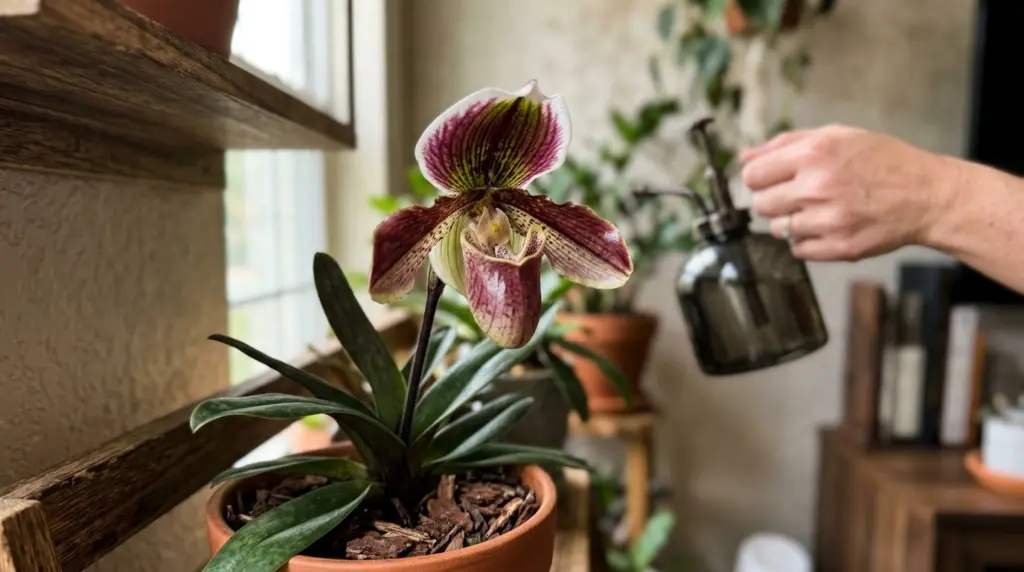
Paphiopedilum: the slipper orchid, grown in shade.
Paphiopedilum is the slipper orchid: the lower petal forms a pouch that looks like a small shoe. Besides its shape, it has two unique cultivation characteristics that set it apart from the rest—it's the most popular genus that requires the least light, and it's the only one where the leaf clearly indicates the temperature the plant prefers.
The sheet reveals the temperature she wants.
This is the most useful shortcut of its kind, and it's worth considering before any table. There are two main groups, and you can identify them without knowing the species name:
Marbled leaves , with a light and dark checkered pattern: prefer warmer environments. Uniform green leaves : prefer cooler environments. Ribbon-leaf varieties, which produce several flowers per stem, also tend towards warmer environments.
In practice, this determines where the plant will live in the house. If yours is marbled and you placed it in the coolest corner because you thought all slipper orchids like the cold, it will just vegetate. The American Orchid Society's fact sheet gives the general temperature range for the genus as 12,7 to 22,2 °C at night and 21 to 29,4 °C during the day , and it is within this range that the two groups are distributed — the marbled ones in the upper part, the green ones in the lower part.
Low beam lighting is a requirement, not a tolerance.
The recommended light range is 10.750 to 21.500 lumens (1.000-2.000 foot-candles) — the same as for Phalaenopsis orchids, and well below the 2.000-3.500 foot-candles of a Cattleya orchid. Indoors, the AOS recommends an east, north, or west-facing window with one to four hours of direct sunlight.
Note the translation: "north window" there refers to the least common window because the instructions are from the United States. In the Southern Hemisphere, the equivalent is the south window. Anyone reading the instructions and placing the plant in a north window here in Brazil is giving it the strongest orientation in the house, not the most favorable one.
Lower humidity than the rest of the group.
Here's the second piece of good news for indoor cultivation: the recommended range is 40 to 50% relative humidity. This is less than Phalaenopsis (50 to 80%) and much less than Masdevallia (70 to 90%). In other words, Paphiopedilum is one of the few that doesn't require a humidifier in most home environments.
Since it doesn't have a pseudobulb, the substrate needs to be kept consistently moist, but not waterlogged. The AOS recommendation is to water as soon as the medium reaches the dry point—don't wait for it to dry out completely.
Fertilizer: full dose of weak formula
This is a reversal of the logic that applies to most orchids, and it's easy to get it wrong. The current recommendation is a full dose of a weak fertilizer —something between 5-5-5 and 10-10-10—instead of the older method of using a quarter dose of a strong fertilizer like 20-20-20.
The routine is year-round, with the substrate being washed once a month or quarter to remove accumulated salt. Repotting every two years , or when the substrate decomposes; small cuttings are done annually.
Three species and hybrids to start with.
The choice makes a big difference here, because the right group depends on the climate of your home — and buying the wrong one is the most common reason for frustration with this type of product.
Hybrids from the Maudiae group are the safest starting point for the Brazilian climate: they have marbled leaves, so they prefer the warmer parts of the plant range, flower easily, and are the easiest to find. If you live in a warm place and are only going to buy one, this is the one.
Paphiopedilum insigne has uniform green leaves and is one of the most tolerant of its kind—it tolerates variations in care better than average, and is a good option for those who have cooler homes or live in mountainous regions.
Paphiopedilum delenatii has pink flowers and a fragrance, which is unusual for the genus. It is more demanding than the previous two and I wouldn't recommend it as a first choice—it's best suited for when the environment is already well-established.
Water: quality matters more than quantity
Paphiopedilum is sensitive to salt buildup in the substrate—not to the same extreme degree as a Masdevallia, but enough that hard water can cause problems over months. That's why the AOS (American Society of Ophthalmology) guidelines recommend washing the substrate periodically: washing is precisely to remove the salt that remains after each watering and fertilization.
If your tap water is hard, the difference appears at the leaf tip, which darkens and dries out, starting with the oldest leaves. It's easy to confuse this with fungus, and the treatment is the opposite: wash the substrate thoroughly with better quality water and change the medium, do not apply fungicide.
Rainwater solves the problem. Where that's not possible, alternating regular watering with a generous wash once a month significantly reduces buildup.
Do not wet the center of the rosette.
Paphiopedilum grows in a fan shape with leaves starting from a central point, and standing water in that center in an unventilated environment will rot the growing point. It's the same mechanism as crown rot in Phalaenopsis orchids, and the same care applies: water around the edge of the pot in the morning , and if water falls into the center, dry it with a paper towel.
This is even more true here because its humidity range is low (40 to 50%) and many people compensate by misting the plant. Misting the leaves of the slipper orchid is precisely what is not advisable — if you need to increase humidity, use a tray with wet expanded clay around it, not water directly on the plant.
How long does the flower last, and what to do afterwards?
The Paphiopedilum flower is one of the longest-lasting among houseplant orchids—it usually stays open for several weeks, and in some species for more than two months. This is part of the genus's appeal: few flowers, but for a long time.
After the flower withers, cut the stem at the base. Unlike Phalaenopsis orchids, this plant doesn't re-flower on the same stem: each fan of leaves blooms once, and then the plant invests in new lateral growth, which will be the next to bloom. Therefore, a plant with a single fan of leaves doesn't bloom two years in a row—it's its natural cycle, not a problem with its care.
Division: be careful, she doesn't forgive.
Without a pseudobulb, Paphiopedilum doesn't have the reserves to support aggressive division. Each fan of leaves is a separate growth, and division of a single isolated growth usually stops growth altogether—it can take years to resume, if it ever does.
The safe margin is to leave at least two to three shoots per cutting . This is less cutting than you would get from a Cattleya of the same size, and it's the price of a genus that doesn't store water. Division should be done along with repotting, right after flowering.
Multifloral remedies, and why they require patience.
There is a third group worth knowing, even if you're not a beginner: the multifloral orchids , with long, ribbon-like leaves, which produce several flowers on a tall stem instead of just one. The most famous is Paphiopedilum rothschildianum , with long lateral petals that open almost horizontally, one of the most coveted orchids in existence.
The key point is timing. Multifloral plants are large and slow-growing—they often take several years to reach flowering size, and many only bloom when the fan of leaves reaches a certain size. Buying a small seedling expecting flowers the following season is a recipe for disappointment.
They also tend towards the warmer end of the temperature range, like the marbled varieties. If the intention is to reach this group, the sensible approach is to first get the environment right with a Maudiae hybrid, and only then invest in a plant that will require years of consistent growth before rewarding you.
For whom is she the right choice?
If your home has low light and dry air—a combination that hinders almost every popular orchid—the Paphiopedilum is probably the most suitable orchid for you. It's the opposite of the Vanda orchid, which needs strong sun and daily watering.
The only drawback is the flower: usually one bloom per stem in most species, lasting for weeks, but it lacks the exuberance of a Phalaenopsis cluster. It's an orchid for those who appreciate unusual shapes, not volume.