Bulbophyllum: the largest orchid genus, diversity and care.
I acquired my first Bulbophyllum at a grower exchange event, without really knowing what I was getting into. Only later did I discover that this is the largest orchid genus in existence, with thousands of cataloged species, each with its own characteristics that can vary surprisingly within the same taxonomic group.
Why is Bulbophyllum considered the most numerous orchid genus?
With thousands of described species, this genus surpasses even the diversity already detailed about Dendrobium in another article, ranging from almost invisible miniatures to specimens with large and showy flowers, making any generalization about care especially risky.
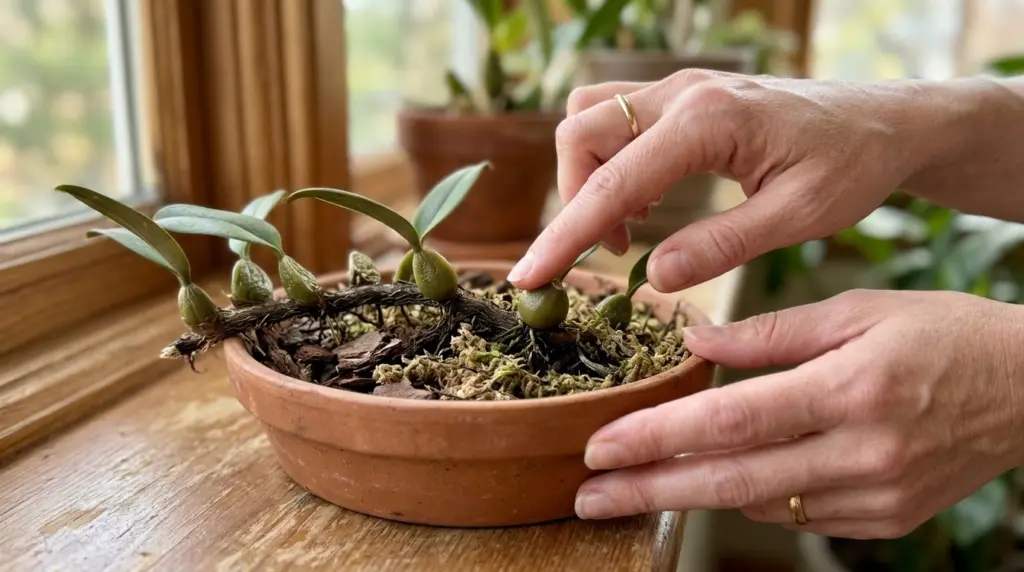
Small, spaced pseudobulb, a characteristic growth trait of this species.
Unlike the clustered pseudobulbs of Cattleya, already detailed in another article, Bulbophyllum usually grows with small, spaced pseudobulbs along a creeping rhizome, forming a horizontal growth pattern quite different from the more compact clumps common in other species.
A shallow pot or openwork basket, adapted to this horizontal growth.
As I've already detailed in another article about types of pots, I choose a container compatible with the plant's growth habit, and for Bulbophyllum I prefer a shallow, wide pot or a perforated basket, giving enough space for the rhizome to spread horizontally without restriction.
The aroma that some species of this genus possess is not always pleasant.
While Cattleya and Brassavola, already detailed in other articles, have a pleasant aroma, some Bulbophyllum species have developed a strong and unpleasant smell, mimicking decaying meat to attract pollinating flies, a curious evolutionary strategy worth researching before buying.
How do I research the expected aroma before acquiring a new strain?
I always confirm with the seller or research online whether the specific Bulbophyllum variety I'm considering has a known unpleasant odor, avoiding surprises after the plant blooms indoors, especially considering that some bloom for an extended period.
High humidity is what most species of this genus prefer.
As I've already detailed in another article about humidity, this factor matters for any orchid, and Bulbophyllum, lacking a robust storage pseudobulb in most species, especially benefits from high and constant relative humidity throughout the year.
I follow a watering routine, keeping the substrate always slightly moist.
Water regularly, similar to the principle already detailed for Paphiopedilum and Masdevallia in other articles, avoiding prolonged dry periods that could compromise the small pseudobulb and finer root of this species.
Moderate, filtered light, avoiding intense direct exposure.
Most species in this genus tolerate softer light, similar to what I've already detailed about Phalaenopsis, reflecting their origin in the dense tropical understory where direct light rarely reaches the ground or the lower branches.
Extremely varied flower shape within this single genus.
I have seen specimens with tiny flowers, almost invisible to the naked eye, and others with long, drooping petals that visibly sway with any movement of air—a variation so wide that I rarely find it in any other genus detailed in other articles on this site.
The substrate I use prioritizes good aeration for the surface rhizome.
Use sphagnum moss or very fine pine bark, keeping the rhizome close to the surface of the substrate instead of burying it, since this species develops better with good aeration around its characteristic horizontal growth structure.
Diluted fertilizer that I apply regularly and moderately.
I follow the general principle already detailed in another article on fertilization, using diluted concentration, since the small pseudobulb of this species does not tolerate excess concentrated nutrients as well as species with larger water reserves can absorb.
How I decided to expand my collection after getting to know the genre better.
After mastering the basic care of my first Bulbophyllum, I acquired other varieties with different shapes and aromas, taking advantage of the diversity of this genus to create a small thematic subgroup within my overall orchid collection, each specimen bringing a distinct visual surprise.
A mistake I've made before was keeping the rhizome buried too deep.
In the first few weeks, I planted my Bulbophyllum with the rhizome partially covered by the substrate, mimicking what I did with the more traditional pseudobulb species, and I noticed slower new growth until I corrected it and left the rhizome exposed on the surface, as this species actually prefers.
A specialized community as a valuable resource for this vast genre.
I participate in an online group specifically dedicated to Bulbophyllum, where other more experienced growers share information about specific species that are difficult to find in more general sources, a resource that has become indispensable considering the complexity of this particular genus and the scarcity of reliable material in Portuguese.
How do I record each different species so as not to confuse specific care requirements?
In my growing notebook, already mentioned in another article, I note the specific name of each Bulbophyllum and any particular aroma or care requirements I have identified, since the extreme diversity of this genus makes it easy to confuse the needs of one specimen with those of another.
Constant ventilation is essential care for this exposed rhizome.
As I've already detailed in another article about ventilation, this care is important for any orchid, and for Bulbophyllum, with its rhizome exposed on the surface and substrate kept constantly moist, air circulation becomes essential to prevent rotting of this growth structure so characteristic of the genus.
How I chose to position each different species considering the expected aroma.
For varieties with a known unpleasant aroma, I reserve a corner further away from the living area of the house, such as a service balcony, ensuring that occasional flowering does not bother people during the period when the characteristic smell is most intense.
Difference in growth rate between species within the genus
I noticed that some varieties of Bulbophyllum grow considerably faster than others, with the rhizome visibly advancing every few weeks, while slower specimens can take months to show any noticeable signs of new development.
How do I repot when the rhizome grows beyond the edge of the current pot?
As soon as I notice the rhizome approaching the edge of the container, I transfer it to a larger, shallower pot, being careful not to damage the structure during the process, ensuring enough space for unrestricted horizontal growth to continue in the coming seasons.
Questions I've been asked about Bulbophyllum
Do all Bulbophyllum species have an unpleasant odor?
No, only some of them developed that type of scent to attract a specific pollinator, so it's worth researching the exact variety before buying if that's an important factor in your purchase decision.
Is Bulbophyllum recommended for beginners who are starting to grow orchids?
It largely depends on the specific species within the genus, so I recommend doing thorough research before choosing, as some varieties are much more tolerant than others within this wide range of diversity.
Do I need a special pot to grow Bulbophyllum?
Not exactly special, but I recommend prioritizing a shallow, wide pot instead of the common deeper one, since the characteristic horizontal growth of this species adapts much better to this type of container than to a deeper, traditional pot.
Growing Bulbophyllum introduced me to a diversity I didn't yet know existed within the orchid world, reinforcing the idea that there's always more to learn and discover, even after years of cultivating different species at home and accumulating experience with so many distinct genera.