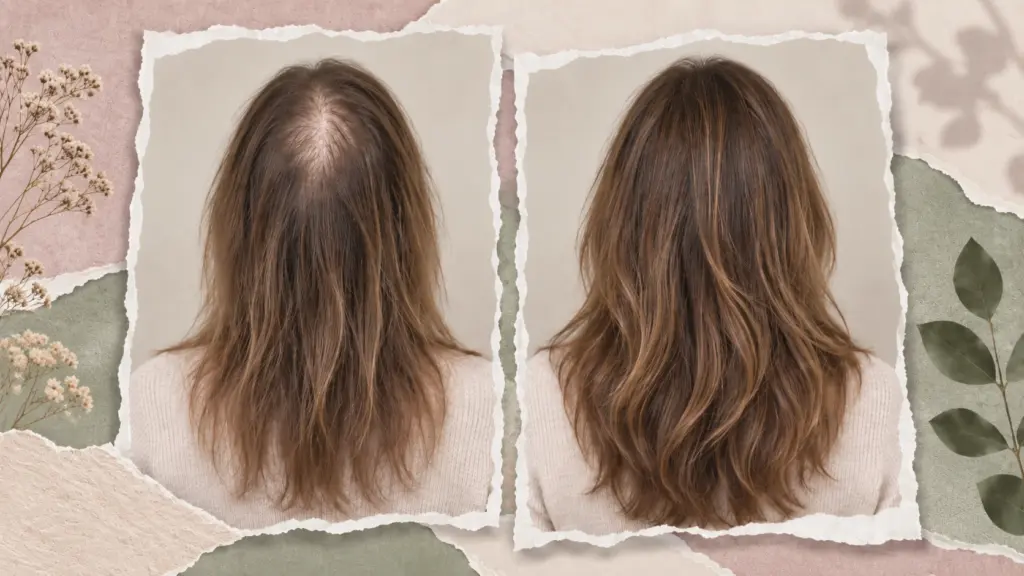
Hair loss? See how to treat it.
Discover a simple routine to care for your scalp, reduce damage to your hair, and understand when hair loss requires more attention.
You will remain on our site to continue reading the content.
How has your hair changed recently?
Some people feel that their hair has lost density and no longer looks as full as it used to. Others notice more strands falling out in the shower, while brushing, or when running their hands through their hair. Understanding this difference helps to better observe what might be happening.
Hair loss can have different causes.
When it comes to hair loss, many people look for a quick fix. This is natural, because seeing your hair change usually causes concern. But the truth is that hair loss can be linked to many different situations, such as stress, hormonal changes, postpartum, recent fever, rapid weight loss, restrictive diets, genetic predisposition, excessive oiliness, or inflammatory processes in the scalp.
For this reason, a home-based routine can help support care, but it should not be seen as a guaranteed solution to every type of problem.
Losing density is not exactly the same thing as significant hair loss.
In some cases, what bothers people most is the feeling that their hair is thinner, with less volume, and a more noticeable parting. In others, the main sign is seeing many strands falling out during daily routines.
These scenarios can happen together, but they don't always mean the same thing. Thinning, breakage, and hair loss at the root are different situations, although all can leave the hair looking thinner.
Breakage and falling can be confused.
If hair strands break easily due to heat, chemicals, friction, or aggressive brushing, the hair loses body and may appear increasingly thinner. This can happen even without a significant change in hair loss at the root.
Therefore, before focusing solely on growth or restoring density, it's worth checking if the hair strands are also fragile along their length.
Rosemary has become part of many people's hair care routine.
Among the most talked-about at-home hair care routines, rosemary frequently appears. It is usually used on the scalp in small amounts and always in a diluted form, as part of a gentler care ritual.
Later on, you will see a simple way to prepare this mixture and how to use it more cautiously.
Essential oils require careful use.
Rosemary essential oil should not be applied undiluted directly to the skin. Because it is concentrated, it can cause burning, irritation, or sensitivity, especially in those who already have a sensitive scalp.
The safest way is to use a few drops diluted in a carrier oil.
The scalp is also part of the problem.
Often, people only look at the hair strands but forget to observe the scalp. Itching, flaking, sensitivity, excess oiliness, and product buildup can interfere with comfort in this area and make it difficult to maintain a balanced routine.
Maintaining hygiene that suits your hair type and avoiding excesses usually helps a lot.
Tight hairstyles can worsen the feeling of hair loss.
When hair is repeatedly tied up too tightly, the constant tension can weaken certain areas, especially the sides and front. This simple detail of the routine sometimes goes unnoticed.
If you've already noticed thinning or sensitivity in certain areas, it's worth reducing the tension in your hairstyles.
Excessive heat can make hair even more fragile.
Using a hairdryer on a very hot heat setting, and using flat irons and styling tools frequently can increase the fragility of hair strands. This doesn't necessarily mean hair loss from the root, but it can increase breakage and reduce the appearance of volume.
For hair that is already sensitized, this care makes a significant difference.
The problem isn't always just with the products.
Sometimes people repeatedly switch between shampoos, masks, and tonics, but fail to consider important factors such as diet, sleep, stress, and recent changes in their bodies.
Hair responds to the overall routine, not just to external treatments.
Some signs indicate that it's worth investigating further.
Although many cases may begin with observation at home, some signs deserve closer attention.
- A very intense and sudden fall.
- Localized bald patches on the scalp.
- Intense itching, pain, or burning sensation.
- Significant peeling or redness.
- Loss of density that continues to progress.
- A clear change in volume accompanied by significant thinning.
Visual monitoring can be more useful than a printout of the day.
Instead of judging your hair solely based on how it feels on a bad hair day, it can be more interesting to observe its evolution over the weeks. Photos taken under similar lighting and angle conditions help to see if there has actually been a change in density or if the impression varied depending on the hairstyle and lighting.
Simple routine is usually better than excess.
When hair loss becomes a concern, it's common to start using many products at once. But this can overload the scalp and make it difficult to figure out what really suits your hair.
A leaner, more consistent routine is usually easier to maintain.
Frequently asked questions about hair loss
Are hair loss and thinning the same thing? No. Hair loss involves more strands coming loose; thinning is more related to thinner strands and lower apparent density.
Can I use rosemary on my scalp? Yes, you can incorporate it into your routine, as long as the essential oil is used in a diluted form.
Can rosemary essential oil be used undiluted? It's not ideal. The concentration can irritate the skin.
Does having more hair in the shower always mean there's a problem? Not necessarily. The important thing is to notice if there's been a persistent increase compared to your normal hair type.
Can tight hairstyles make hair worse? Yes. Repeated pulling can increase fragility in certain areas.
When should I see a dermatologist? When hair loss is intense, sudden, persistent, or accompanied by bald patches, itching, pain, or irritation.
On the next page you will see a simple routine with rosemary, different care tips for thinning hair and increased hair loss, as well as warning signs to investigate further.