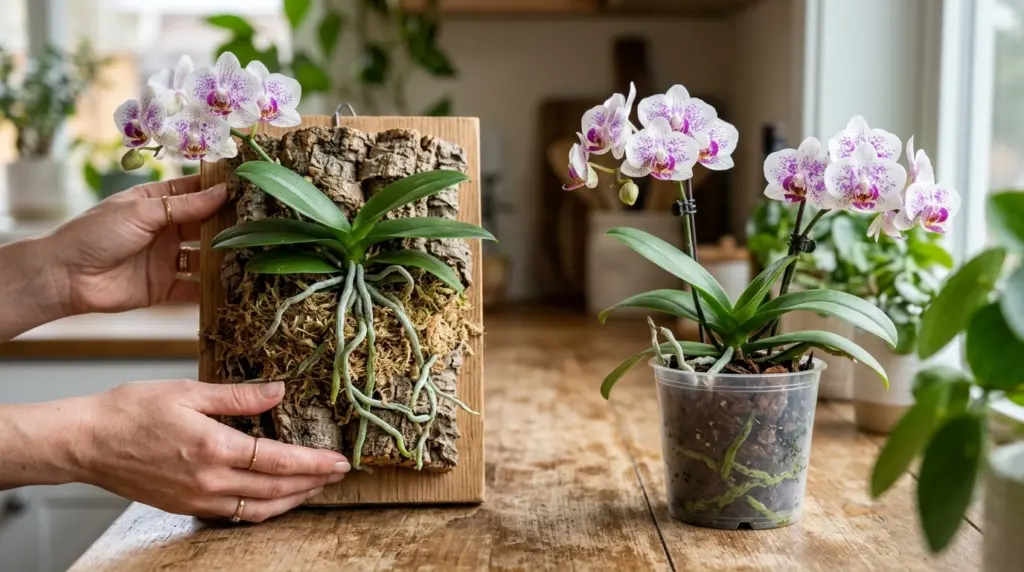
Difference between a potted orchid and an orchid mounted on a plaque.
After years of growing orchids only in conventional pots, I decided to try mounting an orchid on a wooden plaque, curious to better understand this method that I always saw in photos of more elaborate collections. The experience taught me that the two methods require a very different approach to care, each with its own advantages.
What does plate-mounted cultivation mean?
Mounted cultivation, or "mounted" cultivation in English, consists of attaching the plant directly to a piece of wood, cork, or bark, with little or no substrate around the root, more closely replicating how some species grow naturally attached to tree branches.
Visual advantage of plate-mounted cultivation
Aesthetically, the mounted cultivation has a distinct appeal, showcasing the entire exposed root structure in a decorative way, a visual that attracts considerable attention compared to the more discreet and common conventional pot.
Health advantage: almost total air circulation around the root.
Without a substrate retaining moisture, the root receives almost complete air circulation, greatly reducing the risk of rotting due to excess stagnant moisture, one of the most common problems in traditional pot cultivation.
Main challenge: much more frequent watering
Without a substrate to retain water, the mounted plant dries out much faster, requiring much more frequent watering, sometimes daily, compared to the daily or weekly schedule that I detail in another article about watering in conventional pots.
How do I water a plant mounted on a plaque?
I spray or immerse the entire board in water for a short period, a few times a week, depending on the ambient humidity already detailed in another article, adjusting as I observe the drying speed in that specific environment.
An even greater need for high ambient humidity.
As I've already detailed in another article about air humidity, a well-organized grow setup depends even more on this factor, since there's no substrate compensating with its own water reserve—the ambient humidity needs to supply a good portion of that need.
A species that adapts well to mounted cultivation.
Vanda orchids, and some smaller Cattleya species, already detailed in another article about varieties, tend to adapt well to this type of setup, while Phalaenopsis generally performs better in traditional pot cultivation with substrate.
How I made my first circuit board assembly.
I used a cork board, securing the root with soft nylon thread, without tightening too much, and a little sphagnum moss at the base to help retain some initial moisture during the plant's adaptation period to this new support.
Be careful with the material used to secure the plant.
I avoid direct metal wire contact with the root, preferring nylon thread or soft natural fiber, since more aggressive materials can damage the root during the initial attachment process or as the plant grows.
How do I differentiate the fertility care between the two methods?
As I've already detailed in another article about fertilization, a mounted plant needs more frequent and even more diluted fertilization, since any nutrient drains quickly without being retained by the substrate, unlike a conventional pot.
When do I recommend switching from a pot to a plaque?
I recommend this migration method for those who are already confident in basic care and have the time for more frequent watering, not for those who are just starting out in orchid cultivation, as it requires more constant attention than the traditional method.
Difference in longevity of board material between wood and cork.
I've already tested both regular wood board and natural cork board, noticing that cork tends to last longer before it starts to decompose, as well as retaining a slightly higher amount of moisture for longer, a characteristic that helps those who have a less frequent watering routine than is ideal for this cultivation method.
How does a mounted grow tent perform during a longer trip?
Unlike a traditional pot, which retains some moisture in the substrate, a plant mounted on a plaque dries out much faster, making this method particularly challenging during travel, as detailed in another specific article. I usually avoid leaving a mounted plant unattended for more than a few days, unless I have someone trustworthy taking care of it in person during that time.
Hanging the sign versus resting it on a horizontal surface.
I prefer to hang the plaque vertically, more closely mimicking how the plant would naturally grow attached to a tree trunk, promoting better drainage and air circulation throughout the root system. I've also tried supporting it horizontally, but I've noticed that water tends to accumulate less evenly in that position, slightly increasing the risk of stagnant moisture at specific points in the root system.
Recognizing the right time to remove the initial supporting moss
The sphagnum moss initially used at the base to help with fixation and retain moisture during adaptation tends to decompose over time, and I observe when the root is already well established and attached to the plaque before considering removing it completely, allowing the plant to be fully exposed to the air as in the purest mounted cultivation method.
Documenting the results of my first experience with assembly.
I documented the entire process of that first setup in my grow notebook, already mentioned in another article, including the materials used, the watering frequency adjusted over the first few weeks, and the results observed after a few months. This detailed record became a valuable reference when I decided to set up other plants later, avoiding repeating adjustments that I already knew didn't work well.
How the season further influences the cultivation process
In summer, with warmer and drier air in many regions, the mounted plant may need almost daily watering, while in winter, with naturally more humid air in some locations, the frequency may be considerably reduced. This seasonal variation, already more subtle in conventional pot cultivation, becomes even more evident and requires extra attention in the mounted method without a water-retaining substrate.
Combining the two methods in the same collection, without choosing only one.
Today my collection includes both traditionally potted plants and mounted plants, choosing the method according to the species and the aesthetic I'm looking for in each specific piece. I don't see the need to choose a single method and abandon the other completely, since each approach offers a different experience and visual result that enriches the collection as a whole.
Cost comparison between mounting on a slab and keeping in a conventional pot.
The initial cost of setting up a planter is usually similar to that of a good pot, but the continuous water consumption for more frequent watering and the extra time dedicated to care end up representing a greater indirect investment over time, a factor I consider when deciding how many plants in the collection are really worth keeping in this more demanding format.
Questions I've been asked about growing on a plaque.
Can any orchid be mounted on a plaque?
Technically it's possible to try, but species that naturally grow with more substrate around the root, such as Phalaenopsis, usually do better in a traditional pot, having already evolved to this type of more protected environment.
I need to replace the substrate plate periodically, how do I do that with potting soil?
The plaque itself lasts much longer than regular substrate, but I periodically check if it's decomposing or losing firmness, replacing it when necessary to keep the plant well-fixed and supported over the years.
Experimenting with mounted cultivation broadened my understanding of the diverse ways to properly care for an orchid, showing that there is no single right way, but several valid approaches depending on the commitment, time available, and personal style of each grower.