When to repot your orchid: signs that indicate the right time.
For a long time, I simply didn't know how to identify when an orchid really needed repotting, leaving some plants in the same substrate for too long until the problem was already quite advanced and more difficult to reverse. With experience, I learned to recognize specific signs that indicate the right time, avoiding both unnecessary repotting and harmful delays.
Decomposed substrate, the most common sign that it's time to repot.
As I've already detailed in another article about substrate, pine bark decomposes gradually over time, losing structure and turning into something similar to fine soil, compromising drainage and increasing the risk of root rot.
How can I check the condition of the substrate without having to completely drain it?
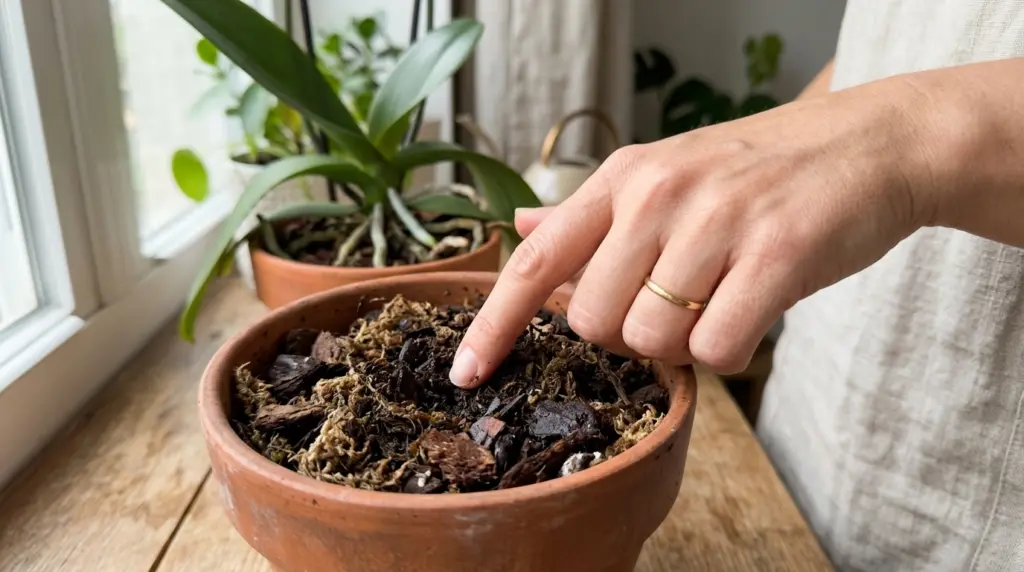
I lightly stick my finger into the surface of the substrate, feeling if it still maintains a loose and aerated structure or if it is already compacted and crumbling, a quick test that helps me decide if it's worth investigating further with complete depotting.
Roots growing out of the edge of the pot are a sign that the plant has grown too large.
When I notice a lot of aerial roots coming out of the edge or drainage hole of the pot, it's a sign that the plant has outgrown the available space in its current container, usually indicating the need for a larger pot to accommodate this continued growth.
How do I differentiate between a normal aerial root and a true sign of an excessively small vessel?
Some species naturally produce aerial roots even with adequate space in the pot, so I also assess whether the plant seems unstable or if most of the root is already outside the substrate, more reliable signs that the space has indeed become insufficient.
Water draining too quickly is a sign of excessive drainage.
When water passes straight through the substrate almost without being retained, with no perceptible moisture after a few minutes, it may indicate that the material has already lost much of its retention capacity, a sign that it's time for a complete replacement.
An unpleasant smell coming from the toilet, a sign I never ignore.
An unusual odor, similar to mold or decay, coming from the substrate or the base of the plant, usually indicates an ongoing problem, generally related to compromised roots, requiring immediate investigation and likely corrective repotting as soon as possible.
Stagnant growth, an indirect sign that I also consider.
When a plant that used to grow consistently stops developing new leaves or roots for an extended period, with no other apparent cause already ruled out, I consider the possibility that the old substrate is limiting this expected development.
Natural time cycle, a reference I use even without an obvious sign.
Even without any clear signs of problems, I usually check each plant every one or two years, since the organic substrate decomposes gradually even when there are no obvious visible signs of compromised overall drainage.
How I use a simple calendar to remember when to check each plant.
I mark in my growing notebook, as mentioned in another article, the approximate date of the last repotting of each plant, creating a simple reminder that helps me not to let too much time pass without this important preventive maintenance.
This indicates that replanting is not yet necessary, thus avoiding unnecessary intervention.
The substrate is still structured, the roots are healthy within the available space, and consistent growth indicates that the plant is doing well in its current container, and in this case I prefer not to disturb it, since unnecessary repotting also generates avoidable stress for a healthy plant.
Why do I avoid replanting just because another plant in my collection needed it?
Each plant has its own pace of substrate decomposition and root growth, so I assess them individually before deciding, avoiding the temptation to replant the entire collection at once just because I noticed a clear sign in a specific plant.
A mistake I've made before was waiting too long to repot a specific plant.
I left a Cattleya in the same substrate for almost four years, ignoring gradual signs of decay, until the root was already significantly compromised when I finally investigated, a delay that required far more laborious recovery than would have been necessary.
How I adjusted my routine after learning about this delay.
I started doing more proactive checks each year, even without obvious signs, especially considering species that I know have a faster decomposition substrate, avoiding repeating the same mistake of letting excessive time pass without this maintenance.
Combining this verification with the regular inspection already detailed in another article
As I've already detailed in another article about organizing routines, I take advantage of the weekly inspection to also quickly assess the condition of the substrate, integrating this check into the regular check I already do for each plant in the collection.
Accumulated mineral salt, a sign that I also consider in conjunction with the others.
As I have already detailed in another article about Zygopetalum, a whitish residue on the surface of the substrate may indicate an accumulation of mineral salt from fertilizer or poor quality water, a sign that sometimes resolves with simple washing, but in more persistent cases reinforces the need for complete repotting.
How do I tell if the current pot is still the right size for the plant?
In addition to checking the substrate, I consider whether the pot is still proportional to the current size of the root system, since a plant that has grown considerably since its last repotting may benefit from a larger container, even if the substrate itself is still in reasonable condition.
How do I prioritize which plant to repot first when several need it at the same time?
When I realize that several plants in my collection need repotting at the same time, I prioritize the one with the most advanced signs first, such as an unpleasant smell or clearly compromised roots, leaving for later the one that shows only a slight sign of substrate beginning to decompose.
How do I react when I notice a mixed signal, with one part good and another compromised?
When the substrate still looks reasonable in one part of the pot, but is clearly decomposed in another, I prefer to opt for complete repotting instead of trying to replace only the compromised part, since mixing new and old substrate in the same container rarely solves the problem permanently.
Questions I've been asked about when to replant.
Do I need to repot every time I notice an aerial root coming out of the pot?
Not necessarily, since some species naturally produce aerial roots even with adequate space, so I assess other signs in conjunction before deciding if it's really time to change the container.
Is there a risk in replanting more frequently than necessary?
Yes, excessive repotting generates unnecessary stress for the plant, so I recommend following the real signs of need instead of disturbing the roots just out of excessive precaution without a concrete reason.
Do all orchid species require the same repotting intervals?
No, some species with a substrate that retains more moisture, such as Paphiopedilum, already detailed in another article, tend to need a shorter interval than species grown in more durable pine bark that decomposes more slowly.
Learning to recognize the right time to repot gave me much more confidence to proactively care for my collection, showing that paying regular attention to the right signs avoids both harmful delays and unnecessary intervention that also harms the plant over time.