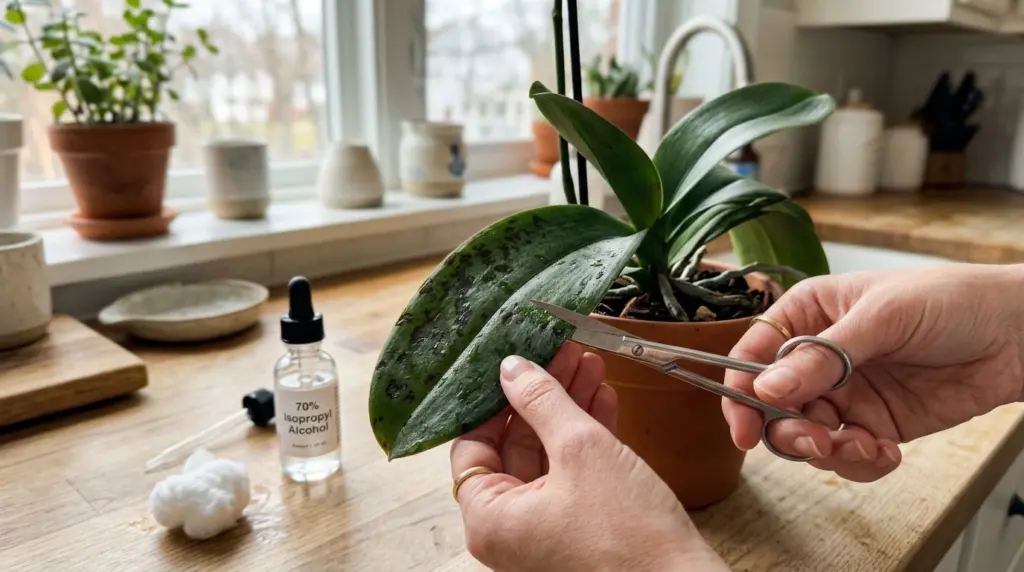
Black spot on orchid leaf: fungus or bacteria, how to treat it?
Dark spots on orchid leaves are one of those situations where acting quickly and acting correctly are not the same thing. Fungi and bacteria produce spots that look similar at first glance, but they advance at very different speeds and require different approaches—and treating bacteria as if it were fungus can cost the plant.
This article is about differentiation: how to separate the two within 24 hours, what to do in each case, and how not to turn one diseased plant into five.
The difference that decides everything: speed.
Before considering color, shape, or texture, consider time. It's the most reliable and easiest criterion to apply.
Bacterial infection progresses rapidly. You can see a difference from one day to the next, and in aggressive cases, from morning to afternoon. It's a real emergency.
Fungal infections progress slowly , over weeks. You have time to observe and decide without rushing.
The practical test: mark the edge of the lesion with a permanent marker and look at it 24 hours later. If the spot has visibly spread beyond the mark, treat it as a bacterial infection and act today. If it remains the same, you have a window of opportunity.
This test costs nothing and resolves most doubts. Take it before buying the product.
The other distinguishing signs
| Feature | Bacterium | Mushroom |
|---|---|---|
| Speed | hours to days | weeks |
| Appearance | soaked, boiled fabric | drier |
| Rail | irregular, with a wet halo | defined, sometimes with rings |
| By squeezing | Soft, yields, can run. | firm |
| Smell | often unpleasant | odorless |
| Urgency | act on the same day | It's possible to observe |
The smell signal is underestimated and is quite specific: bacterial infection in soft tissue usually has a noticeable odor up close. Fungal infections do not.
And the light pressure touch test: bacteria leave the tissue sticky and it yields; fungus leaves the area dry and it resists.
Before treating: confirm that it is an infection.
Two common things mimic infection but are not, and treating both with the same product is a waste of money without any effect.
Sunburn. A light or yellowish spot that later darkens, dries out, has a well-defined border, and always appears on the side of the face that was facing the sun. The difference is that it doesn't grow after it's established, and the damage is permanent—there's no treatment, only relocation.
Salt or fertilizer burn. Darkening that starts at the tip of the leaf and progresses inward, attacking the older leaves first. It is the one most often confused with disease. Treatment involves washing the substrate thoroughly with good quality water and changing the medium—fungicide is ineffective here.
If you are unsure whether it's an infection or one of these two, the complete symptom-based screening method is in the symptom-based diagnosis guide , which orders the causes by probability.
Management of bacteria: the first few hours
In this order, and without skipping any steps.
Isolate the plant from the rest of the collection now. Bacteria spread through water splashes and contact—a diseased plant next to a healthy one means ongoing contamination.
Stop watering from above. Water running down the leaf carries the pathogen to the healthy tissue of the same plant and to neighboring plants.
Cut with a margin. This is the point where most mistakes are made: don't cut at the visible edge of the lesion. Go about a centimeter into the apparently healthy tissue, because the infection advances ahead of what is visible.
Sterilize the blade before and after use. And if cutting more than one plant, sterilize it between each cutting.
Allow the wound to air dry for a few hours in a well-ventilated area away from direct sunlight before applying anything. A damp wound kept indoors will recreate the condition you are trying to eliminate.
Applying cinnamon powder or healing paste to the cut area is a common practice among growers as a protective barrier for the wound. It is not a treatment for infection—it is protection for the cut.
Observe for two weeks before returning to the animal. Recurrence at the edge of the cut is common and requires a new cut, with a larger margin than the first.
Treatment for fungus
Since progress is slow, the order changes: first correct the environment, then evaluate the product.
Remove the affected leaf or part if the area is small and localized. In many cases, this plus environmental remediation resolves the issue.
Increase ventilation. Fungus on orchids is almost always a symptom of stagnant air with high humidity. Without correcting this, the product treats the episode and the next one follows.
Review your watering schedule. Watering at the end of the day leaves the leaves and substrate damp all night, which is the window in which the fungus thrives. Water in the morning.
Fungicide, if infestation persists. Follow the manufacturer's instructions, at the indicated dilution, and not on the entire collection—only on the affected plant.
Sterilizing the blade: how to do it properly
This section exists because it's the step that's most often skipped and has the most serious consequences—it's the only real prevention against the virus, which has no cure.
Flame is the most reliable method. Heating the blade over a flame and allowing it to cool destroys viral material. It is recommended when there is any suspicion of viruses in the collection.
70% alcohol is effective against bacteria and fungi , but it's not reliable against viruses. Suitable for routine use, but insufficient for serious suspected cases.
Using a new disposable blade for each plant is the simplest solution when dealing with multiple plants—it eliminates the problem without relying on protocol.
The critical point: sterilization needs to happen between plants , not just at the beginning of the work. Cutting five plants with the same clean scissors only at the start is the quickest way to turn one problem into five.
Clean the countertop afterward as well, and don't reuse plant substrate that has rotted.
Why it appeared, and how to avoid repeating it.
Infection doesn't appear out of nowhere. There's almost always a contributing factor, and identifying it is what prevents recurrence.
Stagnant air with high humidity is the number one cause. If you increased the humidity without increasing the ventilation, you created that scenario.
Water at the end of the day , leaving the leaves wet overnight.
Water accumulating in the crown or leaf axils , especially in Phalaenopsis, is often fatal.
Unprotected wound — torn leaf, pruning cut, handling damage. That's how the pathogen enters.
New plant without quarantine. Two to four weeks of separation is what prevents a purchased problem from going directly into the collection.
A stain on an old leaf might be nothing.
It's worth considering a counterbalance, because the opposite of negligence also has its costs: unnecessary intervention in a healthy plant.
The oldest leaf on any orchid ages and dies — it's a normal cycle, not a disease. In this process, it usually yellows and develops dark areas before drying out completely.
What differentiates senescence from infection: senescence occurs in the oldest leaf, one at a time , gradually, usually starting at the tip or base, and the plant continues to produce new growth normally.
Infection doesn't discriminate based on leaf age, can appear on several leaves at once, and is usually accompanied by another sign — stunted plant growth, compromised roots, and an odor.
If the plant is producing new leaves or roots and only the oldest leaf is showing signs of a problem, it's most likely that there's nothing to treat. Cut the leaf off when it dries out and continue observing it.
Do not treat the entire collection as a precaution.
When faced with a plant showing signs of spotting, the common reaction is to apply fungicide to all of them "to prevent further damage." This rarely helps and can even make things worse.
Widespread preventive application exposes healthy plants to products they don't need, risking phytotoxicity, and repeated use promotes resistance.
What truly prevents disease is proper management: adequate ventilation, watering in the morning, avoiding wetting the crown, quarantining new plants, using sterilized tools, and weekly inspection. None of these involve any product.
When the plant is beyond repair
Two situations where the realistic approach is to dismiss the situation rather than insist.
Crown rot in a monopodial plant. Phalaenopsis and Vanda plants grow from a single point—without it, there is nowhere for regrowth to occur, unless a keiki (crown) has already formed.
Suspected virus. Mosaic-like spots, streaks, or rings on the tissue are not treatable infections. There is no cure, and the plant is a source of contamination for the entire collection via tools.
Apart from these two cases, orchids recover much better than they seem. A plant that has lost several leaves but has retained its roots will return in one or two seasons.
Summing it Up
Mark the edge and check in 24 hours: if it has grown, it's bacteria and you should see it today; if it hasn't grown, it's fungus and you still have time. Before that, rule out sunburn and salt burns, which mimic it but are not the same.
Cut with a margin, sterilize between plants, let the wound air dry. And correct what facilitated it — ventilation and watering schedule — because treating without changing the conditions only delays the next episode.