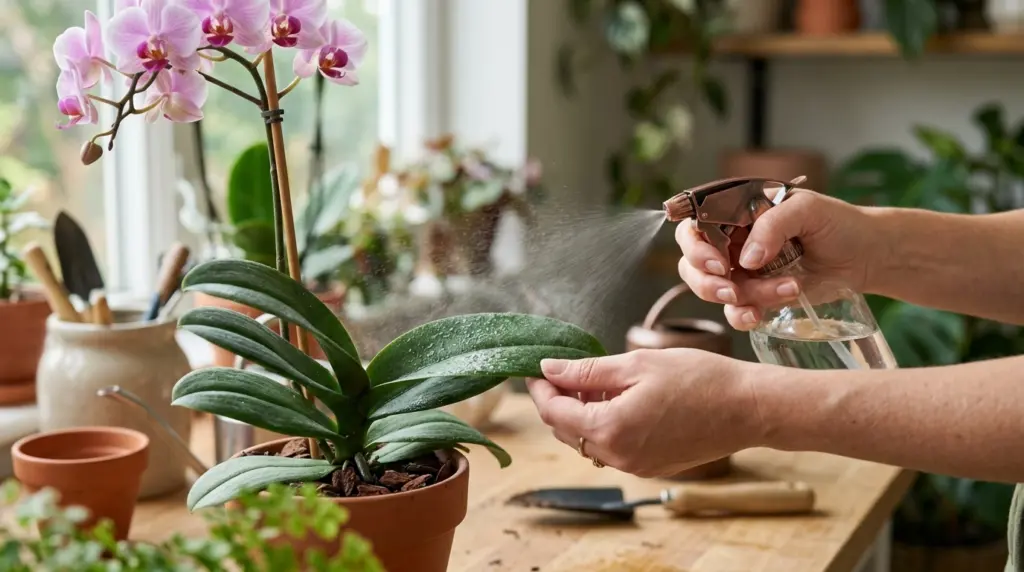
Foliar fertilizer vs. root fertilizer: the difference and when to use each one.
I've already detailed the general principles of orchid fertilization in another article, but I receive quite a few specific questions about the difference between applying fertilizer to the roots and applying it to the leaves. After testing both approaches over the years, I've gained a better understanding of the complementary role each plays in cultivation.
How does nutrient absorption through the root work?
Traditional fertilization, applied along with irrigation water, is absorbed primarily by the roots, following the plant's natural water and nutrient absorption pathway for growth. This is the most common method and the basis of my regular routine.
How does nutrient absorption by the leaf work?
Foliar fertilizer is sprayed directly onto the leaf surface and absorbed through tiny pores called stomata. This absorption pathway is faster, but also more limited in quantity compared to root absorption.
Main advantage of foliar fertilization: speed of response.
I've noticed a faster response in plants that showed mild signs of nutritional deficiency after applying foliar fertilizer, compared to the time it usually takes for root fertilization to show a visible effect.
Limitations on foliar fertilization that I consider important.
The amount of nutrients that the leaf can absorb is much less than the root, so I don't consider foliar fertilization a complete substitute for regular root fertilization, but rather a specific supplement for a particular situation.
When I choose to use foliar fertilizer on purpose
I use it mainly on plants that are recovering from some kind of stress, such as recent acclimation (as detailed in another article), or just before an important period like flowering, seeking an extra and faster boost during those specific times.
How do I apply foliar fertilizer correctly?
I spray a very diluted solution, even weaker than what I use for watering, directly onto the underside of the leaf, where the concentration of stomata is usually higher, avoiding times of strong sunlight that could burn the wet leaf.
Ideal time to apply foliar fertilizer
I prefer to apply it early in the morning, ensuring the leaf has time to dry completely before nightfall, following the same care principle I've already detailed in another article about spraying water on plants.
The concentration I use to avoid burning the leaf.
I dilute the foliar fertilizer to a concentration even lower than half the already reduced dose I use for root fertilization, as detailed in another article, since the leaf is more sensitive to high concentrations than the root, which is accustomed to absorbing nutrients in that way.
Frequency I use for supplemental foliar fertilization.
I reserve foliar fertilization for specific situations, not as a constant regular routine, generally once or twice a month at most, complementing the main routine at the root without overloading the plant with excessive stimulation.
Specific fertilizer formulated for foliar application.
There is a fertilizer specifically formulated for foliar absorption, with a slightly different composition than traditional irrigation fertilizer, and I prefer to use this specific version when available, since the formulation is designed for this particular type of application.
Combining the two methods in a balanced way
In my routine, root fertilization remains the main basis, with foliar fertilization used as an occasional booster at specific times—a combination I found by testing and adjusting over several growing cycles.
How do I decide whether to use foliar fertilizer on a plant that is still acclimatizing?
I've already detailed in another article that I avoid regular root fertilization during the first few weeks of acclimation for a new plant, but sometimes I use a very diluted foliar application as a small extra boost, since this method is gentler and less risky for a root system that is still adjusting to the new environment and substrate.
A sign that the leaf reacted poorly to a foliar application.
If I notice a small spot or burn appearing soon after a foliar application, I consider it a sign that the concentration was too high or that I applied it at an inappropriate time, with strong sunlight hitting the still-wet leaf. I adjust the dilution and timing on the next attempt, always prioritizing extra caution with this more sensitive technique.
Testing the plant's response before standardizing foliar application.
Before adopting foliar fertilization as a regular practice on a specific plant, I test it with a single application and observe the response over one or two weeks, confirming that there was no negative reaction before considering repeating the process more frequently on that particular plant.
Difference in response between thin-leaved and thick-leaved species
Species with thinner, more delicate leaves tend to be more sensitive to overly concentrated foliar applications compared to species with thicker, more resistant leaves, such as some Cattleya orchids, which have been detailed in another article. I adjust the dilution considering this difference in sensitivity between the species in my collection.
I record each foliar application I perform in my notebook.
I keep a separate record from my regular root fertilization log each time I use foliar fertilizer, since the two methods follow different schedules and mixing this information in the same record would make it difficult to accurately track the necessary spacing between applications of each specific type.
Diluting foliar fertilizer with distilled water instead of regular water.
I prefer to use distilled or filtered water to dilute foliar fertilizer, since mineral residue present in regular tap water can leave visible stains on the leaf after it dries, an aesthetic detail I noticed when comparing the results between the two types of water in the same application.
Using a quality sprayer to ensure even application.
I invest in a good quality sprayer with a fine, even mist, since a spray with droplets that are too large tends to run off the leaf quickly without allowing enough time for proper absorption by the stomata, reducing the actual effectiveness of foliar application even when using the correct fertilizer at the right concentration.
How I first realized that foliar fertilization really made a difference.
In a plant that was visibly developing more slowly than the others, despite proper regular watering and fertilization, I applied foliar fertilizer for a few weeks and noticed a perceptible response of new leaves growing faster than the previous pattern for that specific plant. It was this concrete experience that convinced me of the real value of this complementary technique, beyond the theory I had already read before testing it.
How long should diluted foliar fertilizer be stored?
I never store the diluted foliar solution for more than a day, always preparing a fresh quantity for each application, since the diluted mixture loses stability and effectiveness over time, in addition to the risk of contamination if stored for a longer period in an open container.
Questions I've been asked about foliar and root fertilizers.
Is it possible to use only foliar fertilizer, never fertilizing at the root?
I don't recommend it, since the amount of nutrients the leaf absorbs isn't enough to fully sustain the plant's needs in the long term—the root remains the primary source of nutrition.
Can I apply both types of fertilizer on the same day?
I prefer not to combine them on the same day, spacing out at least a few days between applications, avoiding overloading the plant with excessive nutritional stimulation from two simultaneous and different sources.
Understanding this difference broadened my care tools, allowing me to respond more specifically to the given situation without relying solely on the regular fertilization routine I already use most of the time, adapting the care according to the real needs of each stage of cultivation.