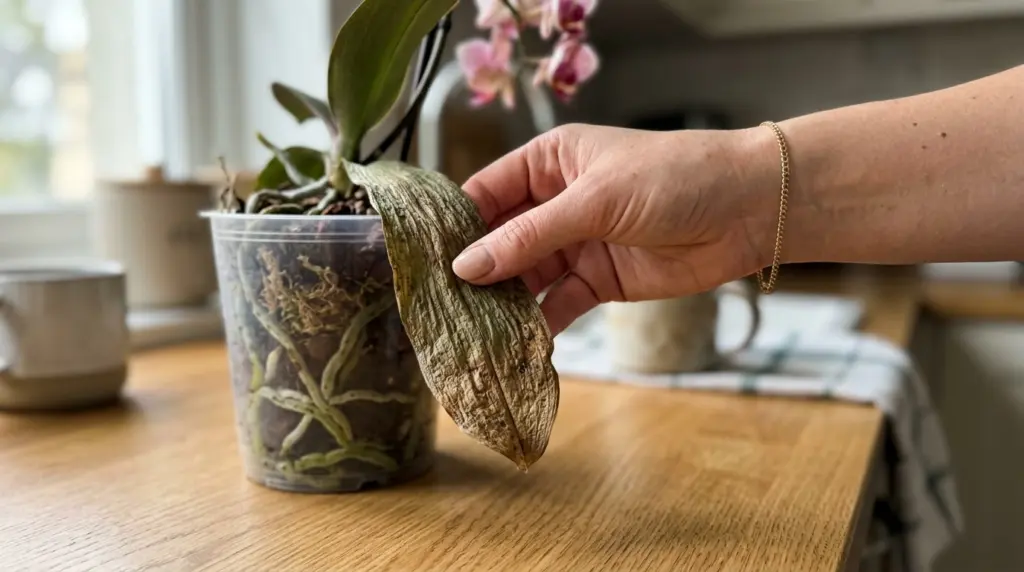
Wilted leaves on an orchid: lack or excess of water, how to tell the difference?
I was confused the first time I noticed an orchid leaf wrinkling and visibly losing firmness, as my immediate instinct was to water it more, assuming the plant was simply thirsty. Only later did I discover that wilted leaves can indicate both a lack and an excess of water, a common misconception I've seen other beginner growers face as well.
Why a wilted leaf can mean completely opposite things.
Both lack of water and excess water can compromise the root's ability to absorb and transport moisture properly to the leaf, resulting in the same visual symptom of loss of firmness, even if the root cause is completely opposite in each scenario.
How do I investigate the root before deciding whether I need to water more or less?
I check the root system through the transparent pot, as detailed in another article, or completely remove the pot if necessary, looking for healthy and firm roots, which would indicate a lack of water, or brown and soft roots, which would indicate excess water and possible rot.
Lack of water, the simplest cause to resolve once confirmed.
If the root is healthy but has been dry for too long, simply increase the frequency of watering gradually, observing the leaf regain firmness over the following days as the plant naturally rehydrates with the corrected care.
Excess water with compromised roots, a more worrying scenario.
If the root is already brown and soft, the problem is more serious, requiring the compromised root removal procedure already detailed in another article, since simply reducing watering does not resolve the damage that has already occurred to the existing root structure.
How do I differentiate the visual pattern between the two opposing causes?
A leaf that lacks water tends to wrinkle more uniformly and longitudinally, appearing slightly flaccid, while a leaf that overwaters, with compromised roots, tends to lose firmness more irregularly, sometimes accompanied by a yellowish coloration at the base.
Extreme temperature, another possible cause that I also consider.
As I've already detailed in another article about ideal temperature, excessive heat can cause water loss faster than the root can replenish it, resulting in wilted leaves even with seemingly adequate watering and healthy roots in the substrate.
How do I confirm if temperature is the likely cause of the problem?
I check if the wilting coincided with a period of unusual heat, especially if the root is healthy and watering has been consistent, a pattern that points to temperature as the causative factor rather than any direct water imbalance.
The pot is too small for the current root system, a less obvious but relevant cause.
As I've already detailed in another article about types of pots, roots that are too confined in a small container may have difficulty absorbing enough water, even with regular watering, requiring repotting into a pot more suitable to the plant's current size.
How do I restore the firmness of the leaf after confirming and correcting the cause?
After identifying and adjusting the responsible factor, whether it's watering, temperature, or pot space, I wait patiently, as full recovery of firmness usually takes days or even weeks, depending on the severity of the original imbalance.
When a wilted leaf doesn't recover even after proper adjustment.
If after weeks the leaf still shows no sign of improvement, I consider that the damage may already be permanent in that specific leaf, and in that case I focus my attention on ensuring that the new leaf, which grows afterward, is healthy and strong.
I've made the mistake of overwatering before, assuming there was a lack of water.
The first time I saw a wilted leaf, I immediately assumed it was due to lack of water and increased watering without checking the root first, worsening a problem that was actually due to overwatering—a mistake that taught me to always investigate before acting impulsively.
How I adjusted my approach after learning from that specific mistake.
Now I always check the root before making any decision about increasing or decreasing watering, understanding that the visual symptom alone, without this additional investigation, is not enough to reliably determine the real cause of the problem.
How do I advise someone who asks me about this very common and confusing symptom?
I always ask the person to first check the root cause before asking any other questions, since that information alone is usually enough to quickly pinpoint which of the opposing causes is actually behind that specific symptom.
Recording each wilting leaf episode in my growing notebook.
I write in my growing notebook, already mentioned in another article, when I notice a wilted leaf, what I discovered by investigating the root and what adjustment I applied; a record that helps me act faster and with more confidence the next time this happens.
Hidden plague, an additional cause that is also worth ruling out.
As I've detailed in other articles about mealybugs and mites, pests feeding on plant sap can also cause wilting leaves, even with proper root system and watering, so I inspect closely for signs of these pests before completely ruling out that possibility.
How do I react when I discover that the cause is a combination of factors?
Sometimes I find more than one contributing factor at the same time, such as excessive heat combined with a vessel that is too small, requiring me to correct both simultaneously instead of focusing on just one isolated cause that alone would not fully explain the problem.
How do I use the already detailed weekly check to catch this signal early?
As I've already detailed in another article about organizing your routine, regularly inspecting each plant helps to notice leaves losing firmness early on, before the problem progresses, greatly facilitating diagnosis and quick correction compared to discovering the problem only after it's already well advanced.
How do I compare the leaf image over time to confirm recovery?
I photograph the affected leaf as soon as I notice the problem and repeat this every few days, comparing side by side to objectively confirm if the firmness is gradually returning, a method that eliminates much of the subjective doubt about whether the applied adjustment is actually working.
Questions I've been asked about wilted leaves.
Should I always increase watering when I see wilted leaves?
Not necessarily, since wilted leaves can indicate both a lack and an excess of water, so I always recommend checking the root system first before deciding what adjustment is actually needed in that specific case.
How long does it take for a wilted leaf to recover after proper adjustment?
It varies quite a bit depending on the cause and severity, but I generally wait at least one to two weeks before assessing whether the adjustment has truly resolved the root problem.
Is it normal for only one leaf to wilt while the rest of the plant appears healthy?
Yes, sometimes the problem only affects a specific leaf, especially if it's the oldest one or if there's localized damage to the root corresponding to that part, without necessarily compromising the overall health of the rest of the plant.
Learning to investigate the root cause before reacting impulsively taught me a valuable lesson about patience and careful observation, showing that the most obvious symptom doesn't always indicate the most obvious solution in the daily care of orchids and the rest of the collection.