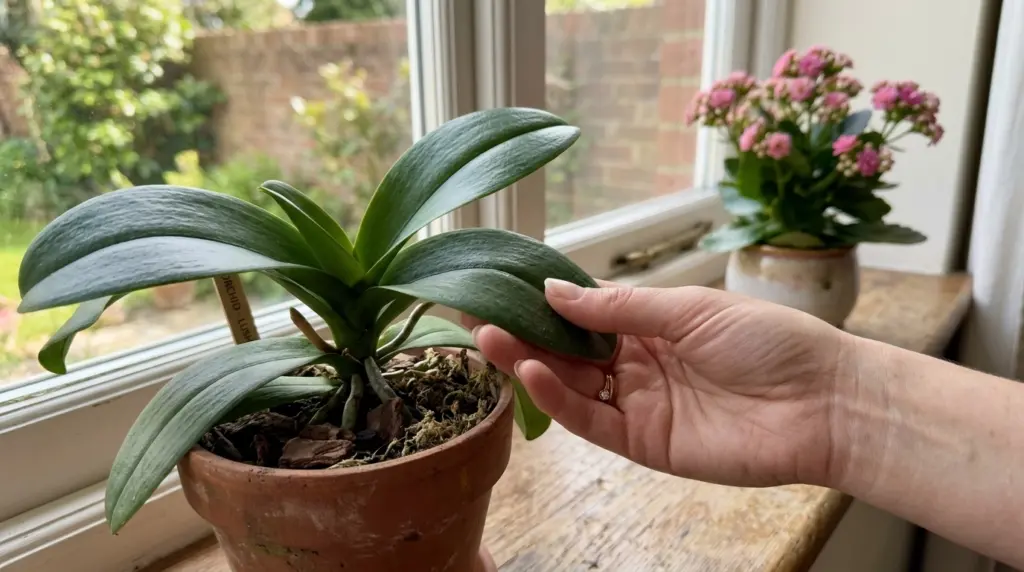
Why isn't my orchid blooming? Common causes and how to fix them.
I received an orchid as a gift a few years ago that went almost two whole years without blooming even once, despite the foliage appearing healthy and vibrant the entire time, with no apparent signs of disease or neglect. This frustration led me to investigate in detail the factors that influence flowering, discovering that there are several different causes behind this problem, which is so common among growers.
Lack of temperature stimulus, the most common cause in some species.
As I've already detailed in another article about ideal temperature, many orchids, including Phalaenopsis, need a drop in nighttime temperature during a certain period of the year to initiate the flowering process, a stimulus that is often lacking in indoor environments with a constant temperature year-round.
How do I trigger this temperature stimulus for a plant that never flowers?
I move the plant to a naturally cooler environment at night during the fall, such as a sheltered balcony, allowing the temperature difference between day and night to serve as the biological trigger the plant needs to initiate the flower stalk.
Insufficient light, another very common cause of this frustrating problem.
As I've already detailed in another article about ideal lighting, a plant that receives only very weak indirect light usually develops healthy leaves, but without enough energy to sustain the flowering process, which requires a considerably greater energy investment from the plant.
How do I know if the light is truly insufficient for this specific species?
I observe whether the leaf has a dark green coloration, a sign of insufficient light, instead of the lighter green expected in a plant receiving adequate lighting. This is a simple visual indicator that helps confirm this likely cause before making any adjustments to its positioning.
Inadequate fertilization is a factor that can also limit available energy.
As I've already detailed in another article about fertilization, phosphorus, in particular, plays an important role in flowering, so a plant that never receives fertilizer or receives an unbalanced formula may simply not have enough nutritional reserves to complete this more demanding process.
How do I adjust fertilization specifically to stimulate flowering?
I slightly increase the phosphorus in the fertilizer formula as soon as I notice signs that the plant is entering the right flowering period, an adjustment that I've seen make a real difference in plants that previously seemed stagnant, only producing new leaves.
The plant is still too young, a reason I sometimes forget to consider.
Some orchids simply need to reach a certain level of maturity before they can bloom, a factor related to age that is completely independent of the care provided, requiring only additional patience until the plant is truly biologically ready.
How do I assess whether maturity might be the limiting factor in this case?
I check the overall size of the plant and the number of leaves developed, comparing it to the expected standard for an adult, flowering specimen, since a seedling that is still small and has few leaves probably just needs more time to grow before flowering.
Pot too large, a factor that redirects energy towards root growth.
As I've already detailed in another article about types of pots, a container that is much larger than necessary causes the plant to invest energy mainly in developing new roots to occupy that space, instead of directing resources towards flower production.
How do I correct the size of the pot when I identify this imbalance?
Repotting into a container more suited to the actual size of the current root system, following the principle already detailed in another article on how to repot correctly, redirecting the plant's energy focus back to flowering instead of excessive vegetative growth.
Inadequate humidity, an environmental factor that also influences this process.
As I've already detailed in another article about humidity, a very dry environment can stress the plant in such a way that it prioritizes basic survival over reproduction, making this environmental adjustment another relevant factor to consider in this complex scenario.
How do I combine all these factors into a systematic investigation?
I review each factor individually, starting with the most likely one considering the specific species, adjusting one at a time to identify exactly which change actually made a difference, avoiding confusing cause and effect by changing everything simultaneously without a clear criterion.
A mistake I've made before was changing several factors at the same time without any criteria.
In an attempt to resolve the issue quickly, I simultaneously changed the light position, the fertilization routine, and the pot of the same plant, and when it finally bloomed months later, I couldn't be sure which specific adjustment had actually made a difference.
How I adjusted my approach after learning from that mistake.
Now I apply only one adjustment at a time, waiting a few weeks to observe the response before considering the next change. It's a slower method, but it gives me much more clarity about what really works for each specific plant.
Recording each adjustment and the plant's response in my growing notebook.
I note in my growing notebook, already mentioned in another article, every change I apply to a plant that doesn't flower, and how long it takes for it to finally produce a flower stalk—a valuable record to apply this learning to another similar plant in the future.
A hidden plague or health problem, a cause that is also worth ruling out.
As I've detailed in other articles about mealybugs and mites, a discreet pest continuously consuming the plant's energy can also be the reason behind the absence of flowering, so inspect carefully before assuming the cause is purely environmental.
How I finally decided to resolve the issue of the plant I received as a gift.
After systematically reviewing each factor, I discovered that the main problem was insufficient light combined with an oversized pot, and as soon as I corrected those two things, the plant finally produced its first flower spike after almost two years of frustrating waiting.
How do I advise someone who asks me about a plant that has never flowered since it was purchased?
I always ask first about the current light position and the size of the pot in relation to the root system, since these two factors combined are usually responsible for most cases of lack of flowering that I have helped other growers solve over the years.
Questions I've been asked about orchids that don't bloom.
How long should I wait before considering that there is actually a problem?
It depends on the species, but I generally wait for at least one full season cycle before assuming there is a limiting factor needing specific correction.
Is it possible for an orchid to simply never bloom even when everything is perfect?
It is rare, but possible in the case of a plant with some unidentified genetic or health limitation, although the vast majority of cases actually respond well to some environmental adjustment after careful investigation.
Is there a specific product that directly stimulates flowering?
There are fertilizers specifically formulated for this purpose, but I prefer to correct the basic environment first, since a stimulant product alone rarely compensates for an inadequate fundamental condition, such as insufficient light or lack of the necessary temperature stimulus.
Systematically investigating why an orchid doesn't bloom has taught me a great deal about the complexity of factors that influence this process, showing that patience and gradual adjustment are often worth more than any quick and generalized solution applied without proper prior investigation.