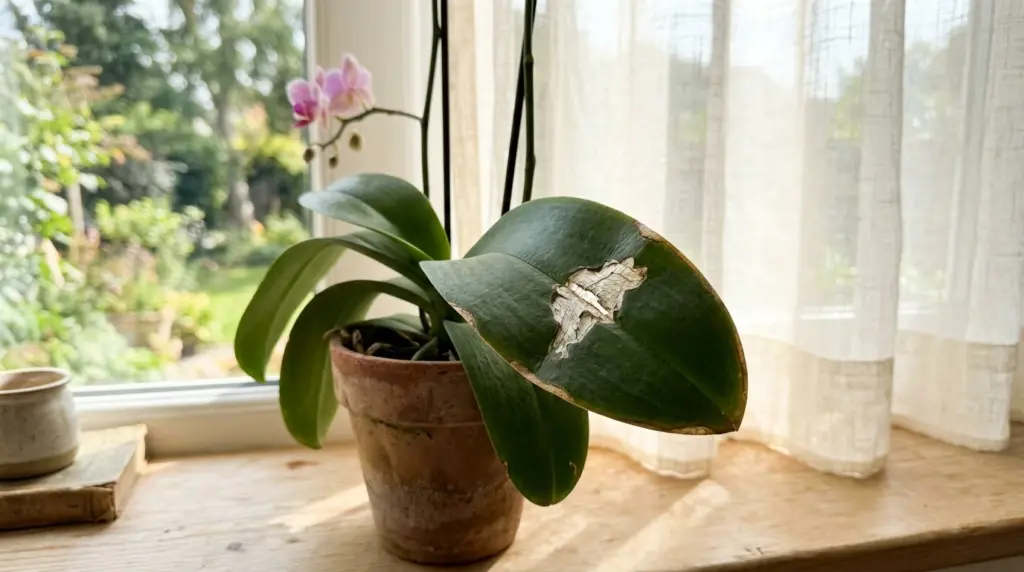
Sunburn on orchids: how to prevent this irreversible damage.
Sunburn has one characteristic that sets it apart from almost every other orchid problem: it's irreversible . Fungus can be treated, pests eliminated, and rotten roots recovered. Sunburnt tissue is dead and will not come back.
Therefore, this article is more about prevention and about not confusing it with disease than about treatment — because treatment, in the sense of restoring the leaf, does not exist.
How to recognize it, and why it matters so much.
The practical problem is confusing it with infection. People apply fungicide to burns, waste product, and conclude that "it didn't work"—when there was nothing there that could have worked.
| Feature | Sunburn | Infection |
|---|---|---|
| Texture | dry, paperwork | damp or soaked |
| Rail | well defined | irregular, wet halo |
| Location | always on the side exposed to the sun | anywhere |
| ATHLETIC | it doesn't grow after installation | advances |
| Smell | no | bacteria usually have |
The deciding factor is the same as always: mark the edge with a pen and look at it in 24 hours . A burn will remain exactly the same. An infection will spread beyond the mark.
Location also gives it away. Burns appear on the side of the leaf that was facing the sun, and often on all plants that were in the same position—something the infection rarely does so symmetrically.
Appearance in stages
Early detection allows you to move the plant before the damage spreads to other leaves.
First sign: a whitish, yellowish, or reddish area, still without altered texture. At this point, the leaf is stressed, but the tissue may remain intact.
Next: the dry area takes on a paper-like appearance and darkens, turning brown or almost black, with a sharp edge.
In the end: the necrotic area becomes permanent. It doesn't grow back, but it also never recovers.
If you caught it in the first stage, moving the plant might be enough to prevent it from progressing. It's the only window of opportunity where action changes the outcome.
How much sun can each gender withstand?
There's no such thing as "orchids can't be in the sun." There are variations by genus, and the difference is enormous—which explains why the same spot in the house can burn one plant and cause another to bloom.
| Genre | Light (foot-candles) | At home |
|---|---|---|
| Phalaenopsis | 1.000 to 2.000 | East-facing window; morning sun |
| Paphiopedilum | 1.000 to 2.000 | 1 to 4 hours of direct sunlight |
| Masdevallia | low to moderate | up to 2-3 hours of direct sunlight |
| Cattleya | 2.000 to 3.500 | more than 4 hours of direct sunlight |
| Cymbidium | 3.000 to 6.000 | outdoors, shaded at midday. |
| vanda | 5.000 or more | balcony or backyard |
These charts come from the American Orchid Society's cultivation guides , one per genus.
Hemispheric inversion that causes burns
This is the detail that causes the most burns for those who are following the correct instructions, and it is almost never mentioned in translated content.
American guidelines recommend window orientation considering the Northern Hemisphere. East and west function the same in both hemispheres —the sun rises and sets on the same sides. But north and south are reversed.
Where an American text says "south window" refers to the sunniest window, in Brazil the sunniest window is the north window . And where it says "north window" refers to the shaded option, here the equivalent is the south window.
Anyone who reads "place in a north-facing window for shade" and does that in Brazil is putting the plant in the strongest position in the house. It's guaranteed to cause burns on a sensitive plant.
When the risk is higher
Midday in the summer. The midday sun in the Brazilian summer burns even the leaves of plants that like strong light. Morning sun until about ten o'clock is much safer than sun from eleven to three.
Glass expands the space. A leaf pressed against the glass receives concentrated heat, and the glass prevents ventilation that would dissipate that heat. Move it a few centimeters away.
Sudden change of position. This is the most important and most underestimated factor. A plant that lived in the shade and is moved directly into the sun will burn, even in areas it would tolerate if it had been acclimatized.
Wet leaves in the sun. Drops act like tiny lenses, concentrating light in specific spots. This is yet another reason to water early in the morning, not in the middle of the day.
After pruning the tree , in outdoor cultivation. The plant, which lived in the shade, is suddenly exposed, and the damage occurs within days.
Acclimate: how to increase light without burning yourself
If you've concluded that the plant needs more light—because it's not flowering, or because the leaves are too dark green—the increase must be gradual.
The method is simple: gradually increase exposure over two to three weeks . Start with one hour of direct sunlight, then two, and monitor the leaf color.
The leaf is the indicator. Very dark green indicates insufficient light. Lighter green, sometimes with a slightly yellowish or reddish tint at the edges, is the productive zone. Whitish spots indicate excess—retreat.
Acclimation also applies to newly purchased plants. If it came from a greenhouse with controlled shade, going straight to a sunny window will burn it.
Shading: what percentage to use
For outdoor cultivation, shade netting is the standard solution, and the percentage of shade needs to match the plant species. The netting is sold by percentage of blockage.
30% is suitable for brightly lit plant species, such as Vanda and Cymbidium, in areas with less intense sunlight or in locations that already receive partial afternoon shade.
50% is the most versatile value and the one that suits most mixed collections — Cattleya, Oncidium, Dendrobium. If you're only buying one, this is the one.
70% for shade-loving genera: Phalaenopsis, Paphiopedilum, and high-altitude species in general.
In tree-tied cultivation, the canopy plays this role — what changes the equation is that the canopy varies with the season in trees that lose their leaves, and pruning can remove the shade all at once.
Artificial light also burns.
There's a misconception that LEDs are safe because they don't heat up like older light bulbs. They do heat up less, but the light intensity at short distances is enough to cause damage.
The recommended installation height is to keep the light fixture between 30 and 60 centimeters above the plant, adjusting according to the wattage. Leaves directly touching or just a few centimeters from the light source will cause the light to turn white.
The sign is the same as with sunlight: discoloration on the side facing the light, on the part closest to the source. And the same acclimatization rule applies — if you increase the power or move the light fixture closer, do it gradually.
What to do with a burnt leaf
The response goes against the impulse: generally, don't cut.
Even with a necrotic part, the rest of the leaf continues to photosynthesize and nourish the plant. Cutting removes tissue that is still functioning and creates a wound—which is an entry point for infection.
It's only worth removing the plant in two cases: if the burned area is so large that the leaf has practically no green tissue remaining, or if the necrotic area begins to show signs of secondary infection, which appears as a moist and soft area advancing from the dry edge.
If you cut it, do so with a sterilized blade and allow the wound to air dry before returning the plant to its place.
The important thing is what you do next: move the plant or install shade. Without correcting its position, subsequent leaves will burn anyway.
The burn that appears at the root
A word of caution regarding a less obvious case: in plants with exposed roots, such as Vanda in a basket, or in the aerial roots of Phalaenopsis that have grown out of the pot, direct sunlight can also burn the roots.
The sign is the root tip drying out and the surface becoming whitish and brittle, lacking the green hue it displays when hydrated.
This often happens when the plant is moved to a brighter location and only the leaf was considered in the decision. Aerial roots that were previously shaded by the pot itself are now receiving direct sunlight.
There is no treatment other than moving or shading the area — burnt roots do not recover, and the plant loses part of its absorption capacity precisely when it needs it most.
Summing it Up
A dry burn with a defined border on the exposed face should not grow—if it has grown, it's an infection, and the treatment is different. Mark the border and check it again in 24 hours before buying any product.
Discover the light range for your gender, and translate the window orientation to the southern hemisphere: here, the strongest window is to the north. Always increase light gradually. And don't cut off a burnt leaf—correct its position.