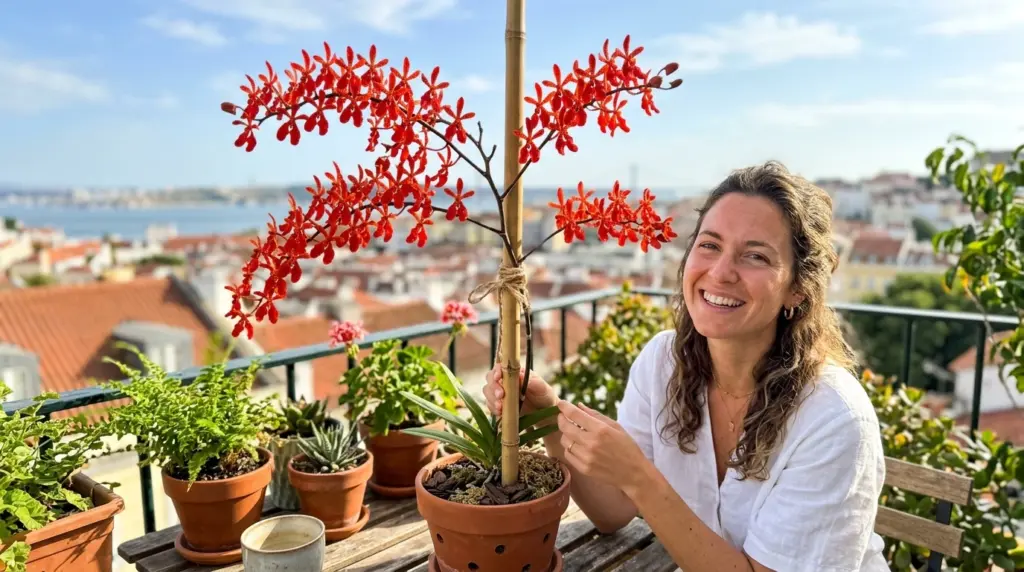
Renanthera: vibrant color and high size, cultivation of this generous orchid
I received my Renanthera from a friend who was moving and needed to find a new home for his plants, a species that I had never cultivated before. I soon realized that I was dealing with an orchid of considerable size and color so intense that it became impossible not to notice, even among the rest of my already quite varied collection.
Intense orange-red color, one of the most vibrant of my collection
Renanthera flower features an extremely vibrant orange-red, often with darker speckled spots, a chromatic intensity that surpasses even the already detailed color on Oncidium in another article, making it virtually impossible to ignore when flowered.
High monopodial growth, similar to Vanda
As I have detailed about Vanda in another article, Renanthera grows monopodially, with a single stem stretching vertically, but generally reaching even greater size, requiring plenty of vertical space available as the plant matures over the years.
Intense light that this species requires, close to the need of Vanda
Renanthera needs very intense light, similar to the requirement already detailed about Vanda in another article, being essential to develop the characteristic vibrant color and sustain the generous flowering that this species offers in favorable condition.
Where I position my Renanthera to meet this need for light
I keep it on a balcony with plenty of sun, close to the place reserved for my Vanda, already detailed in another article, ensuring the intensity necessary for the plant to develop vibrant color and not just stay with green foliage without generous flowering.
Thick aerial root, a feature that also shares with Vanda
It develops thick greenish aerial root, similar to what I already detailed about Vanda in another article, although this species tolerates cultivation both in pots with loose substrate and suspended in basket, offering more flexibility of cultivation method.
Generous watering that this species tolerates well, without great risk of excess
Regulates regularly, without great concern for excess, since Renanthera tolerates constant humidity well, provided that the drainage is adequate, avoiding only the accumulation of standing water that would harm any orchid in the collection.
Loose substrate that I use, prioritizing good drainage
Use of medium to coarse grain pine bark, already detailed in another article on substrate, ensuring adequate drainage compatible with the tolerance of this species the most frequent watering without high risk of root rot.
As a support the tall stem as the plant gains size over time
I use a robust tutor, similar to the one detailed in another article on Epidendrum, adjusting as the stem gains height, ensuring that the plant does not tilt by its own weight as it develops over the following growing seasons.
Branched floral stem with many flowers, a generous spectacle
It produces a branched stem capable of carrying dozens of flowers simultaneously, a generous pattern similar to the one already detailed on Oncidium, although on an even larger scale considering the generally more robust size of this specific species.
Reinforced fertilization that I apply to sustain this generous size
I follow the general principle already detailed in another article on fertilization, with regularity and concentration a little higher than I apply for smaller species, supporting the robust development that supports both the high stem and the generous flowering.
Considerable space that this species requires over time
Unlike a more compact species like Ludisia, already detailed in another article, Renanthera can take up a lot of vertical space as it matures, something I have already had to seriously consider when planning where to keep this plant inside my home in the long term and without compromising the rest of the collection.
How I planned the balcony space thinking about future growth
I reserved a corner with higher ceilings specifically for Renanthera, anticipating the considerable vertical growth that she would still have ahead, avoiding having to reorganize everything after the plant had already reached a more advanced and difficult to move size without risk of damage to the root or stem already well developed.
Combining Renanthera with Vanda, species of similar need
I follow the same principle already detailed in another article about organizing routine, positioning Renanthera close to Vanda, since both share a similar need for intense light and more frequent watering, facilitating the joint maintenance of this specific group.
A mistake I made underestimating the future growth of this species
I initially positioned my Renanthera at a point with little vertical space available, regardless of how much it would grow, and had to relocate ahead of schedule to prevent the stem from bumping into the ceiling as it continued to develop vertically over the following seasons of continuous growth.
Recording the height of the stem each season in my notebook
I note in my grow notebook, already mentioned in another article, the approximate height of the stem of my Renanthera every season, a record that helps me anticipate when it will be necessary to consider more space or even containment pruning.
Humidity environment that also favors healthy development
As I have already detailed in another article on humidity, this factor matters for any orchid, and Renanthera, with a thick aerial root similar to that of Vanda, benefits from high relative humidity, something I guarantee with regular spraying in addition to the watering already mentioned.
Constant ventilation that helps balance this more generous watering
As I have already detailed in another article on ventilation, this care is important for any orchid, and for Renanthera, which tolerates more frequent watering, constant air circulation helps to dry the root between one watering and another, reducing the risk of rotting even with this high tolerance to moisture.
Size difference between more compact commercial hybrid and pure species
There are commercial Renanthera hybrids developed specifically with more compact size, an option that I consider for those who have limited space, although the characteristic vibrant color usually remains present even in these minor variations within the same generous genre in chromatic intensity.
How I reacted when I gained this plant without previous experience with the species
At first, I was unsure about how to properly care for a species so different from the rest of my collection, but the familiarity I already had with Vanda ended up serving as a solid foundation, greatly facilitating the initial adaptation to this generous new plant received as a gift.
Questions you have asked me about Renanthera
Is Renanthera a good option for those who already grow Vanda successfully?
Yes, it is a very quiet natural progression, since the two species share a similar need for intense light and more frequent watering, requiring few adjustments in the routine already established with Vanda.
Can you keep Renanthera compact, avoiding overgrowth?
It is challenging to control completely, as vertical growth is a natural feature of this species, but occasional pruning of the top can help stimulate lateral branching rather than purely continuous vertical growth.
Is Renanthera a good option for those who have limited outdoor space?
I recommend considering the most compact hybrid already mentioned if the available space is reduced, since the traditional variety really demands a lot of free height as it reaches the characteristic adult size of this generous species.
Growing Renanthera taught me to plan ahead for the space needed for each new species, showing that considering the adult size of the plant is as important as any other aspect of the daily care offered to it throughout the cultivation journey.