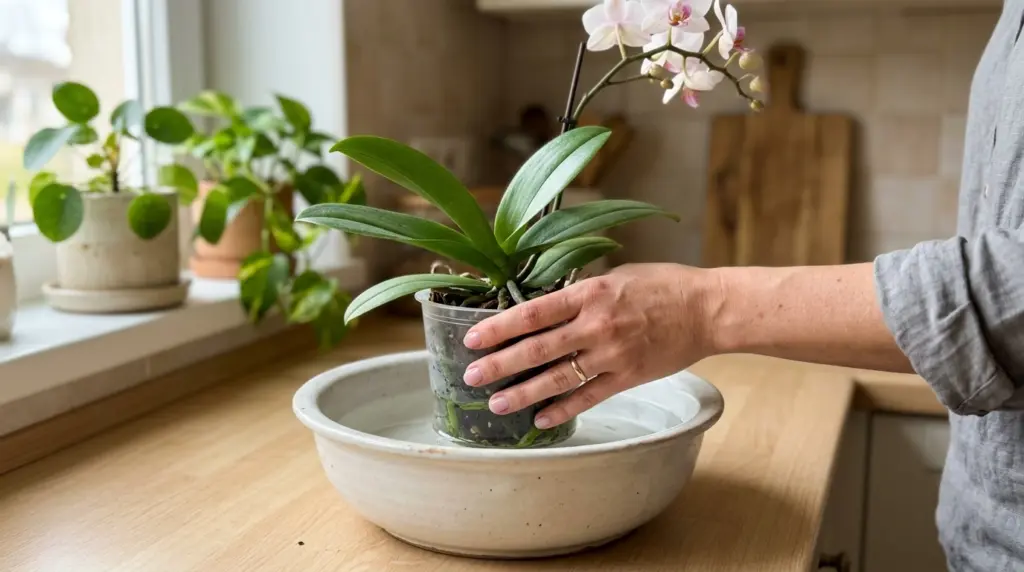
Crown rot in Phalaenopsis: the most serious problem, how to prevent it.
I lost my second cultivated orchid to a problem I wasn't very familiar with at the time: water accumulated in the center of the plant after careless watering, resulting in the crown rotting rapidly without me noticing in time. This is one of the most serious problems a Phalaenopsis can face, and learning how to prevent it became a priority after this painful loss.
What is the crown and why is it so vital to this specific species?
The crown is the central point of growth for Phalaenopsis plants, from which every new leaf emerges, since this species has monopodial growth without a storage pseudobulb, making this single point absolutely essential for the continued survival of the entire plant.
Why is this species especially vulnerable to this specific problem?
Unlike species with pseudobulbs, already detailed in other articles, which have multiple distributed growth points, Phalaenopsis depends entirely on this single crown, so any damage to it represents a much greater risk to the overall survival of the plant.
Water accumulating during watering is the most common cause of this problem.
As I've already detailed in another article about how to water correctly, water that remains stagnant in the center of the leaf rosette, without draining, creates an ideal environment for rotting, especially when combined with cooler temperatures at night.
How to avoid this dangerous buildup in the crown of the plant by watering?
I direct the water towards the surrounding substrate, avoiding pouring it directly into the center of the rosette, and if I accidentally wet that area, I use a soft cloth or paper towel to absorb the excess immediately, without leaving water accumulated for any length of time.
Immersion irrigation, a technique that reduces this risk compared to overhead irrigation.
As I've already detailed in another article about watering techniques, submerging the pot in a basin completely avoids direct contact of water with the crown, making this method safer for those who have faced this problem before or want to prevent it more safely.
The timing of watering is also a factor that influences the risk of this problem.
I prefer to water in the morning, allowing enough time for any residual moisture in the crown to dry completely throughout the day, avoiding leaving the plant with this area wet overnight, when the lower temperature further promotes rotting.
How do I identify early signs of crown compromise before it's too late?
I look for yellowish or grayish discoloration right in the center of the plant, between the base of the newest leaves—a subtle sign that requires regular inspection to be identified before the problem rapidly progresses to a more critical stage.
How do I react immediately to the first suspicious sign in this area?
I remove any water present and apply diluted hydrogen peroxide or cinnamon powder directly to the suspected area, as detailed in another article about natural healing, acting as quickly as possible considering how fast this problem can progress.
Why reaction speed makes all the difference in this specific case.
Unlike another, more gradual problem already detailed in other articles, crown rot can progress alarmingly quickly, sometimes compromising the entire plant in just a few days, making immediate action far more critical than in any other scenario.
What happens if the crown is already completely compromised?
Unfortunately, if the crown has already completely rotted, the plant usually does not survive, since there is no other growth point to replace this unique structure, making prevention and quick action at the first sign absolutely essential.
How do I increase ventilation specifically to protect this vulnerable area?
As I've already detailed in another article about ventilation, good air circulation helps dry any residual moisture more quickly, a point I especially emphasize for plants located in more enclosed environments or with little natural air exchange.
A mistake I've already made was watering it on top of the surface on a cold night without thinking about the risk.
The loss I mentioned happened on a particularly cold night when I quickly watered the plant from above without paying enough attention, leaving water pooled right in the center of the plant. I only noticed the damage days later, too late for any effective intervention.
How I completely adjusted my routine after this painful loss.
I switched to exclusively using immersion watering for all my Phalaenopsis orchids, practically eliminating the risk of this type of accident, a change I consider one of the most important I've ever made to my routine after learning this lesson the hard way.
Recording any suspicious signs in this area in my grow notebook.
I note down in my grow notebook, already mentioned in another article, any suspicious discoloration I notice near the crown, even before confirming a real problem. This record helps me monitor closely and act quickly if necessary.
How do I advise another beginner grower about this specific risk?
I always recommend that those starting out with Phalaenopsis orchids prioritize learning the immersion watering technique from the beginning, since completely avoiding water contact with the crown practically eliminates the risk of this serious and rapidly progressing problem.
I use a small fan to dry the crown faster if it accidentally gets wet.
If I accidentally wet this area while watering, in addition to absorbing the excess with a soft cloth, I direct a small fan to speed up the drying process, further reducing the time the crown is exposed to this potentially dangerous moisture.
How do I monitor my entire Phalaenopsis collection after learning this lesson?
I've included a specific crown check in my weekly inspection, already detailed in another article, paying closer attention to this particular area on each plant of this species, since ongoing prevention has become much more valuable after having already faced this loss in the past.
How do I emotionally cope with the possibility of losing a plant to this problem?
I still remember the frustration and sadness of losing that second orchid early in my growing journey, but I transformed that painful experience into real motivation to teach other growers about this specific risk, hoping that fewer people will have to go through the same difficult learning process I did.
Questions I've been asked about rotten crown
Are Phalaenopsis orchids the only ones affected by this specific problem?
It is more common and more severe in this species due to monopodial growth without a storage pseudobulb, but other species with similar growth patterns, such as Vanda, can also suffer from this same type of crown problem.
Is there any chance of recovery after the crown has already rotted?
It's quite rare, but in very early cases, some growers manage to save the plant by removing the entire affected part and waiting for the unlikely emergence of a new lateral shoot, although this possibility is not guaranteed.
Can I use regular over-the-counter hydrogen peroxide for this treatment?
Yes, low-concentration hydrogen peroxide sold in pharmacies works well when diluted in water before application, being an affordable and effective option to help contain the spread in an emergency situation like this.
Learning about crown rot the hard way taught me the critical importance of prevention in this specific type of problem, showing that some simple care, such as the correct watering technique, makes all the difference between keeping or losing a beloved plant from the entire collection.