Brassavola: the night-scented orchid, cultivation and care.
I received my Brassavola somewhat by chance, included in a swap with another grower I met in an online orchid group. I only realized the true difference of this species on a particular night, when I entered the room and smelled an intense perfume that I didn't recognize, coming precisely from the plant that I had almost forgotten in a corner of the shelf.
Intense nocturnal aroma: the most striking characteristic of this species.
Unlike the more subtle, daytime aroma detailed in another article about Cattleya, Brassavola releases a strong, sweet scent specifically at night, an evolutionary strategy to attract nocturnal pollinators like moths, which are much more active after dark.
Cylindrical leaf that visually distinguishes this species.
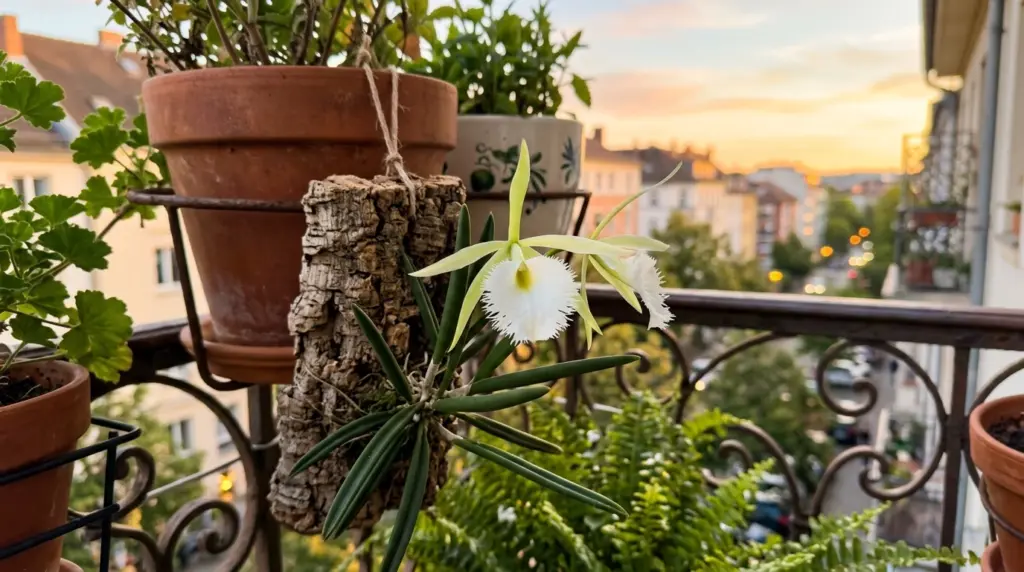
Unlike the flat leaves of most orchids already detailed in other articles, Brassavola has cylindrical and succulent leaves, an adaptation that helps retain water and reveals its natural tolerance to drier periods between rains in its native habitat.
I follow a watering routine that respects the succulent nature of the leaf.
I let the substrate dry completely between waterings, an interval even longer than I detail in another article about Cattleya, since the cylindrical leaf of the Brassavola acts as an additional water reserve, tolerating this longer dry period well.
Intense light is what this species requires to bloom well.
Brassavola needs quite intense light, similar to what I detailed about Vanda in another article, being one of the most demanding species in this aspect among those I have cultivated, directly reflecting its origin in an environment well exposed to the sun.
Where do I position my Brassavola to meet this need?
I keep it on a sunny balcony, similar to the spot reserved for my Vanda orchid, which I've detailed in another article, ensuring the necessary intensity for the plant to develop quality flowers and not just produce leaves without blooming.
Loose substrate that promotes the rapid drying that this species needs.
I use coarse-grained pine bark, even looser than what I detail in another article about substrate for Cattleya, prioritizing rapid drainage and ventilation around the root, compatible with the complete drying cycle that Brassavola tolerates so well.
Characteristic flower shape, with thin, elongated petals.
The Brassavola flower has a narrow, elongated petal, usually greenish or cream-colored, with a large, prominent white labellum, a shape quite different from the more rounded Phalaenopsis flower, already detailed in another article.
How can I best take advantage of the nighttime aroma of this species at home?
I place my Brassavola near a room where I usually spend time at night, like the living room, precisely to take advantage of the more intense scent it releases after dark, a detail that makes all the difference considering that this is when the aroma really stands out.
Fertilization that I adjust for this vigorously growing species.
I follow the general principle already detailed in another article on fertilization, applying it regularly during the active growth phase, since Brassavola usually responds well to a constant supply of nutrients when exposed to intense light that stimulates this more vigorous growth.
The ease of cultivation surprised me after the uncertain start.
Despite its need for intense light, I discovered that Brassavola is surprisingly tolerant of other care lapses, recovering well from occasional periods of neglect—a resilience that contrasts with the more delicate sensitivity already detailed in another article about Miltonia.
How I attach my Brassavola to a wooden board, an alternative growing method.
I've tried attaching a Brassavola directly to a wooden plaque with some moss around the root, a mounted method similar to the one I detailed for Vanda in another article, which works well for this species thanks to its high tolerance to dry periods between waterings.
Difference between conventional pot cultivation and mounted cultivation in this species
In a mounted grow setup, I need to water a little more frequently, since there's no substrate retaining any moisture, but in return, the ventilation around the root is even better, significantly reducing the risk of rotting even with the more frequent watering required.
Combining Brassavola with Vanda and Cattleya in the same area of intense light.
I follow the same principle already detailed in another article about organizing routines, grouping Brassavola with other species that have similar high light requirements, making it easier to maintain this more demanding group together within the entire collection.
I made a mistake in the past by underestimating this species' need for light.
When I first received my Brassavola, I placed it in a corner with moderate light, similar to what I provide for Phalaenopsis orchids, and the plant simply didn't flower for almost a whole year, until I noticed and moved it to a location with considerably more intense light.
Result after correcting the light positioning.
A few months after moving to a sunnier location, my Brassavola finally produced its first flower spike, confirming that the lack of sufficient light was indeed the limiting factor preventing flowering up to that specific point.
Recording the time of day when the aroma is most intense in my grow notebook.
In my grow notebook, already mentioned in another article, I note the approximate time when I perceive the strongest aroma of Brassavola, a curious record that helps me plan when to be around to better enjoy this very particular sensory aspect of this species.
Generous ventilation is something this type of cylindrical leaf also appreciates.
As I've already detailed in another article about ventilation, this care is important for any orchid, and in the case of Brassavola, often grown mounted or in a very loose substrate, constant air circulation further reinforces the rapid drying that already favors the health of the exposed root of this species.
How does Brassavola compare in overall quality to the rest of my collection?
After adjusting the lighting conditions, I realized that Brassavola actually requires less daily attention than species like Miltonia or Vanda, which have been detailed in other articles. Simply ensuring bright light and a spaced-out watering cycle is enough for it to thrive relatively easily within an established weekly routine.
Questions I've been asked about Brassavola
Is Brassavola a good choice for those who like fragrant orchids?
Yes, it's an excellent choice precisely for that reason, although the scent is concentrated in the nighttime, unlike the more daytime perfume already detailed in another article about Cattleya.
Is it possible to grow Brassavola indoors in an apartment without a balcony?
It's challenging without a very intense light source, since this species really needs strong exposure to bloom, so I recommend considering supplemental artificial light, already detailed in another article, if there's no outdoor area available at home.
Is there a risk that nighttime odors could be too strong in a bedroom?
It might be too intense for some people who are more sensitive to perfume while sleeping, so I recommend placing it in a common area, like the living room, instead of the bedroom, so you can enjoy the scent without it becoming bothersome during the night.
Growing Brassavola introduced me to a sensory dimension of the orchid that I hadn't yet fully explored, showing that its nocturnal aroma can be just as striking as any more obvious visual characteristic of the flower.