How to water orchids without rotting the roots: the method I've used for years.
My first orchid, a white Phalaenopsis that I received as a gift, died of root rot in less than three months. At the time, I watered it like I did any other houseplant, a little water every day, without understanding that orchids have a completely different relationship with water. It was a shock that made me study the subject in depth, and today, with dozens of plants at home, I have a watering method that rarely fails.
Why do orchids rot when watered too frequently?
In nature, most orchids grown at home, such as Phalaenopsis, grow attached to tree branches, with their roots exposed to the air, receiving water only when it rains and drying out quickly afterward. Soaked substrate for prolonged periods suffocates the roots, which need oxygen as much as water, and this is what causes rotting.
How do I know when it's time to water, without relying on a fixed schedule?
I never water on a fixed day of the week. Instead, I observe the substrate and the weight of the pot—when the pine bark or substrate used is visibly dry and the pot feels much lighter to the touch, it's a sign that it's time. This sensory method has completely replaced any rigid schedule I tried to follow at the beginning.
The immersion method I use on most of my plants.
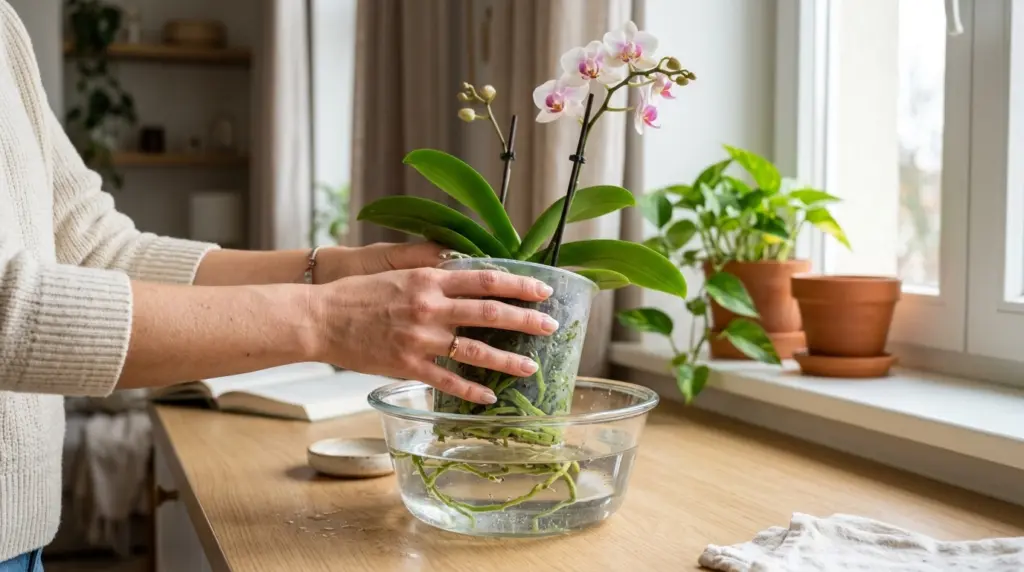
I submerge the entire pot, with the drainage hole, in a basin of water for about ten to fifteen minutes, allowing the substrate to absorb water evenly and completely. Then, I remove it and let all the excess drain before returning the plant to its usual place, never leaving standing water in the saucer or cachepot.
Why I never leave standing water in the cachepot or saucer.
Water accumulating at the bottom of a decorative cachepot, even if the inner pot has a drainage hole, keeps the base of the root in constant contact with moisture, recreating exactly the condition that causes rot. I always drain it well and, if I use a cachepot without a hole, I remove the residual water manually after each watering.
Difference between watering from above and watering by immersion.
Watering from above, pouring water directly onto the substrate, is faster, but it usually waters unevenly, leaving part of the substrate still dry while another part is already soaked. Immersion ensures much more uniform hydration throughout the root system, a detail that made a real difference in the health of my plants after I changed my habit.
Frequency I actually use, station by season.
In the summer, with the heat and drier air, I water every five or six days. In the winter, the substrate takes much longer to dry, sometimes ten days or more, so I respect this slower pace instead of forcing a fixed frequency that would only make sense in a specific season.
Because the type of substrate changes the watering frequency.
Coarse pine bark substrate dries out faster than sphagnum moss, which retains moisture for longer. I've completely adjusted my watering routine by changing the substrate for a specific plant, learning that each material requires a different watering schedule.
Visual sign that the root is well hydrated.
Healthy Phalaenopsis roots turn greenish right after watering, and lighten to a grayish-green or silvery color as they dry. I learned to use this color change as a direct visual indicator, without needing to touch or guess just by the weight of the pot.
A mistake I've made before: using ice water straight from the refrigerator.
During a time when I was trying to save time, I used ice water stored in the refrigerator to water my plants, and I noticed that some reacted badly, with flowers dropping faster than normal. Today I always use room temperature water, avoiding this unnecessary thermal shock to the roots.
How do I adjust watering right after repotting?
After repotting, as detailed in another article, I wait a few days before the first full watering, allowing time for any roots damaged during the process to heal, reducing the risk of fungal infection entering through a still-fresh cut.
Watering multiple orchids at the same time without losing control.
With a larger collection, I separate the plants into groups with similar needs, watering all those in the same group on the same day, instead of trying to remember each pot individually. This simple organization has prevented both forgetfulness and overwatering, which has happened before when I tried to manage everything from memory.
Difference in watering needs between Phalaenopsis and Cattleya.
While Phalaenopsis orchids tolerate more frequent watering cycles well, Cattleya orchids, already detailed in another article about species, prefer to dry out almost completely between waterings, since their pseudobulbs act as a natural water reserve. Confusing this watering schedule between the two species was a mistake I made in the past, watering Cattleya orchids with the same frequency as Phalaenopsis and compromising the health of their roots.
How the plant's position in the home influences watering frequency.
A plant near a window with plenty of light and ventilation dries out the substrate much faster than a plant in a more protected and shaded corner of the apartment. I adjust the watering frequency of each pot individually considering this specific position, instead of applying the same rule to the entire collection just because they are of the same species.
Testing the substrate with your finger before deciding to water.
In addition to assessing the weight of the pot, I gently insert my finger between the layers of the substrate, feeling if there is still moisture in the inner layers, not just on the visible surface. This simple test avoids the mistake of assuming the plant has already dried out just because the top layer looks dry, when the center of the pot is still quite moist.
Take extra care when watering on very hot or very cold days.
I avoid watering during the peak midday heat on very hot days, preferring early morning or late afternoon, when the water has more time to be absorbed before more intense evaporation. On very cold days, I also avoid watering late at night, giving the substrate time to partially dry before the temperature drops even further during the night.
Recording the date of each watering so as not to lose track.
I keep a small log, either physical or on my phone, noting the date of the last watering of each plant or group of plants. This simple record eliminates the doubt of "did I water them this week?", a mistake that easily happens when the collection grows beyond just a few plants in the living room.
Questions I've been asked about watering orchids.
Can I water orchids with ice, as some tutorials suggest?
I don't recommend it — besides the thermal shock that very cold water can cause to the roots, this method doesn't guarantee the uniform hydration that immersion provides, making it more of a convenient solution than something truly ideal for the plant.
How do I know if I'm underwatering instead of overwatering?
Wilted or wrinkled leaves, even when the substrate is still moist, may indicate that the root system is already compromised and unable to absorb water — in this case, the problem may have started with previous overwatering, not with a current lack of water.
After losing my first orchid due to incorrect watering, I understood that patience and observation are worth much more than any fixed calendar rule — each plant and each environment requires its own watering rhythm.