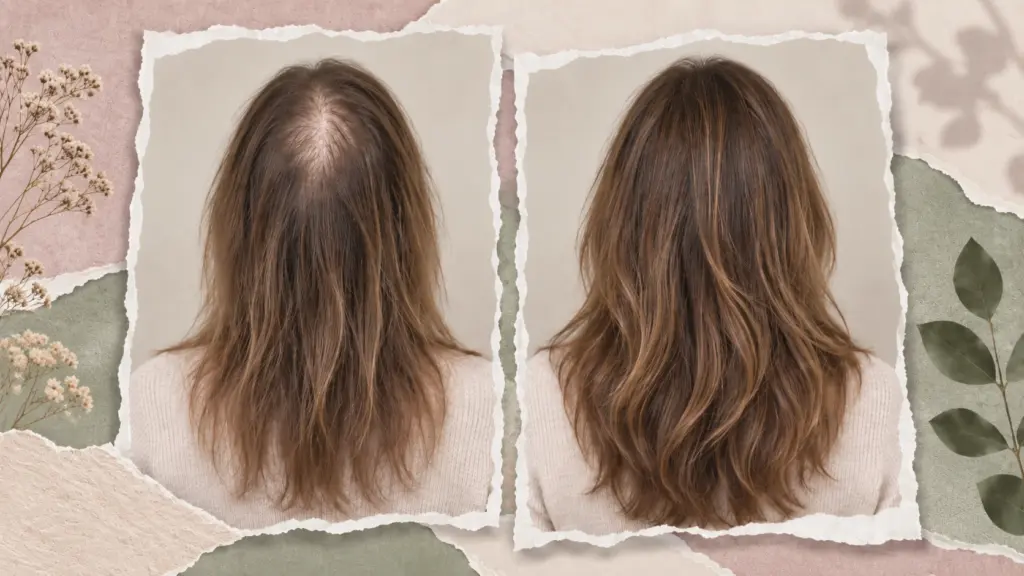
Hair loss? See how to treat it.
A few consistent precautions tend to work better than overdoing it in your routine.
Understand when this perception may be linked to hair thinning and when it's worth evaluating the situation more carefully.
SEE WHEN TO INVESTIGATE ➜Simple routine with rosemary
A practical way to include rosemary in your hair care routine is to dilute a small amount of essential oil in a carrier oil suitable for cosmetic use. The goal here is to create a light and simple treatment for the scalp, not an aggressive mixture.
Ingredients
- 1 tablespoon of carrier oil, such as jojoba, fractionated coconut, or grapeseed oil.
- 2 to 3 drops of rosemary essential oil.
How to prepare
Mix the ingredients in a small, clean container and prepare only the amount that will be used for the application at that moment.
How to apply
Separate your hair into sections and spread small amounts of the mixture onto your scalp. Then, gently massage with your fingertips for a few minutes.
Avoid using your nails and do not rub vigorously. Then, leave it on for a short period if desired and wash normally.
How often to use
A simple frequency, such as 1 to 2 times per week, is usually more realistic than overdoing the applications. More quantity or more frequency does not necessarily mean better results.
Test on a small area first.
Before using on a larger area, it's advisable to test it on a small patch of skin. If you experience severe burning, redness, significant itching, or persistent discomfort, discontinue use.
If your hair has lost density
When hair appears thinner, it's worth noting whether the change is concentrated around the part, the top of the head, or if the overall volume of the hair length has also decreased.
This perception may be related to thinner hair strands, greater visibility of the scalp, or a decrease in the overall volume of hair.
Tips to help preserve visual volume.
- Avoid wearing hairstyles that are too tight for extended periods.
- Reduce intense sources of heat.
- Untangle your hair more gently.
- Avoid successive chemical treatments without a break.
- Observe the evolution with photos taken under similar conditions.
If your hair is falling out more
When the main sign is seeing many strands of hair coming loose, it's worth noting if this happens in the shower, while combing, on the pillow, or when running your hand through your hair.
It's also helpful to consider if there have been any significant changes in recent months, such as stress, illness, a very restrictive diet, or hormonal changes.
Avoid aggravating the manipulation of the threads.
While observing the situation, try to reduce aggressions that could increase the risk of breakage and make it difficult to accurately assess the fall.
- Don't brush repeatedly just to check if it's still falling out.
- Avoid tying up wet hair too tightly.
- Reduce excessive friction with a towel.
- Detangle starting from the ends.
- Use less heat while your hair feels more fragile.
The scalp can provide clues.
If hair loss is accompanied by itching, pain, unusual oiliness, redness, or flaking, this may indicate that the scalp needs more attention. In these cases, the best approach is not always to rely solely on home remedies.
Don't change your entire routine all at once.
When many things change at once, it becomes difficult to understand what helped and what worsened. Try to make only a few adjustments and observe your hair calmly over the weeks.
Sleep, diet, and stress all factor into the equation.
Hair loss isn't just a matter of product. The body as a whole influences the hair growth cycle. Poor sleep, periods of intense stress, and a very poor diet can all contribute to this.
Therefore, a broader perspective is often more useful than seeking a single, immediate solution.
When is it worth investigating further?
Some situations warrant dermatological evaluation instead of relying solely on home observation.
- Localized bald patches on the scalp.
- A very intense fall or one that occurred suddenly.
- Progressive and clear loss of density.
- Intense itching, pain, or persistent burning sensation.
- Significant peeling or signs of inflammation.
- No improvement even with a more careful routine.
An organized routine helps more than exaggerated promises.
The best use of a simple rosemary recipe is as part of a more conscious care routine for the scalp and hair. It's not a promise of immediate regrowth or a universal solution for all types of hair loss.
When your routine is light, consistent, and combined with observing your own hair, it becomes easier to understand if it makes sense for you.
FAQ
Can I use pure rosemary essential oil on my scalp? It's not ideal. It's always safer to use it diluted.
How much to use? A simple mixture can use 2 to 3 drops of essential oil in a tablespoon of carrier oil.
Are hair loss and thinning hair the same thing? No. Hair can appear thinner due to thinning, breakage, or decreased density, in addition to actual hair loss.
Can I use it every day? It's not necessary. A more moderate frequency is usually more suitable.
Does a rosemary hair care routine make hair grow immediately? It shouldn't be viewed that way. It's a complementary treatment, not a promise of immediate results.
If I see hair in my brush, should I be worried? Not necessarily. It's worth observing if there has been a persistent increase in hair compared to your usual pattern.
What can worsen the appearance of hair density? Breakage, excessive heat, tight hairstyles, frequent chemical treatments, and hair fragility.
When should you see a dermatologist? When hair loss is intense, sudden, persistent, or accompanied by bald patches and symptoms on the scalp.