Signs that your orchid is happy: what to look for in the roots and leaves.
After years of observing my orchids almost daily, I've developed a kind of visual vocabulary to quickly understand how each plant is feeling, without having to wait for a serious problem to appear before taking action. Here I share the signs I've learned to recognize, both the good ones and those that require attention.
Firm, greyish-green roots: the most reliable sign of health.
A healthy Phalaenopsis root usually has a greenish hue right after watering, lightening to a silvery gray as it dries, always remaining firm to the touch. This color variation cycle is, for me, the most reliable indicator that everything is alright.
New root tip, light green and shiny.
A new root tip growing, usually in a lighter green with a characteristic sheen, is one of the most encouraging signs I've ever learned to recognize, indicating that the plant is actively developing and responding well to its current environment.
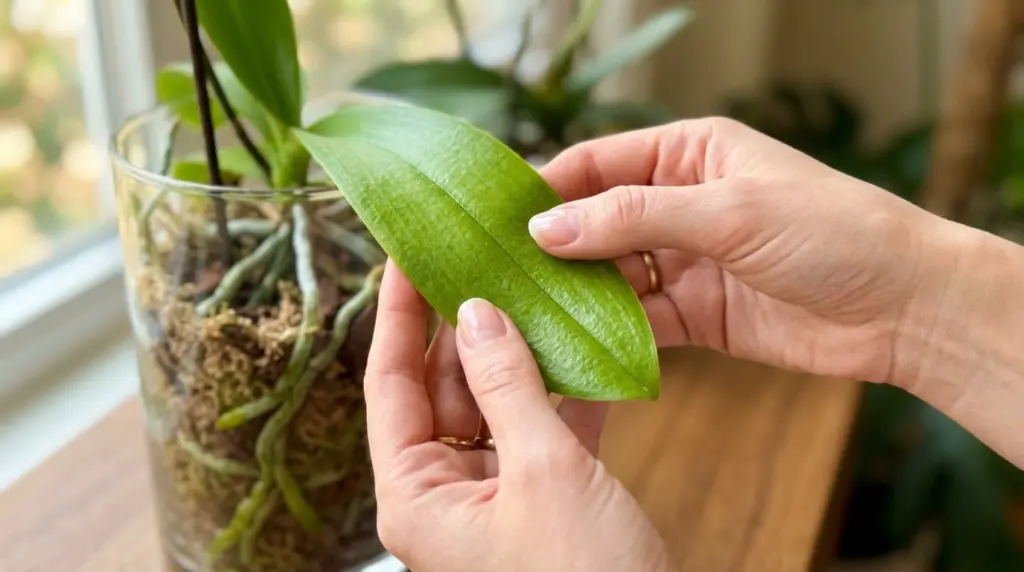
Firm, slightly arched leaf
A healthy leaf usually has a slight natural curve, is firm to the touch, and doesn't wilt or wrinkle. I've learned to differentiate this healthy curve from a truly limp leaf, a sign that usually indicates a root problem or insufficient moisture.
A balanced shade of green, neither too dark nor too light.
I've already detailed in another article about light that very dark leaves can indicate too little light, while yellowish leaves can indicate too much. The ideal shade is somewhere in between, a vibrant green but not excessively dark, a sign that the amount of light received is balanced.
Firm crown, with no visible water accumulation.
The crown, the central point where new leaves emerge in species like Phalaenopsis, should always be dry and firm, without any visible standing water. Stagnant water in this specific area is one of the most serious risks, and can lead to fatal rotting in a short time if not corrected.
A new flower stalk is emerging at the expected time.
Seeing a new flower stalk emerge, usually after the temperature boost detailed in another article, is one of the most rewarding signs that all the other care—watering, light, fertilization—is working together in a balanced way.
Flower stays open for a long time.
A healthy orchid usually keeps its flowers open for weeks, sometimes months, depending on the species. Very early flower drop, earlier than expected for that specific variety, may indicate some environmental stress that is worth investigating.
Warning sign: wilted and wrinkled root, but still greenish.
Wilted roots, but still with some greenish color, usually indicate recent dehydration, a sign that watering is overdue, not necessarily a more serious problem. I usually solve it simply by adjusting the watering frequency, as detailed in another specific article.
More serious warning sign: brown and soft roots
Dark brown roots, soft to the touch, usually already dead or rotten, are a more serious sign that often indicates prolonged overwatering. In this case, I assess the extent of the damage and, if necessary, prune the affected root during the next repotting.
How do I do a quick weekly check of the entire collection?
I set aside a few minutes each week to go over each plant, quickly observing the root, leaf, and crown, looking for any changes since the previous check. This simple habit allows me to identify problems early on, when they are still easy to correct.
How I use photography to track evolution over time.
I periodically take photos of each plant, especially of the root visible through the transparent pot, as detailed in another article, creating a visual record that helps me objectively compare its evolution over weeks or months, instead of relying solely on memory.
Leaf texture: beyond color, what does touch reveal?
In addition to visual inspection, I lightly touch each plant leaf during my weekly check, feeling whether the firmness is normal or more limp than usual. This tactile test, combined with visual observation, helps identify early stress before it becomes visually obvious to anyone just glancing at the plant.
Natural leaf shine as an indicator of overall health.
Healthy leaves usually have a subtle natural sheen, without appearing dull or lifeless. I've noticed that this sheen visibly diminishes when the plant is experiencing some kind of stress, whether from inadequate light or insufficient nutrition, serving as another complementary sign to those I've already mentioned.
How the appearance of keiki indicates plant vigor.
Keiki, the small shoot that some orchids naturally produce, usually on the already withered flower stem, is a clear sign that the mother plant has plenty of energy, capable of investing in vegetative reproduction in addition to its own maintenance. I have seen this phenomenon occur in particularly well-established plants in my collection.
Comparing the growth rate between plants of the same species
When I have more than one plant of the same species, I compare their growth rate, since this direct comparison reveals more than evaluating an isolated plant without reference. If one is visibly lagging behind the others under the same conditions, it's a sign that something specific about that pot or position deserves extra attention.
Recording the observed signs in my tracking notebook.
In addition to the periodic photos already mentioned, I write a brief note in my grow notebook whenever I notice something different in a specific plant, whether positive or negative. This combined record of image and text has created, over the years, a fairly complete history that I consult whenever I need to compare the current behavior of a plant with what I have experienced before in a similar situation.
How do I teach someone else to recognize these signs for the first time?
When I help someone who is starting to grow orchids, I show them side-by-side a healthy root and a compromised one, if I have an example available in my collection, since direct visual comparison teaches much faster than just verbally describing the difference. I recommend that any beginner take the time to carefully observe a clearly healthy plant before even worrying about identifying a problem.
How does the change of season affect the signals I observe?
During their dormant period, usually near winter, some species naturally reduce visible growth, which shouldn't be mistaken for a sign of a problem. I've learned to adjust my expectations according to the season, recognizing that a temporary pause in growth is normal behavior, not a cause for immediate alarm.
Relying on accumulated experience rather than a fixed, generic rule.
Over time, I realized that getting to know each plant individually, its own rhythm and its particularities, is worth more than applying a generic rule that's the same for the entire collection. Each orchid develops a unique pattern according to the specific environment in which it lives, and continued observation is what truly teaches you to differentiate normal variation from a real warning sign.
Questions I've been asked about signs of orchid health.
Do I need to worry if a specific root dies, but the others are fine?
Not necessarily — it's normal for an older individual root to eventually die naturally, as long as the rest of the root system remains healthy and the plant continues to produce new roots.
Is a falling leaf always a sign of trouble?
An older leaf at the base of the plant falling off naturally after years is part of the normal life cycle, unlike several leaves falling off rapidly, which does warrant closer investigation.
Learning to read these signs is what gave me the most confidence in growing orchids, transforming daily care into attentive observation instead of an anxious routine full of doubt about whether I'm doing the right thing or not.