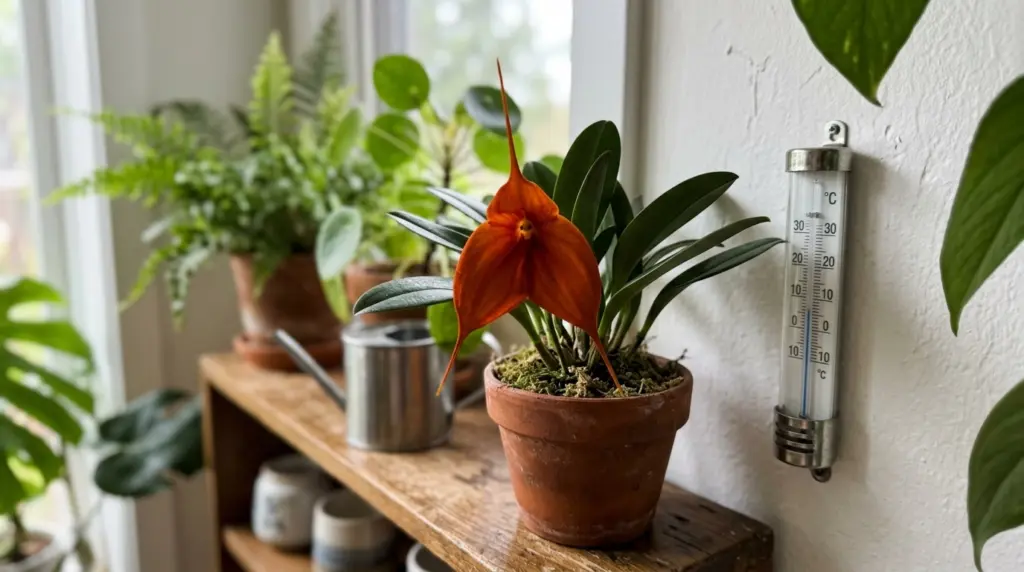
Masdevallia: vibrant triangular flower, cultivated in a cool environment
Masdevallia has a reputation that hinders more than it helps: "a difficult orchid, only for those with air conditioning." The part about temperature is true, but incomplete—and this reputation leads many people to buy thermometers and continue to misunderstand what actually kills the plant, which is the water quality and substrate density. It's worth understanding the genus by its origin, because almost all cultivation requirements are deduced from there.
Where she comes from, and why, determines everything else.
Masdevallia is a large genus. Kew's Plants of the World Online accepts 659 species, distributed from Mexico to Brazil, with a strong concentration in the Andes—Colombia, Ecuador, and Peru. The recorded altitude range is wide, from about 130 to 3.800 meters, which explains why there is so much variation in requirements within the same genus.
Most of the species that reach domestic cultivation, however, come from the upper part of this zone: the Andean cloud forest, above 1.500 meters. There, the air is permanently humid, fog passes almost every day, the temperature fluctuates little, and there is no real dry season.
A plant that evolved in this environment didn't need to develop a water reserve—which is why Masdevallia doesn't have a pseudobulb . Without this reservoir, there's no plan B: if the substrate dries out, there's nowhere to draw water from. It's the opposite of Cattleya, which can withstand weeks of drought in its pseudobulb. Saving water solves half the cultivation doubts—when you're undecided about something, the useful question is "what would happen to this plant on a slope at 2.500 meters with fog?".
The temperature range, according to those who publish cultivation data sheets.
The American Orchid Society's cultivation guidelines are straightforward on this point, and it's worth correcting a common myth: what the plant needs is a relatively constant temperature , not a dramatic drop between day and night.
| Condition | Reference | What to watch out for |
|---|---|---|
| Ideal Range (AOS) | 12,7 to 22,2 ° C | It works for most species of the genus. |
| Night | lower part of the track | Fresher than the day, without needing a shock. |
| Stress zone | above ~25 °C | Growth halts, bud dries before opening. |
| Light (AOS) | ambient light up to 2-3 hours of direct sunlight | Most do well with 2-3 hours of direct sunlight. |
The key detail about the upper limit is that it's not about averages, it's about peak temperatures. An afternoon of 30°C does more damage than an entire week at 24°C. The quickest sign that things have gone too far is the flower bud drying out before opening—when that happens, what you should look for is what got too hot, not what lacked water.
Regarding lighting, a necessary adjustment: American guidelines recommend a north-facing window for less direct sunlight. In the Southern Hemisphere, this is reversed—here, the window with the least sun is the south- facing one , and the north-facing one is the strongest. Misinterpreting this is a common way to burn paper even when following the correct instructions.
The water brings down more Masdevallia than the heat.
This is the part that almost never appears on "orchid for beginners" lists, and it's where the real problem lies. Masdevallia orchids, like the rest of the Pleurothallidinae alliance, are sensitive to accumulated mineral salts. In the cloud forest, the plant receives rainwater and condensation—practically distilled water. Treated tap water carries chlorine, fluoride, and dissolved salts that concentrate in the substrate with each watering.
In practice: rainwater is the first option, and reverse osmosis filtered water is the second. As a quality reference, the cultivation of sensitive species usually works with water below 100 to 150 ppm of dissolved solids — an aquarium TDS meter is inexpensive and resolves the doubt. If the local water is hard, it's worth measuring before blaming the climate.
The symptom of salt buildup is characteristic and easy to confuse: the leaf tip burns and darkens, starting with the older leaves . It is very similar to fungal damage, and the treatment is completely different — wash the substrate with good water in sufficient volume and change the medium, do not apply fungicide.
Regarding frequency: the substrate never dries out completely. This doesn't become a fixed schedule, because it depends on the pot, substrate, and ventilation — it becomes a habit to stick your finger between the bark and feel if there is still moisture in the middle of the pot, not just on the surface.
High humidity calls for ventilation in the same proportion.
High relative humidity is a real requirement for this genus — the range cited in cultivation literature is around 70 to 90%, and below 60% for too long the plant stunts growth and the bud dries out. But there's a built-in trap: high humidity with stagnant air rots the roots in a substrate that never dries out.
The two things go hand in hand. Every time the humidity increases, the air circulation must increase accordingly. A small fan at low speed, pointed at the wall and not at the plant, does the job without drying out the leaves.
Thin substrate and more frequent repotting than expected.
Pure sphagnum moss works well for small seedlings; for adult plants, a mixture of fine pine bark with perlite and a little sphagnum moss is better. Coarse bark is not suitable: it dries out too quickly and leaves large gaps where the fine root system cannot take hold.
Small pot, always smaller than seems necessary. The root system is thin and the whole system is compact — a large pot means a lot of wet substrate without roots to occupy, and then it rots.
Annual repotting , or when the sphagnum moss starts to become mushy. This is more frequent than with most house-grown orchids, and it's intentional: old, decomposed substrate retains precisely the salt that the plant doesn't tolerate. The best time is right after flowering, never when the bud is still on the plant.
Three species to start with, and the one that is most forgiving.
Masdevallia tovarensis is the recommended variety for those new to the genus. It tolerates slightly better heat than others, produces white flowers in clusters of three to five per stem—unlike most of the genus, which produces one flower per stem—and blooms at the end of the year.
And there's a particularity worth knowing before making the mistake: don't cut the stem after the flower falls . The *Phalaenopsis tovarensis* will rebloom on the same stem in subsequent years. Those who come from Phalaenopsis orchids cut it out of habit and miss the season.
Masdevallia veitchiana is the most spectacular: intense orange covered in tiny purple papillae, which create a shimmering effect when exposed to light. It is Peruvian, from the Machu Picchu region, and requires a cool night.
Masdevallia coccinea has large flowers, in red, magenta, or white, on a tall stem. It's Colombian, thrives at high altitudes, and is the least heat-tolerant of the three—best left for after you've properly prepared the environment with a tovarensis.
Growing crops in warm climates: what works and when to give up.
Living in a hot place doesn't prevent cultivation, but it does require creating a microclimate. In order from cheapest to most expensive: a bathroom with a window is usually the most humid and coolest room in the house; a tray with moist expanded clay under the pots retains local humidity; and, in the coldest months, a room with air conditioning around 20°C during the afternoon. Those who cultivate in quantity opt for a climate-controlled wine cellar or a small greenhouse with an evaporative cooler.
But let's be honest: those who live in tropical climates without any of these options are better off starting with another genus. Without the lower part of the temperature range at night, the Masdevallia survives for a while and never blooms—and that frustrates more than it teaches. I wouldn't recommend it to someone who is starting out with orchids and doesn't have a way to control the heat.
The summary I would give to someone buying their first copy...
Address the water issue before addressing the thermometer. Most people arrive at Masdevallia worried about the heat, buy a thermometer, measure the ambient temperature—and continue watering with hard water, watching the plant slowly decline for no apparent reason.
Good quality water, fine substrate changed every year, stable temperature within the correct range, and air circulation. All four together, because none compensates for the lack of another. It is the genus that least tolerates improvisation—and, in return, it produces the most unusual flower one can have indoors.