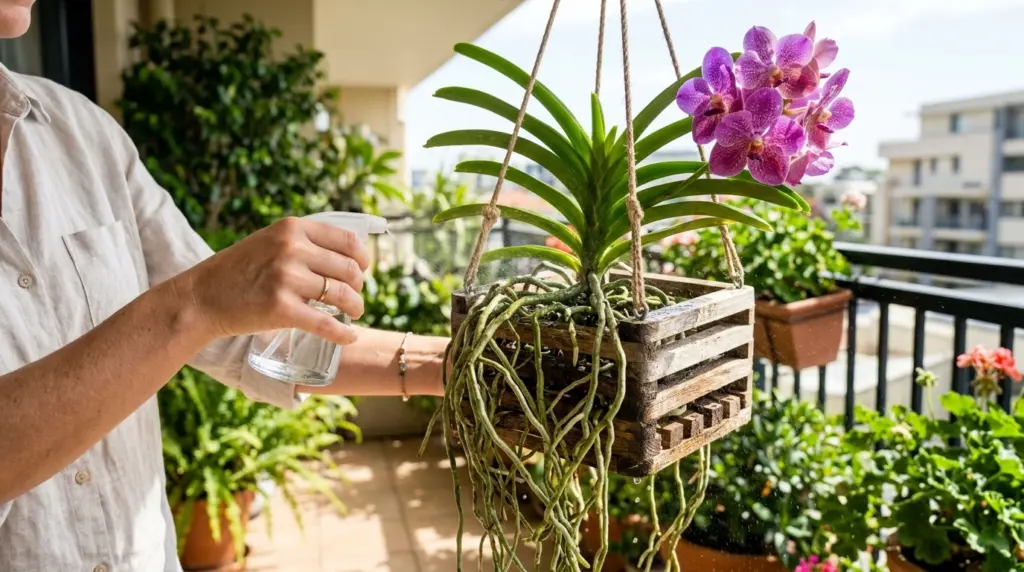
Vanda: the exposed-rooted orchid that requires more water and light.
Vanda is the orchid that is grown hanging, with its bare roots exposed to the air, without a pot or any substrate. For those who came to orchids through Phalaenopsis, it seems to contradict everything—but it is the most consistent genus in the group: it is the one that requires the most light, the most water, and the most heat, and the exposed roots are precisely what makes this possible.
The most popular orchid of all, the one that needs the most light.
The American Orchid Society's growing guidelines indicate 50 % to 100% full sun, or above 53.750 lumens (5.000+ foot-candles) . To give you an idea: that's more than double the amount needed for a Cattleya (2.000-3.500 foot-candles) and about five times the amount needed for a Phalaenopsis (1.000-2.000 foot-candles).
This puts the Vanda orchid out of reach for almost all indoor cultivation. It's a plant for uncovered balconies, backyards, rooftops, or greenhouses—not for indoor spaces. The plant's own information sheet states that in regions below the 37th parallel, 25% to 35% shade may be necessary, which applies to much of Brazil in the summer: full sun all day long can burn it here.
Heat: the most tolerant of the group.
| Condition | Track (AOS) |
|---|---|
| Night | 12,7 to 22,2 ° C |
| Day | 21,1 to 35 ° C |
| Maximum tolerance | to 41 ° C, with humidity and air circulating |
Those 41°C are the highest extreme among commonly cultivated orchids, and that's what makes Vanda a logical choice for hot tropical climates. It's the exact opposite of Cymbidium, which refuses to bloom if it exceeds 23,8°C at any time. Those who live in hot cities and constantly struggle with the temperature have here a genus that works in favor of the climate instead of against it.
Water daily, that's it.
The instructions on the label are straightforward: in a greenhouse, water daily , regardless of whether the plant is in a pot, basket, or mounted. This is neither excessive nor lenient—with bare roots, the only available water is what remains in the spongy root coating after watering, and this is depleted within hours.
This is the requirement that eliminates the most candidates for the genus. Vanda doesn't forgive weekends away. Those who travel frequently and don't have anyone to water their plants are better off choosing a genus with a pseudobulb, like Cattleya, which stores water for weeks.
How to identify the right time: hydrated Vanda roots turn green; as they dry, they become silvery-gray. When they are all silvery, it's time. Always use lukewarm water — the instructions warn that temperatures below 10°C can harm the plant.
Growing without substrate, and a detail of the Epsom salt.
Vanda orchids can be grown without any substrate , hung in a perforated basket, or mounted. If potted, the recommendation is medium to coarse-grained bark — and the instructions are explicit: sphagnum moss is not necessary . Sphagnum moss retains water for too long near the roots of Vanda orchids and causes them to rot.
One little-mentioned detail worth knowing: for bare-root plants, the AOS recommends occasional bathing in an Epsom salt solution, about once a month . Epsom salt is magnesium sulfate, and the logic is that those who cultivate without substrate have no nutrient reserves in the medium—each element must be replenished by the water. It's the kind of detail that only appears in substrate-free cultivation and doesn't make sense in a regular pot.
Fertilize at half to a quarter of the normal dose, regularly during active growth, using a balanced 20-20-20 formula. Reduce or stop fertilization in winter. A phosphorus-rich formula is optional in spring to stimulate flowering.
The three types of leaves, and why this changes the sun requirement.
Within the genus there are three leaf shapes, and they are not merely an aesthetic detail — they indicate how much light the plant can tolerate.
Cylindrical-leaved plants , called teretes, require the most sun: they are plants originating from open environments, grow tall, and are the least suitable for cultivation in small spaces. Flat, ribbon-leaf plants , called strap-leaf, are the most common in the market and tolerate some shade. Semi-teretes are hybrids between the two groups and fall in between, both in shape and requirements.
If you have a balcony with partial sun instead of full sun, a strap-leaf has a real chance and a terete probably won't bloom. That's the first thing I would look at before buying.
The exception that tolerates mild weather.
It's worth getting to know Vanda coerulea , because it defies the typical profile of the genus. It's a blue-lilac checkered flower species, originating from high altitudes in Southeast Asia, and therefore tolerates cooler temperatures than common tropical Vandas.
It is also the genetic basis for a large portion of the blue hybrids on the market—and these hybrids inherit some of this tolerance. For those who live in regions with colder winters and want to cultivate Vanda orchids, this is the approach worth exploring, rather than insisting on a strictly tropical species.
Aerial roots: do not cut, do not bury
Vanda orchids produce long roots that grow in all directions, and the temptation to organize them is great. Two things you shouldn't do: cut healthy roots, because that's where all the plant's ability to absorb water and nutrients is concentrated; and try to put aerial roots inside a pot with bark, because roots that have formed in the air have a different structure and rot when confined in a humid environment.
A dry, hollow root that is brittle and lacks the green coating inside can be removed. The question is resolved by watering: a live root turns green, a dead root remains beige.
How to properly water a plant without a pot
"Watering" a bare-root Vanda orchid is not the same as watering a potted plant, and that's where most people go wrong by doing too little.
Spraying won't work. What works is soaking the roots until they change color —from silvery-gray to green—and that takes longer than it seems. With a watering can, this means repeatedly running water over the root mass for one or two minutes, not a quick jet. Many people prefer to submerge the entire plant in a bucket for ten to fifteen minutes, which ensures even hydration.
The key point to consider when soaking the plant is the water that accumulates between the leaves afterward. Vanda orchids have leaves arranged in rows, and stagnant water in these leaf axils in an unventilated environment will rot the growing points. After soaking, tilt the plant to allow the water to drain.
On very hot and dry days, watering twice—in the morning and late afternoon—is not excessive. It's the only popular species where this can be considered a normal routine.
Leaf drop at the base is normal, up to a certain point.
Vanda orchids grow vertically, forming a single stem that grows upwards, and naturally lose their lower leaves over time. Losing a basal leaf occasionally, already yellowed, is normal.
What is not normal is losing several leaves in a row, or losing leaves that are still green. This usually points to two things: persistent dehydration — the root is not being watered enough, which is common when spraying instead of soaking — or rot in the stem, which appears as a dark, soft area.
Over time, the plant becomes tall and ungainly, with a lot of bare stem underneath. The accepted solution is to cut off the top part that has its own aerial root system and replant it as a new seedling—the remaining base often regrows. It's best to do this during the growing season, never when the plant is in bud.
For those who does Vanda make sense?
This orchid is the perfect choice for a very specific situation: a balcony or backyard with strong sun, warm weather, and someone at home to water it every day. In this scenario, it's one of the most generous orchids that exist, with large flowers, intense color, and repeated blooms.
Outside of that scenario, there's no middle ground. Insufficient light prevents it from flowering, and infrequent watering causes it to dehydrate quickly because it has no reserves. I wouldn't recommend it for an apartment without a balcony, nor for someone who travels a lot—it's not a matter of skill, it's a matter of routine incompatibility.