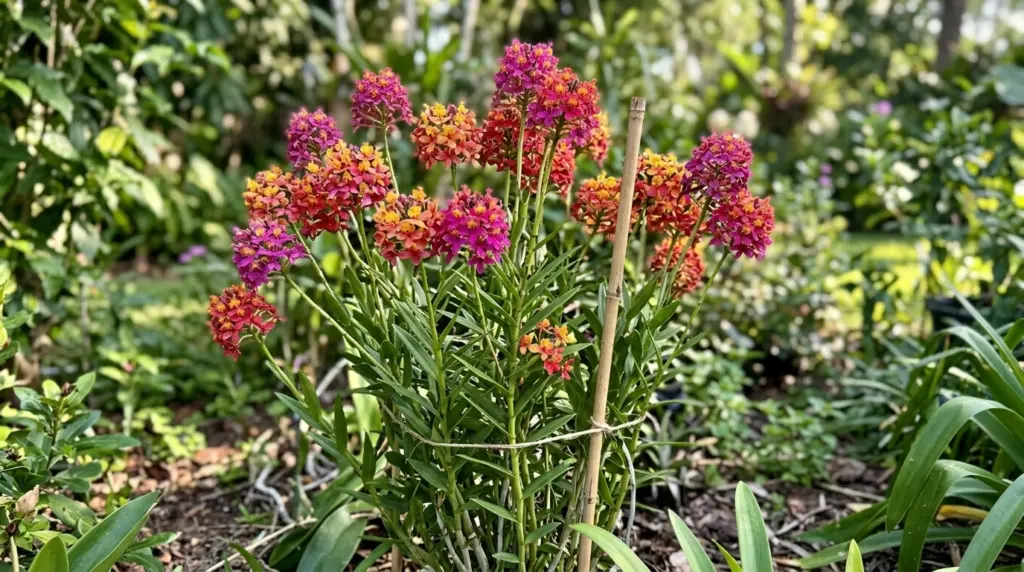
Epidendrum: the orchid with almost continuous flowering, a growing guide.
I received my first Epidendrum as a small seedling, almost looking like just a handful of thin, unremarkable stems. I didn't expect much from that unassuming plant, but within a few months it surprised me with a dense bouquet of small, colorful flowers atop each stem, revealing a prolific bloom that I hadn't seen in any other species in my collection up to that point.
Growth in sugarcane, a characteristic that visually distinguishes this species.
Epidendrum grows on an elongated, thin stem called a cane, similar to what I have already detailed about Dendrobium in another article, although generally thinner and more erect, forming a dense clump as new stems emerge over time.
Virtually continuous flowering, a rare feature among species.
Unlike most orchids described in other articles, which bloom at a specific time of year, Epidendrum can produce flowers almost year-round under favorable conditions, a generous behavior that makes it one of the most rewarding species in my collection.
A dense bouquet of small flowers at the top of each stem.
Unlike the large, solitary Cattleya flower, already detailed in another article, Epidendrum produces a dense cluster of small flowers at the top of the stem, creating a natural bouquet-like visual effect quite different from the rest of the collection.
Ease of cultivation makes this species great for beginners.
Epidendrum tolerates a wide range of conditions well, being considerably more tolerant of care errors than more demanding species such as Vanda or Odontoglossum, already detailed in other articles, making it a safe choice for those who are still learning.
Light tolerance for this species ranges from moderate to intense.
It tolerates both moderate and more intense light well, being flexible enough to adapt to different positions indoors, although I've noticed more generous flowering when exposed to slightly stronger light, similar to what I've already detailed about Cattleya.
The watering method I follow, without being too strict about the interval between each application.
Water when the substrate is almost dry, without worrying too much about extreme precision, since Epidendrum tolerates both occasional dry periods and slightly more frequent watering well, a flexibility that greatly facilitates the routine of those who cultivate this species.
Common substrate that I use, without any very specific requirements.
I use the same medium-grain pine bark already detailed in another article, without needing any special adjustments for this species, since it adapts well to the standard mixture I already use for most of the collection.
Simple propagation through keiki, a common phenomenon in this species.
As I've already detailed about Dendrobium in another article, Epidendrum also frequently produces keiki, small daughter plants that emerge along the cane, a fairly accessible propagation method that I've used several times to expand my collection of this specific species.
A generous variety of colors is available within this genre.
I find Epidendrum in orange, red, pink, yellow, and purple, a wide chromatic diversity that allows me to assemble a small collection of just this species with considerable visual variety without repeating color among different specimens.
Regular fertilization, which I apply almost constantly during the flowering period.
I follow the general principle already detailed in another article about fertilization, but with a slightly higher frequency than I apply to seasonally flowering species, since the almost continuous growth and flower production also require a more constant supply of nutrients.
How do I prune the stem after a long flowering period?
I only cut the stem close to the base when it truly stops producing new flowers for several weeks in a row, since often the same stem continues to bloom intermittently for months, unlike the more defined pattern of other species with a single, more predictable cycle.
The tall size that some varieties of Epidendrum can reach.
Some varieties can grow quite tall, exceeding one meter in height under favorable conditions, requiring a more robust support than I usually use for other species in my collection, a detail I only discovered after my first plant had already grown considerably.
How do I use a robust support to encourage the taller growth of this species?
I installed a sturdy bamboo stake, much more resistant than the thin stake I use for other orchids, ensuring that the taller, heavier cane doesn't topple over as it continues to develop and gain height over the following months of active growth.
Combining Epidendrum with the rest of the collection without much restriction.
Unlike the more selective grouping already detailed in another article about organizing routines, Epidendrum fits relatively well close to several other species, thanks to the wide tolerance I mentioned earlier, greatly facilitating the overall organization of the entire collection.
I made a mistake in the past by underestimating the growth of this species.
I placed my first Epidendrum in a pot that was too small, without considering how much it would grow in a short time, and I had to transplant it to a larger container sooner than expected, a reminder that this generous species deserves enough space from the start of cultivation.
Recording the continuous flowering period in my grow notebook.
I note in my growing notebook, already mentioned in another article, how many consecutive months each specific Epidendrum remains in bloom, a record that helps me compare different varieties and identify which specimen truly stands out for the generosity and duration of its flowering.
Difference between the creeping variety and the tall-stemmed variety of this genus.
In addition to the tall-stemmed variety I've already detailed, there's also a more creeping and compact group of Epidendrum, which spreads horizontally similar to the growth pattern described for Ludisia in another article, offering an interesting option for those who prefer a shorter plant within the same genus that is generous in flowering.
How I use Epidendrum to fill empty space in my collection throughout the year.
I take advantage of this species' virtually continuous flowering to ensure that there is always some flowering plant at home, even during periods when most of the other orchids in the collection only have leaves, without any active flower spikes at that specific moment in the annual cycle of each different species.
Questions I've been asked about Epidendrum
Is Epidendrum a good first orchid for someone who has never grown one before?
Yes, it is an excellent choice precisely because of its wide tolerance to variations in care, making it more accessible than more demanding species such as Vanda or Odontoglossum, which have already been detailed in other articles.
Why did my Epidendrum stop blooming after several generous months of water?
It could simply be a natural pause after a long production cycle, so I recommend maintaining normal care and waiting, as flowering usually resumes after a relatively short rest period.
Do I need a tutor from the very beginning of cultivating this species?
Not necessarily right at the beginning, but I recommend having a support tool available to install as soon as you notice the cane growing taller than expected, preventing it from toppling over before you can provide the necessary support.
Growing Epidendrum has taught me that the most showy plant at the beginning isn't always the most rewarding, and this unassuming species has become one of my favorites precisely because of the generosity and consistency it offers throughout the year, without requiring complicated care or excessive special attention on a daily basis.