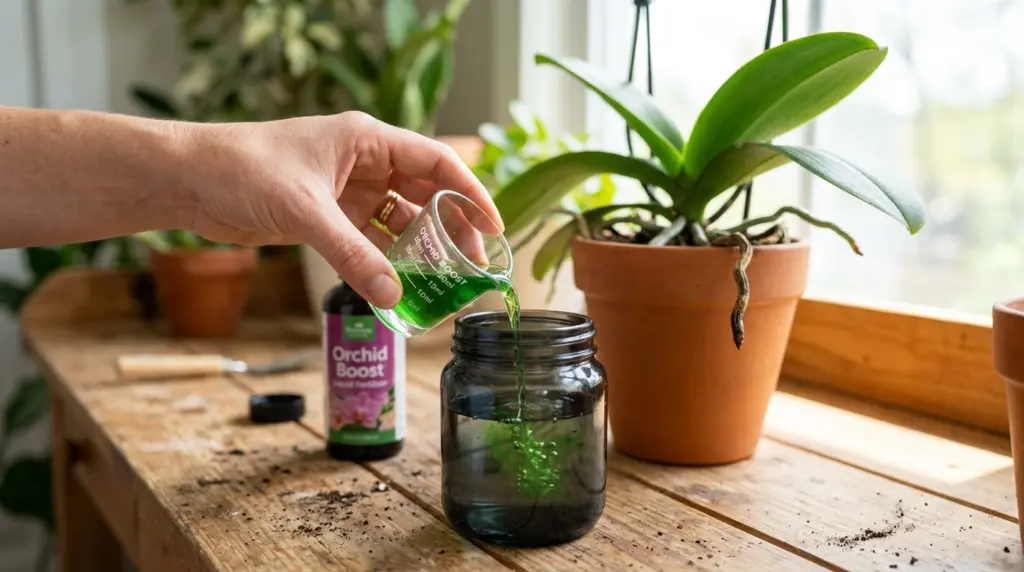
Fertilizer burn in orchids: why less is more in this species
In a well-intentioned attempt to accelerate the growth of an orchid that seemed a bit slow, I applied fertilizer at a higher concentration than recommended, thinking that "a little more" would bring better results faster. Within a few days, the root and leaf tips began to show clear signs of burning, a classic mistake that taught me to strictly adhere to the recommended dilution for this very sensitive plant.
How do I identify burns caused by excess fertilizer?
I look for darkened and dry leaf or root tips, often with a well-defined border separating the affected area from the still healthy tissue, a pattern that usually appears a few days after applying fertilizer that is more concentrated than ideal.
Why orchids are especially sensitive to excess fertilizer.
As I have already detailed in another article about fertilization, orchids naturally evolved in an environment with diluted and scarce nutrients, unlike traditional garden plants accustomed to richer soil, making this species more vulnerable to concentrations that other plants tolerate easily.
Excessively strong dilution, the most obvious cause of this problem.
Applying fertilizer without diluting it to the correct concentration, or following instructions intended for another type of plant, is the most direct cause of this problem, reinforcing the importance of always checking if the product is specific or suitable for orchids before any application.
How do I confirm the correct dilution before applying any fertilizer?
I always check the specific instructions on the orchid label, and when in doubt, I prefer to dilute it even more than recommended, following the principle that it's safer to apply less than to risk an excessive concentration that could cause harm.
Excessive frequency is another factor that can also lead to this problem.
In addition to concentration, applying fertilizer more frequently than the plant can process also leads to an accumulation of mineral salts in the substrate, a problem already detailed in another article about Zygopetalum, which can cause a similar burning symptom.
Since I follow the principle of "diluted and frequent" instead of "concentrated and rare"
I prefer to apply well-diluted fertilizer with moderate regularity, rather than a strong concentration less frequently, since this gentler approach better mimics the gradual natural exposure the plant would have in its original wild environment.
Applying it to already dried roots or leaves further increases the risk.
I've found that applying fertilizer to completely dry substrate can further concentrate the product in direct contact with the root, so I prefer to water lightly before fertilizing, ensuring some moisture that helps distribute the nutrient more evenly.
How do I perform preventative cleaning of the substrate even without visible signs of a problem?
I let clean water run generously through the vase every month, without fertilizer, removing any accumulated residue before it becomes concentrated enough to cause damage—a simple preventative measure that I already use regularly for my entire collection.
How do I remove the already damaged part after identifying the burn?
I cut off the tip of the already dried root or leaf with disinfected scissors, following the same precautions detailed in another article about rotten roots, ensuring that the compromised tissue does not continue to negatively affect the still healthy part of the structure.
How do I temporarily suspend fertilization after identifying this problem?
I completely stop fertilizing for a few weeks after a blight episode, allowing the plant to recover without additional stress, gradually resuming only with an even more diluted concentration than I applied before the incident.
The difference between fertilizer burn and sunburn, both of which have already been detailed.
As I've detailed in another article, sunburn usually affects the area of the leaf most directly exposed to light, while fertilizer burn tends to concentrate on the root tip or leaf edge, a distinction that helps confirm the actual cause.
How I recalibrated my own routine after learning from that specific mistake.
I went back to strictly following the dilution recommended by the manufacturer, completely abandoning the mistaken idea that "more concentrated" would result in faster growth, understanding that this logic simply does not apply to the real needs of this sensitive species.
How to use precise measurement instead of rough estimate in dilution
I started using a specific measuring container to dilute the fertilizer, instead of visually estimating, ensuring real consistency in the applied concentration—a small investment that has already prevented me from repeating the same mistake in any future application.
Recording each fertilizer application in my growing notebook.
I note in my grow notebook, already mentioned in another article, the date and dilution used in each application, a record that helps me maintain consistency and quickly identify if any signs of burns coincide with a specific recent fertilization.
How do I advise another grower eager to see quick results in their plant?
I explain that healthy orchid growth is naturally slower than many other plants, and that trying to speed up this process with more concentrated fertilizer usually causes the exact opposite problem, damaging the roots instead of stimulating faster growth.
How do I choose between liquid fertilizer and stick fertilizer to reduce risk?
I prefer liquid fertilizer diluted in water with each application, since stick fertilizer releases nutrients in a less controlled way and is more difficult to adjust, increasing the risk of excessive concentration near the root that is in direct contact with this fixed source.
How do I monitor root recovery after stopping fertilization?
I check weekly to see if new, greenish, and healthy root tips are emerging, an encouraging sign that the plant is recovering well from the stress caused by previous excessive concentration, usually visible within a few weeks after the correction is applied.
How do I combine preventative washing with the general routine already detailed in another article?
I included the monthly washing of the substrate within the organization routine already detailed in another article, marking this task along with the others for the entire collection, ensuring that this preventive care is not forgotten amidst the other regular maintenance activities.
Questions I've been asked about fertilizer burning
Does the plant fully recover after a fertilizer burn?
Generally yes, especially if identified early and fertilization temporarily suspended, although the already compromised part will not regenerate, new growth usually emerges healthy after this corrective adjustment.
Can I use generic garden fertilizer instead of one specifically for orchids?
I don't recommend it, since the formulation and recommended concentration are usually quite different, considerably increasing the risk of this type of burn if you apply a product intended for another type of plant.
Should I completely stop fertilizing if I've had this problem before?
It's not necessary to stop completely, but I recommend resuming with an even more diluted concentration than you used previously, increasing it gradually only if the plant shows a clear sign of tolerance well over the next few applications.
Learning about fertilizer burning taught me that more isn't always better when caring for orchids, reinforcing the importance of following specific instructions instead of relying on well-intentioned but misguided assumptions about how to safely accelerate plant growth.