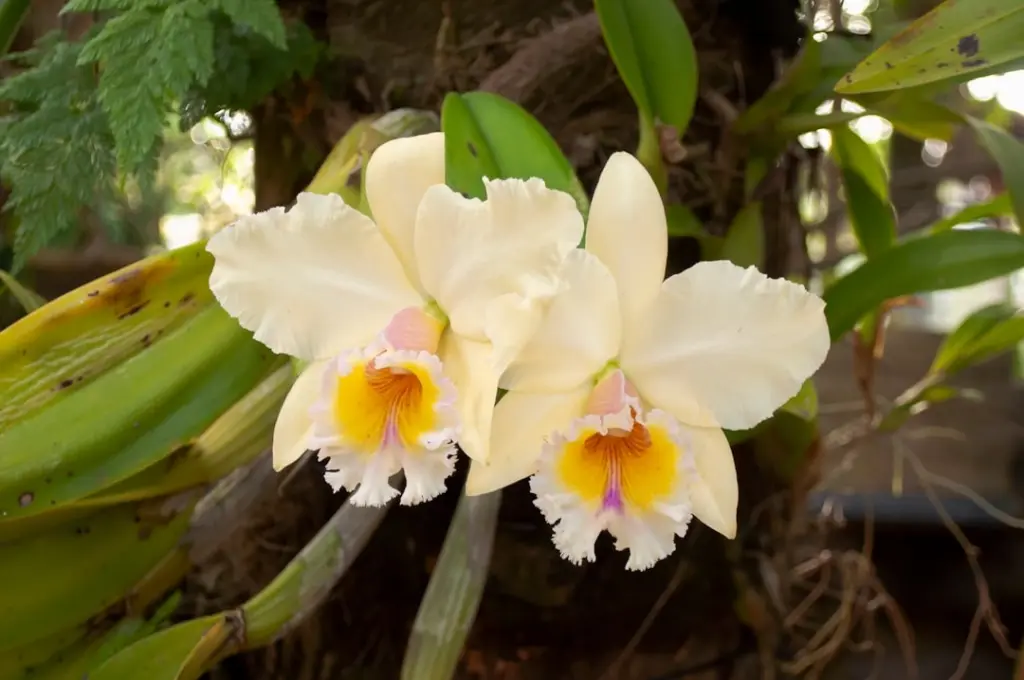
Native Brazilian orchids and the legal issue of collection.
There's an irony in orchid cultivation in Brazil: many people pay a high price for imported hybrids and don't know that several of the world's most famous orchids are Brazilian—some native to the region where they live.
The Cattleya orchid that appears in every European exhibition photograph from the 19th century came from Pernambuco. The symbolic flower of Santa Catarina is an orchid that grows in native forest nearby.
This article covers two things that go hand in hand: which are the main native orchids and why they are a good choice to grow here — and the legal side, because buying native orchids the wrong way is a crime, and most people don't know that.
Brazil is one of the countries with the richest orchid populations in the world.
Orchidaceae is one of the largest families of flora in Brazil. The exact number of species changes according to taxonomic revisions, and the official reference to consult is the Flora and Funga of Brazil, maintained by the Rio de Janeiro Botanical Garden — a free public database where you can check if a species is native and in which states it occurs.
It's worth using this information before buying. If the seller says the plant is of a certain species, two minutes of research will show you if that species actually exists in Brazil and where.
The highest concentration is in the Atlantic Forest , which is simultaneously the richest biome in orchids and the most fragmented in the country. This combination is the root of the conservation problem.
The native speakers you probably already know.
| Species | Where does it occur? | Feature |
|---|---|---|
| Cattleya labiata | Northeast | started the European craze for Cattleya |
| Cattleya purpurata | Sul | flower symbol of Saint Catherine |
| Cattleya walkeriana | Cerrado, Southeast | compact, very fragrant |
| Cattleya intermedia | South coast | Rustic, good for beginners |
| Cattleya nobilior | Midwest | close relative of Walkeriana |
| Cattleya coccinea | Serra do Mar | small, intense red |
| Bifrenaria harrisoniae | Rain Forest | waxy flower, rustic cultivation |
| Zygopetalum spp. | South and Southeast | strong perfume, striped labellum |
Two observations about names, because they generate fruitless searches.
Cattleya purpurata is sold in many places as Laelia purpurata — the same plant, just an older name. And Cattleya coccinea was classified as Sophronitis coccinea , a name still widely used among orchid enthusiasts.
If searching for one name doesn't yield results, try the other. They are not different species; it's a taxonomic reshuffling.
Why native is a practical advantage, not just a symbolic one.
There's a concrete reason to prefer the Brazilian species, and it's not patriotism: its cycle is already synchronized with the seasons here.
A hybrid developed in the northern hemisphere was selected for a light and temperature regime that is the opposite of ours. It adapts, but it usually takes time to get its cycle right, and sometimes it flowers out of season or irregularly.
A species native to your region will begin growing when your climate warms up and will receive the flowering trigger at the time it naturally occurs in your city. No simulation is needed.
Native to the high-altitude Atlantic Forest, it thrives in outdoor cultivation in the South and Southeast regions of Brazil. Native to the Cerrado, it tolerates a marked dry season, which acts as a natural resting period. Native to the Caatinga, it tolerates what most species cannot.
This is why a Cattleya intermedia grown in a backyard in Porto Alegre requires less work than an imported hybrid in the same location.
What each biome teaches us about cultivation.
Knowing which biome a species comes from provides an almost ready-made cultivation regime. It's a better shortcut than any generic table.
Atlantic Forest. High humidity for most of the year, well-distributed rainfall, and temperature variation according to altitude. Species from this region tend to prefer constant humidity and do not tolerate prolonged drought. Those from higher altitudes — Serra do Mar, Mantiqueira — require cool nights and suffer in persistent heat.
Cerrado. Dry season marked from May to September, strong sun, large difference between day and night. Cerrado species have robust reserves and require dry dormancy — watering them the same way in winter is the most common mistake. Cattleya walkeriana is a classic example.
Amazonia. High and constant heat and humidity, little temperature variation. This Amazonian species rarely needs cold to flower, and is therefore a good option for the North and Northeast of Brazil. However, it suffers in dry environments.
Caatinga. The epitome of hardiness. This species tolerates drought and heat that most others cannot, and often grows on rocks. They are the easiest to keep alive and the least demanding in terms of humidity.
The practical implication is straightforward: before buying, ask which biome the species comes from. This answers watering, rest period, and chilling requirements all at once.
Micro-orchids, a Brazilian chapter.
There is a little-known universe outside the orchid-growing community: micro-orchids, plants only a few centimeters tall with proportionally enormous flowers.
The high-altitude Atlantic Forest is especially rich in this group. Genera such as Pleurothallis , Stelis , Octomeria , and the smaller members of the Cattleya coccinea group occur in areas of frequent fog in the Serra do Mar mountain range.
From a cultivation standpoint, they have an obvious advantage: they take up very little space, and a collection of dozens fits on a shelf. A person with a small apartment can achieve a variety that would be impossible with Cattleya.
The downside is that most require high humidity and a consistently mild temperature — which in practice means a terrarium or controlled environment in much of Brazil. It's not a group to start with, but it's worth knowing that it exists.
How to build a native collection from scratch
If the idea is to start somewhere, the sensible sequence goes from the most tolerant to the most demanding — and not from which one has the prettiest flower in the photo.
First: Cattleya intermedia or a native Epidendrum . They are hardy, tolerate variations in care, and allow for mistakes without ruining the plant. If you have an outdoor area, they can already be planted on a tree.
Second: Cattleya walkeriana if you are in the Cerrado region or can provide dry rest during the winter; or Cattleya labiata if you are in the Northeast. Here you start working with the life cycle, not just survival.
Third: Zygopetalum or Bifrenaria , which have slightly more specific requirements but are still forgiving.
Next: high-altitude species and micro-orchids, which is where the need for a controlled environment begins. Leaving these for last avoids the frustration of losing an expensive plant due to lack of proper facilities.
One detail that saves money: common native species in cultivation cost much less than they seem, because producers propagate them in quantity. The high price appears in selected clones and rare species — which is precisely what you shouldn't buy at the beginning.
The part that almost no one tells you: taking plants from the wild is a crime.
This information is missing from almost all cultivation content, and it's important precisely because the practice is common and socially tolerated.
Collecting native plants in nature without authorization is an environmental offense. Law 9.605/1998, the Environmental Crimes Law , criminalizes conduct that damages native flora, including the extraction and destruction of vegetation in protected areas.
It doesn't matter if it's "just a plant," nor if the intention is to take good care of it. The problem lies in the act of harvesting itself, and this applies both to those who harvest it and those who buy it knowing its origin.
Orchids are also subject to international trade controls under CITES — the convention that regulates trade in endangered species. Bringing an orchid from another country in your luggage without documentation is illegal, even if the plant was legally purchased there.
Why does this matter beyond the law?
Two practical reasons that affect the direct grower.
Harvesting is one of the causes of the threat. This species of flower, beautiful and of high commercial value, is precisely the most targeted, and small populations in forest fragments cannot withstand continuous removal. Added to habitat loss, this is what pushes the species onto the endangered list.
Wild plants are usually difficult to cultivate. They are adapted to very specific light, humidity, and substrate conditions of that exact location, and changing them to a pot is a big shock—the loss rate is high.
Furthermore, collected plants bring pests and pathogens directly into your collection without any quarantine. I've even seen reports of entire infestations starting on a "rescued" plant.
A nursery plant, propagated through cultivation, has grown under the conditions in which it will live. It adapts better, flowers more reliably, and doesn't cost more than it seems—the price difference compared to a plant of dubious origin is small.
How to buy native products the right way
Registered nursery or producer. Commercial production of native plants is a regulated activity, and serious producers are registered. Asking for an invoice is the simplest way to distinguish the genuine from the imitation.
Exhibitions organized by orchid societies are the best place to find high-quality native species. The exhibitors are growers who propagate the plants, and they usually explain the plant's origin without you having to ask twice.
Plant propagated by seed or meristem. This is the ideal origin: it takes nothing from nature, and in the case of meristem propagation you know exactly what you are getting because it is a clone of a known plant.
Exchange between growers. Division of a clump from an already cultivated plant is perfectly legitimate and is how a large part of collections grow. A well-established Cattleya produces new plants every two or three years.
Signs that the plant came from the wild.
It's important to know how to recognize it, so you don't buy something without realizing it.
Large, old plant at a low price. A mature clump takes years to form in a nursery, and that has a cost. A price significantly below market value for a large plant is a red flag.
A roughly cut root, with remnants of tree bark still attached. A nursery plant removed from a pot or plaque, its root system adapted to that environment.
A seller who is evasive about the origin , or who casually says that the plant is "from the bush," "from the farm," or "from a collection," is undesirable. The expected answer from a producer is the species name and how it was propagated.
Sold by the roadside , without identification or receipt. This is the classic way plants are collected.
What if you find a fallen orchid?
This is a legitimate question, and the answer has nuances.
An orchid that fell along with a branch after a storm, or that is on a branch already cut during authorized urban pruning, is a different situation from collection. The plant was condemned anyway, and relocating it to a nearby tree or taking it away is rescue, not extraction.
The dividing line is simple: did you take the plant from where it was alive, or did you collect it from where it was already lost? Uprooting it from the trunk is collection. Picking it up from the ground after it has fallen is rescue.
In a conservation unit, not even that is allowed — nothing is removed, not even fallen material. And if there is any doubt about a protected area, the best course of action is to consult the local environmental agency beforehand.
Where to see native animals in nature, without taking anything.
Seeing an orchid in bloom in its natural habitat is a different experience than seeing one in a pot, and it's totally accessible — it just doesn't involve taking the plant home.
Botanical gardens. Several maintain orchidariums with identified native species, which is the best way to learn to recognize them: you see the plant with the correct label and can compare it to what you have at home.
Conservation units with trails. High-altitude Atlantic Forest parks concentrate many species, and during flowering season you can see quite a lot from the path itself, looking up. Binoculars are more helpful than using your hand.
Exhibitions organized by orchid societies. They take place in almost every state, usually featuring identified plants, judging, and people willing to explain things. It's where you learn the fastest, and where you can buy with guaranteed provenance.
A tip for trail behavior: it's not enough to just say "don't collect." Also avoid handling or stepping on leaf litter off the trail and disturbing fallen plants within a conservation unit—there, the fallen material is part of the ecosystem.
Why have some native species been added to the endangered list?
Understanding the mechanism helps to understand why collection pressure is so crucial in orchids, more so than in other plant groups.
Naturally restricted distribution. Many species occur only in a specific altitude range, within a mountainous region. Small and concentrated populations do not absorb the reduced resources.
Slow growth. A mature flowering plant can take several years to form from seed. Removing a mature plant is not like picking fruit—it's removing decades of accumulation.
Dependence on a specific pollinator. A large proportion of orchids depend on a single group of pollinators. If that group disappears from the area, the plant may continue to live but stop reproducing—the population ages without replacement.
Habitat loss combined with harvesting. Each one in isolation would be tolerable; together, it is not. This is why a species with showy flowers and high commercial value in a fragmented biome is the most critical combination.
It's worth checking the conservation status of the species before buying, especially if it's rare or very expensive — a rare and cheap plant is practically synonymous with irregular origin.
What can the grower do for conservation?
Home cultivation can be part of the solution, and that's not just empty talk.
Propagate and distribute. Each division of clump that circulates among growers is a plant that did not need to leave nature. A species that is widespread in cultivation has less harvesting pressure.
Document the origin of your plants. Knowing where each one came from adds value to your collection and allows you to trade them with clear provenance.
Refuse plants of dubious origin, and explain why. Demand is what sustains illegal harvesting. Sellers who are frequently asked about provenance will switch suppliers.
Growing native plants is, in the end, the most interesting way to cultivate here: a plant adapted to the climate, with a local history, and that multiplies in your own home. The opposite of buying an expensive hybrid that never gets the cycle right.