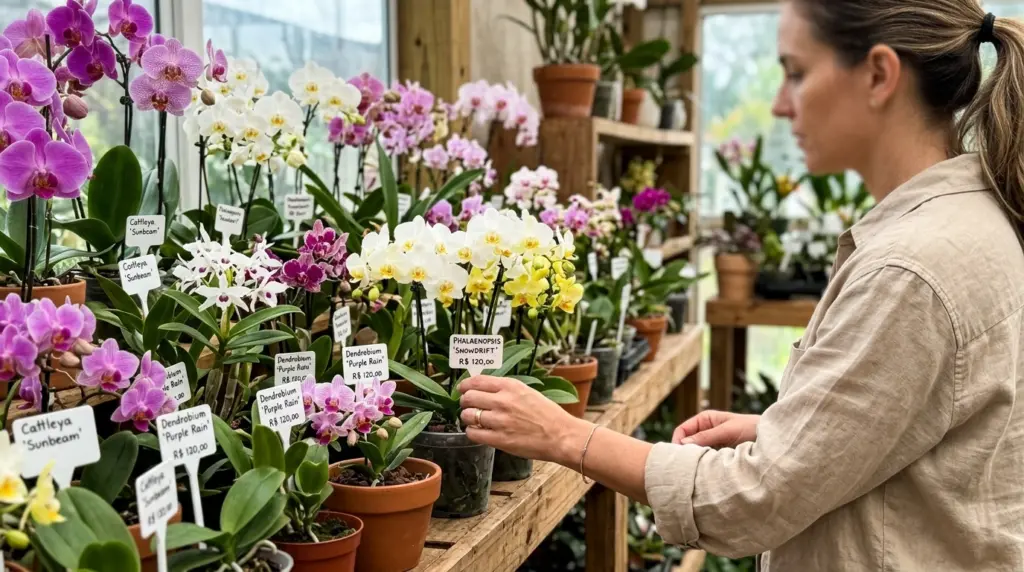
How to organize a care routine for multiple orchids at the same time.
When my collection grew from five to over sixty plants, I had to completely rethink how I organized my daily care. What worked well with just a few plants, remembering each one individually, became impractical, and I developed a system that now allows me to take care of everything without forgetting anything or feeling overwhelmed.
Why memory alone isn't enough with a large collection.
With just a few plants, remembering each one individually is perfectly feasible, but as the collection grows, this method becomes unsustainable, greatly increasing the risk of forgetting to water or fertilize a specific plant for weeks.
Grouping plants together based on similar watering needs.
I organize my plants into groups according to the substrate and species, since both directly influence the watering frequency, as detailed in another article, watering an entire group on the same day instead of trying to remember to water each pot individually.
Using a label with basic information on each pot.
Each pot has a small label with the species name and the date of acquisition, information that I can quickly consult without relying solely on my memory to identify which plant is which, especially useful when I receive curious visitors asking about the collection.
Physical or digital calendar: which do I prefer to use?
I use a simple reminder app on my phone, marking the watering day for each group of plants, with automatic notifications that alert me when the scheduled date arrives, completely eliminating the need to memorize a complex schedule.
Setting aside a fixed day of the week for a complete check.
I set aside a fixed day, usually on the weekend, to do a complete check of the entire collection, verifying signs of health as detailed in another article, even for plants that are not scheduled to be watered on that specific day.
How I physically organized the space to facilitate access.
I grouped the plants on shelves and tables, organized by light requirements, as detailed in another article, making both watering and regular visual observation easier, without having to walk all over the house every time I need to take care of the collection.
Preparing watering materials in advance
I prepare the fertilizer already diluted and the soaking basin before starting my daily watering routine, reducing the time spent on repeated preparation and making the process more fluid when I need to care for several plants in a row.
Delegating some of the caregiving when I need to travel.
I've already detailed this in another article specifically about travel, but with a large collection, leaving clear and organized instructions by group for whoever will be taking care of it in my absence makes all the difference, avoiding confusion about which plant needs which specific care.
How the logbook became essential on this scale.
With a small number of plants, record-keeping was more optional, but in a large collection, the cultivation notebook, already detailed in another article, became indispensable for tracking patterns, identifying recurring problems, and planning future care without relying solely on memory.
Reviewing and adjusting the system periodically.
Every few months, I reassess whether the grouping and organization still make sense, since the collection changes over time, new plants arrive, and others may need repositioning, requiring the system to evolve along with the collection.
How this system reduced my anxiety about daily care.
Before organizing things this way, I felt a constant anxiety about forgetting something. After structuring the system, the task became a calm and predictable routine, without that feeling of always playing catch-up.
Color-coding the labels allows for even faster identification.
In addition to the species name, I use a label with a small colored mark indicating the watering group to which each plant belongs, allowing for almost instantaneous visual identification without having to read the entire text every time I need to confirm which group that specific plant belongs to within my overall organizational system.
How I trained my perception to quickly recognize each group.
Over time, I developed such a strong familiarity with each group that I hardly need to consult the label anymore, recognizing at a glance which plant belongs to which care category. This intuitive recognition only came after months of following the structured system with discipline, but today it greatly speeds up the daily care process.
Involving another person in the household in the care routine.
I taught my partner to recognize the basic groups and to do a simple check on the days I can't personally take care of them, a support system that was only possible precisely because the organization by group, with clear labeling, makes the process understandable to anyone, not just to me who already knows each plant individually by heart.
How do I divide the total time dedicated to caregiving throughout the week?
Instead of concentrating everything on a single day, I distribute small tasks throughout the week, such as a quick two-minute observation each day and a more thorough watering concentrated on the weekend. This distribution prevents the care of the collection from becoming a tiring and overly focused task, making the process lighter and more sustainable in daily life, even with an already busy personal routine.
Simplifying as much as possible for those who are starting to expand their own collection.
For those who are just starting to notice that their collection has grown beyond previous informal control, I recommend starting simple: just a basic spreadsheet with watering dates and the name of each plant, gradually evolving to a more elaborate system as the actual need increases, instead of trying to implement all at once the complex structure that took me years to develop.
Adjusting the system as new plants of different species are added to the collection.
Whenever I acquire a new species with needs different from those already existing, I assess whether it fits into an already established group or if it needs to form its own category within the system. Maintaining this flexibility prevents the system from becoming too rigid, allowing it to grow organically as the diversity of the collection increases over time.
Setting aside extra time for a plant that needs individual attention.
Even with the group system working well, I always reserve extra time for each plant showing specific signs of problems, as detailed in another article, since these specific situations require individualized attention that the overall group system cannot cover on its own.
Periodically assessing whether the collection still fits within the available time.
From time to time, I honestly assess whether the current size of my collection is still compatible with the actual time I have available to dedicate to its care, avoiding growing it beyond what I can sustain with quality, even though the temptation to acquire yet another beautiful plant is always present on any visit to a specialized store.
Questions I've been asked about organizing a routine with lots of plants.
At what quantity of plants does it become worthwhile to create this more structured system?
I recommend starting to structure it as soon as you feel the first real difficulty in remembering everything, usually around ten to fifteen plants, although this varies according to each person's memory and routine.
Is a reminder app really necessary, or can you just use a notebook?
It's possible to do it with just a notebook, but the app with automatic notifications eliminates the need to remember to consult the notebook, one less step that has saved me from forgetting on more than one occasion over the years of growing.
Organizing my care routine was just as important as any specific watering or fertilizing technique, allowing my collection to grow without compromising the quality of individual plant care in the process, something I consider fundamental to sustaining this hobby in the long term.