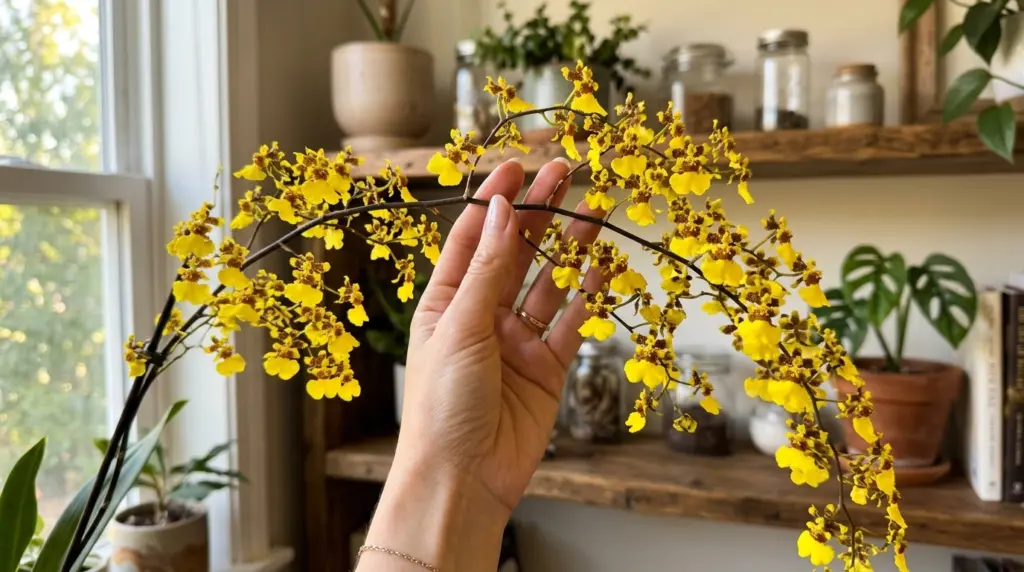
Oncidium: known as golden shower, requires specific care for this species.
I saw an Oncidium in bloom for the first time at a plant fair, with dozens of small, yellow flowers covering a branching stem—a spectacle that growers affectionately call a "golden shower." I couldn't resist and took one home, beginning a relationship with a species that I now consider one of the most generous in its flowering in my collection.
Why is Oncidium known as golden rain?
Many Oncidium varieties produce an impressive number of small flowers on a single branching stem, creating a cascading golden visual effect that fully justifies its popular nickname among growers.
Physical characteristic that helps to identify this species.
A visible pseudobulb, similar to what I've already detailed about Cattleya, although generally smaller, and a thinner, elongated leaf are common characteristics that help to recognize Oncidium even before the spectacular flowering occurs.
Light requirements that this species typically demands.
As I've mentioned in other articles about light, Oncidium tolerates and generally benefits from brighter light, similar to what Cattleya requires, although some specific varieties accept slightly less intensity than this comparison suggests.
Watering schedule I follow for this species with pseudobulbs.
I let the substrate dry almost completely between waterings, following the same principle already detailed for Cattleya, since the pseudobulb acts as a reserve that tolerates this longer interval well without compromising the plant's health.
Substrate I usually use for Oncidium.
I use medium-grained pine bark, already detailed in another article about substrate, ensuring good drainage compatible with the drying cycle that this species prefers to maintain healthy roots.
Generous flowering pattern that characterizes Oncidium.
The branching stem can produce dozens of flowers simultaneously, an interesting contrast to the Cattleya, which usually has fewer flowers, but of a much larger individual size, showing the diversity of flowering strategies within the orchid universe.
How to support the branched stem during development.
I use a discreet support to prop up the stem as it develops and gains weight with the flower buds, preventing it from breaking under its own weight before full flowering occurs—a precaution I learned after losing a promising stem in one of my first attempts.
Variety of aromas that some Oncidium species exhibit.
Some specific varieties of Oncidium have a subtle sweet aroma, slightly reminiscent of chocolate or vanilla in certain species, a sensory surprise I only discovered after I already had several plants flowering at home.
Fertilization that I adjust during the development of the flower stalk.
I slightly increase the phosphorus as soon as I notice the beginning of stem development, following the same principle already detailed in another article on fertilization, supporting the complete development of so many flower buds in a single branched structure.
How do I differentiate Oncidium from other similar pseudobulb species?
A branched stem with many small flowers is the most reliable indicator, since other species with pseudobulbs, such as Cattleya, usually have a simpler stem with fewer flowers that are individually much larger.
A pot proportional to the root size, the same logic as other species with pseudobulbs.
I follow the same principle already detailed in another article about types of pots, choosing a relatively suitable container, neither too large nor too small, ensuring enough space for the pseudobulb to develop over the next few seasons without compromising the drainage that this species needs to maintain healthy roots.
How do I know when it's time to replace a wilted stem?
I wait until the branched stem is completely dry and brownish before cutting it close to the base, unlike the strategic pruning I sometimes do on Phalaenopsis orchids, which I've detailed in another article, since Oncidium orchids generally don't re-bloom on the same stem after all the flowers have fallen off naturally.
Difference in size between large and compact varieties of Oncidium.
I have cultivated both the traditional variety, with a stem that can exceed half a meter in length, and a more compact version, with a much shorter stem, but still generous in the quantity of flowers. The compact version fits better in small spaces, without sacrificing the characteristic visual spectacle of this species so beloved among collectors.
Combining Oncidium with other species of similar need on the same shelf
I position my Oncidium near the Cattleya, already detailed in another article, taking advantage of the fact that both species share similar light and watering needs, making it much easier to organize the care routine when species with similar requirements are grouped in the same area of the house.
Recording the perceived aroma of each new variety acquired.
I note in my grow notebook, already mentioned in another article, which specific variety of Oncidium had a perceptible aroma and a description of that smell, since not every plant purchased comes with this clear information on the label, and this personal record has become a valuable reference for future purchase choices based on this specific sensory criterion.
A mistake I've made before is not supporting the rod in time.
One of the first times I cultivated Oncidium, I waited too long to put up the support stake, with most of the buds already formed, and the stem ended up partially breaking under its own weight before I could intervene in time. I learned that the right time to install the support is right at the beginning of the stem's development, not after it's already heavy and vulnerable.
How did cascading blooms influence my choice of placement?
Because of the branched and slightly drooping shape of the flower stem, I prefer to position my Oncidium in a slightly elevated spot, like a high shelf, allowing the stem with the flowers to cascade down naturally, creating a much more beautiful cascading visual effect than if the plant were on the floor or on a very low surface in the house.
Sharing Oncidium flowers with those who visit the house.
I once cut part of a particularly generous stem to make a small arrangement as a gift for someone who visited my house, since the number of flowers on a single branching stem allows for sharing without significantly compromising the display on the original plant, something that would be more difficult to do with a single, large flower species like the Cattleya.
How the gradual development of the stem tests the grower's patience.
From the first sign of a stem emerging until full bloom, it can take weeks of waiting, a period I've learned to appreciate as part of the experience, watching the gradual growth day by day, rather than simply impatiently waiting for the spectacular final result that only comes after all that patient development.
Questions I've been asked about Oncidium
Is Oncidium a good option for those who already have experience with Phalaenopsis?
Yes, it's a good next choice after mastering the basics, although it requires adjusting to a less frequent watering schedule, similar to what I've already detailed about Cattleya, unlike the more frequent watering schedule for Phalaenopsis.
Do all the flowers on the branched stem open at the same time?
Generally not, they tend to open gradually and in stages, extending the total visible flowering period, since not all reach the opening point simultaneously on the same branched stem.
Oncidium has become one of my favorite species precisely because of the visual splendor of its blooms, proving that sometimes beauty lies in quantity and not just in the individual size of each flower—a spectacle unlike anything else I had ever seen before discovering this specific species.