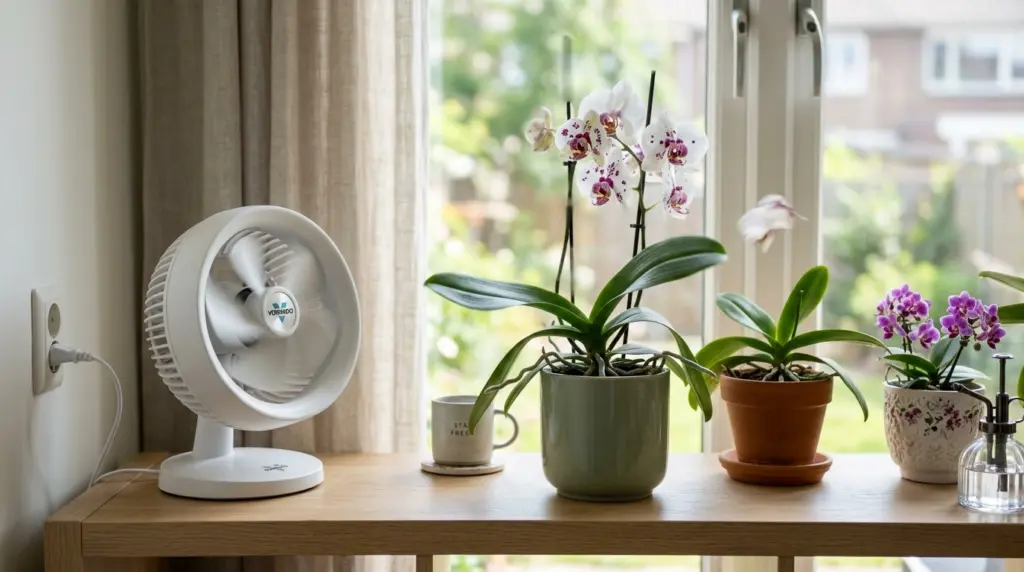
Ventilation: why standing air harms the orchid
I had a period in which my orchids, despite watering and light correct, began to develop recurrent fungal problem. Only after investigating a lot I realized that the environment where I kept the collection had very little air circulation, a factor that I simply had not considered until then as an essential part of care.
Why ventilation is as important as watering and light
Air still creates an environment conducive to the development of fungus and bacteria, especially in combination with higher humidity, already detailed in another article. The constant circulation of air helps to quickly dry any excess moisture in the leaf and crown, preventing much of these problems.
How do I identify if my environment has insufficient ventilation
Repair if the leaf or the substrate surface takes too long to dry after watering, compared to what I have seen in other environments. Environment with good circulation dries noticeably faster than a closed and stopped corner of the house.
Small fan: simple solution that I started to use
I installed a small fan, connected at low speed, positioned to create a slight movement of air in the environment where I concentrate most of my collection, without pointing directly and with full force to the plants.
Why avoid pointed fan directly and with full force
Very strong and direct air current can dry the plant too fast, and cause physical stress on thinner leaf. I seek a smooth and indirect flow, enough to circulate the air without drying excessively or hurting the plant with the direct impact of the wind.
Open window: the most natural ventilation source
Whenever the weather allows, I keep at least one window ajar close to the plants, taking advantage of the natural air circulation, which is usually more balanced and less artificial than relying on mechanical fan alone all the time.
How do I organize the spacing between plants to improve airflow
I avoid cramming pots too close to each other, leaving enough space between them for the air to circulate throughout the foliage, not only the outer surface of the set. Plants too tight in each other create pockets of air stopped between them.
Balance between ventilation and humidity, two factors that work together
I have already detailed in another article on humidity that too much ventilation can dry the environment too fast, compromising the necessary humidity. I always seek to balance the two factors, never prioritizing one to the point of completely harming the other.
Beware of cold air stream from the air conditioner
I never place orchids directly in the air outlet of the air conditioner, as concentrated cold and dry flow can cause as much damage as standing air, an opposite extreme that also harms plant health differently.
Ventilation in closed environment without window, such as indoor office
For those who grow in an environment without natural window, a small table fan at minimum speed, turned on for a few hours of the day, already helps a lot to avoid completely stopped air that favors fungal problem.
How ventilation helps specifically after watering
Soon after immersion watering, already detailed in another article, I guarantee good air circulation around the plant, helping to dry any residual water on the leaf or crown faster, greatly reducing the risk of problem associated with humidity stopped for a prolonged time.
Result I realized after improving ventilation
After installing the fan and rearranging the spacing between plants, the recurring fungal problem practically disappeared from my collection, confirming in practice how much this previously neglected factor really made a difference.
How I chose the right type of fan for this specific use
I opted for a small table fan, with automatic oscillation, ensuring that the air flow is distributed over a larger area instead of always focusing on the same point. Model with adjustable speed also helps a lot, since I can reduce the intensity on a drier day and increase slightly in day with higher humidity.
Difference in need of ventilation between most exposed root species
Vanda and other species cultivated with roots fully exposed to air, already detailed in another article on varieties, depend even more on good circulation than species grown on traditional substrate, since the exposed root dry and breathe properly is even more central to the health of these specific plants.
How I identified the root cause of the fungal problem I was facing
Before connecting the problem to the lack of ventilation, I came to suspect over-watering and even contaminated substrate, testing adjustment in each of these factors separately without completely solving the situation. Only after eliminating these other possibilities and investigating the environment as a whole did I realize that the root of the problem was in insufficient air circulation of that specific room of the house.
Testing different fan positions before fixing the definitive solution
I moved the fan through different points of the environment before finding the position that created enough circulation without directly disturbing any specific plant with too strong flow. This adjustment took a few weeks of observation and small changes, until arriving at a configuration that really solved the problem without creating a new type of stress for the collection.
Ventilation in larger collection distributed by several rooms of the house
As my collection grew and spread across different rooms, I needed to evaluate the ventilation of each room individually, since one room can have good natural circulation while another, more closed, needs additional mechanical solution. I no longer assume that the same ventilation strategy works equally well throughout the house without this specific evaluation of each space.
How the shape and arrangement of foliage also influence circulation
Plant with denser and overlapping foliage retains moisture between the leaves themselves more easily than one with more spaced foliage, so I consider this characteristic when deciding how much space to leave around each pot when organizing the collection, giving even more distance to the species of foliage more closed and compact.
Cleaning the fan blades regularly to keep the air flow efficient
I clean the fan blades periodically, since accumulated dust reduces the efficiency of the generated air flow, besides being able to disperse unwanted particles on nearby plants. This simple maintenance care ensures that the equipment continues to fulfill well the function for which it was installed in that specific environment.
Questions you've asked me about orchid ventilation
Do I need to leave the fan on all day?
Not necessarily a few hours a day, especially after watering, are usually enough, although naturally more stationary environment can benefit from more constant circulation.
Can direct connected fan in the plant all the time be harmful?
Yes, constant exposure to direct and strong air current can excessively dry the plant & I prefer an indirect and smooth flow, circulating the general environment instead of hitting the plant directly continuously throughout the day.
Ventilation is one of those factors that go unnoticed until it causes a visible problem, but after adjusting this detail, I understood that it is part of the same set of care that I already dedicate to watering, light and humidity, all working together to keep the collection really healthy.