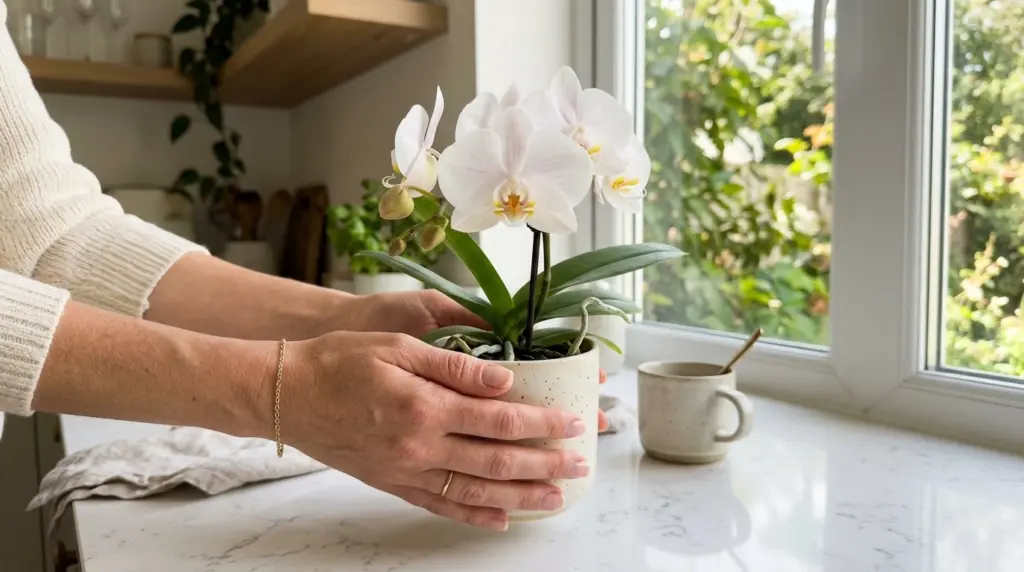
Phalaenopsis: why is the most suitable orchid for those who are starting out
Phalaenopsis is the orchid that almost everyone has first, and it's no accident: it's the best-selling in the world, it blooms for weeks and accepts home condition better than any other popular genre. The problem is that this fame of "easy" comes with a lot of vague instruction ' "indirect light", "take it when it's dry" 'which says nothing actionable. This guide is the opposite of it: the concrete tracks on which it works, where these numbers come from, and what to do in the three moments when most plants get lost.
Light: the number that solves the doubt of the window
A american Orchid Society Cultivation Sheet works with 10,750 to 21,500 lumens, the equivalent of 1,000-2,000 foot-candles. At home, this is window east & morning sun, direct, for a few hours. Window south or west serves if you have curtain filtering.
Here is a warning that I see few people give in Portuguese content: the american cards describe window orientation to the northern hemisphere.East and west work the same in both hemispheres, but south and north are reversedwhere AOS says "south window" as the sunniest, in Brazil it is the north window. Following the instruction literally down here is a common way to burn sheet thinking it is hitting.
If the crop is under artificial light, the floor to bloom is above 10,000 lumens per square meter. The plant survives with much less 2,000 io, but surviving and flowering are different things, and it is precisely there that lives the most common complaint of those who have Phalaenopsis for years without seeing flower again.
The practical way to evaluate without meter is to look at the leaf. Very dark green, almost emerald, is sign of insufficient light 2 beautiful, but does not bloom. Light green with slightly yellowish tone is the productive range. Leaf with whitish or reddish stain is excess.
Temperature, and the trick to force the floral stem
| Condition | Range (AOS) | Remark |
|---|---|---|
| Day | 24 To 29 °C or more | maximum tolerated 32-35 °C |
| Night (normal) | above 15.5 °C | maintenance range |
| Night (to induce rod) | ~13°C for a few weeks in autumn | it's the flowering trigger |
| Moisture | 50 To 80% | with air always circulating |
The most useful item in this table is the third. Phalaenopsis initiates floral stem in response to cooler nights, around 13°C, for a few weeks in autumnthat's why so many people have healthy plants that never bloomed again: indoors, with a stable temperature all year round, the trigger is never triggered. Putting the plant on a protected balcony during the cold autumn nights solves more than any flowering fertilizer.
And it has an important counterpoint, which AOS itself records: temperature oscillating causes button drop. Or is it night cold controlled in autumn to induce rod, yes; thermal shuttle after the bud has already formed, no. After the rod appeared, stability.
It is worth comparing with other genres to understand what is specific of it. Cattleya demands a drop of 5.5 to 8.3 °C between day and night all the time. Masdevallia wants practically constant temperature. Phalaenopsis is the medium: stable most of the year, with a point cold window in autumn. There is no single rule of orchid 'there is gender rule.
Watering: never dry completely, and always in the morning
Phalaenopsis has no pseudobulb, so it does not hold water reserve 'THE substrate can not dry completely in any time. But it also can not get soaked, because the root needs oxygen as much as water.
The actual frequency depends on the weather, and OSA gives the amplitude: it can go from day yes, day no in hot and dry summer until once every ten days in a cool environment. Anyone who gives you a fixed number of days is guessing 'What works is to evaluate the weight of the pot and stick your finger between the peels to feel if there is still moisture in the middle, not only on the surface.
The time rule is the one that most avoids serious problem: water in the morningwater that sits still in the crown of the plant at night, when the temperature drops and evaporation stops, is the recipe for crown rot & DAB that in Phalaenopsis is usually fatal, because it grows from a single growth point. If water falls there, dry with paper towel.
Fertilization: two schools, both work
The AOS form presents two schemes, and it is worth knowing both because they serve different routines:
The first is two applications per month of nitrogen-rich formula 30-10-10 during growth, switching to a phosphorus-rich, type 10-30-20, at flowering time.High nitrogen makes sense in shell substrate, because the decomposition of the shell consumes nitrogen.
The second is one quarter of the dose in each watering, continuous, which works best in hot and humid environment where watering frequently.In cooler environment, the recommendation drops to twice a month in weak dose.
Between the two, I would prefer the second for those who are starting: weak and constant dose forgives forgetfulness and errs less for excess. Excess fertilizer burns root, and burnt root of Phalaenopsis takes months to recover.
Replanting: when, and why spring
The frequency indicated is each one to three years, and seedlings annually. The trigger is not the calendar, it is the substrate: when the bark begins to turn over land and retains too much water, the root suffocates.
The indicated time is a spring, just after flowering. It makes sense for two reasons: the plant enters the active growth phase and heals wound root faster, and does not lose the flowering cycle. Replanting with bud on the plant is the easiest way to lose the flower.
Medium grain size substrate for adult plant, fine for seedling. After replanting, wait a few days before the first full watering, to give time for any root cut to dry & this greatly reduces the risk of infection entering by fresh wound.
The stem after the flower falls: cut or not
This is the doubt that most appears, and the honest answer is: it depends on what the plant indicates. Stem that turned green can sprout and bloom on a side branch 2 in this case it is worth cutting a little above a knot and wait. Stem that dried and turned brown does not return, and then cuts at the base.
The caveat is that old stem reforestation usually gives smaller flower and fewer. When the plant is young or came from a long flowering, I would cut at the base even though it is green 'let her invest energy in leaf and new root, and the next flowering comes stronger. It is exchange between flower now and plant better after.
The three mistakes that kill most Phalaenopsis
Decorative vase without hole. Water accumulated at the bottom keeps the root base permanently wet, and rot from the bottom up. If using cachepo, remove the inner vessel to water and return only after everything has drained.
Water in the crown at night. I have explained above, and it is the only error on this list that is usually irreversible.
Ice cube. It circulates as a practical method and is bad for two reasons: the AOS explicitly recommends warm water, warning that water below 10 °C can injure the plant, and the amount of a cube does not hydrate the substrate evenly.
Why she remains the best first orchid
Nothing of the above is difficult 'it is only specific. Phalaenopsis tolerates a wide range of day temperature, accepts the light that most houses have, and warns in advance when something is wrong, by the leaf and the color of the root. Compared with a Cymbidium, which refuses to bloom if it passes 23.8 °C at any time, or with a Vanda, which asks for strong sun and daily watering, it is in fact the most compatible genre with the real life of an apartment.
If I had to summarize in two sentences for those who just bought the first: water in the morning and never leave water in the crown; and in the fall, let her spend a few nights in the cold if you want to flower again. The rest is learned by looking at the plant.