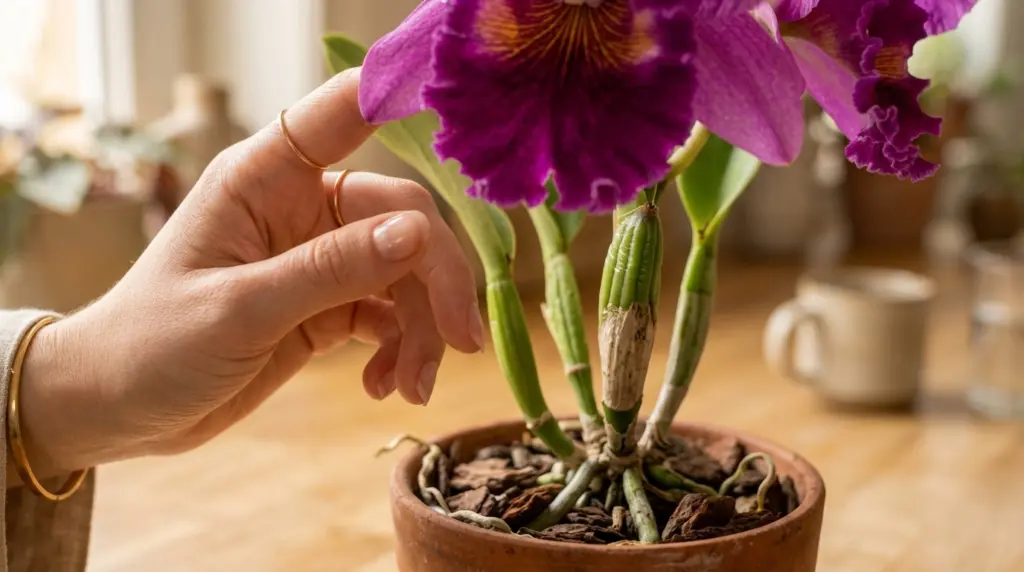
Cattleya: aroma, color and the most traditional orchid of the exhibitions
Cattleya is the orchid of traditional exhibitions, and the one that most people see when they hear "collection orchid": large flower, saturated color, strong perfume. It is also the genre in which those who come from Phalaenopsis erra more 'cause almost everything that works there needs to be reversed here. She wants more sun, wants to dry between watering, and requires one thing that Phalaenopsis dispenses: temperature difference between day and night, every day.
The requirement that almost no one meets: the night fall
This is the point that decides whether your Cattleya will bloom or just fatten leaf american Orchid Society Cultivation Sheet it does not treat this as a preference, but as a requirement: one is needed drop of 5.5 to 8.3 °C in night temperature.
| Condition | Range (AOS) | Remark |
|---|---|---|
| Day | 21.1 To 29.4 °C | tolerates up to 35 °C with shade, moisture and air |
| Night | 12.7 To 22.2 °C | ''' |
| Fall day/night | 5.5 To 8.3 °C | requirement, not preference |
| Moisture | 40 To 70% day | comfortable band at home |
It is worth contrasting, because it is what makes each genre its own case: the Masdevallia wants temperature practically constant. The Phalaenopsis wants stability almost every year, with a cold window punctual in the fall. Cattleya wants the oscillation as a permanent routine. Who grows the three in the same place of the house will have good result in one and mediocre in the other two.
In practice, a closed apartment with a stable temperature is the worst scenario for her. Balcony, external parapet or any place that feels the natural fall of the night solves for free what no fertilizer solves.
Light: more than twice as much as Phalaenopsis
The indicated range is 21,530 to 37,700 lumens, or 2,000 to 3,500 foot-candles 20% to 35% full sun. Comparing: the Phalaenopsis works on 1,000-2,000 foot-candles.
For window cultivation, OSA is specific: they are necessary more than 4 hours of direct sun the plug indicates south window OD and here enters the inversion of hemisphere, which is worth repeating because it is the most common source of error when following American material: in Brazil, the strongest sun window is to the north. Whoever puts Cattleya in south window down here is giving her the worst position in the house.
Under artificial light, the floor mentioned is above 3,000 lumens to grow and bloom. And the visual indicator is useful: well-lit Cattleya leaf turns light green, sometimes with a slightly yellowish or reddish tone at the edges. Dark and soft green means too much shade 'Beautiful plant that does not bloom.
Watering: fast dry-wet cycle
Here the inversion in relation to Phalaenopsis is total. Cattleya has pseudobulbo io that thickening in the base IO that works as a water reserve. Therefore it it should dry between one watering and another, in fast cycles of wet and dry.
Keep Cattleya substrate always moist, as it is done with Phalaenopsis, root rot. It is the classic mistake of those who migrate gender leading the habit.
A detail of the sheet that usually passes beaten: use lukewarm waterOSA warns that water below 10°C can injure the plant. Watering with very cold water straight from the tap on a cold day is preventable damage.
Wrinkled and wilted pseudobulb, with moist substrate, is almost never lack of water 'IS compromised root that can not absorb. In this case, more watering worsens.
Fertilizer and substrate
The recommended dose is half to a quarter from the normal dose, regularly, while the plant grows actively.Nitrogen-rich formula, type 30-10-10, during growth 'DOES because substrate shell consumes nitrogen when decomposing.In autumn and winter, reduce or stop. Some growers use formula rich in phosphorus in spring to stimulate flowering.
Substrate based on bark, medium to coarse grain size IO she wants aeration and rapid drying cycle. The record records that indoor cultivators usually add 25% to 33% sphagnum to the mixture, which makes sense because indoors the substrate dries more slowly than in a greenhouse and the ratio compensates for the difference in evaporation.
Replanting each two to three years, when the substrate decomposes, rising to a pot 5 to 8 cm larger in diameter. As Cattleya grows in rhizome horizontally, it is worth positioning the seedling with the oldest growth next to the edge of the pot and the rhizome pointing to the center (gives space for it to advance for two or three cycles before touching the wall.
Most of the famous Cattleya are Brazilian
This is a point that usually stays out of the content translated from English, and makes a practical difference for those who grow in Brazil: several of the best known Cattleya in the world are native here, and this means that they are adapted to a regime of rain and temperature similar to that of our backyard.
A Cattleya it is from the Northeast and was the species that started the European fever by Cattleya in the XIX century Cattleya, from the Midwest and Southeast, it is small, very fragrant and emits the floral stem from the base of the rhizome, not from the top of the pseudobulb 'UNusual behavior that confuses those who wait for the stem to come out from above. A Cattleya it is close to it and equally compact.
And a Cattleya purpurata, from the South, is the flower symbol of Santa Catarina UDO for a long time classified as Laelia purpurata, name by which it is still sold in many places. If you look for Laelia purpurata and Cattleya purpurata, you will find the same plant with two names: it is taxonomic rearrangement, not different species.
For those who are starting out, Brazilian species is generally a safer choice than imported hybrid, because its cycle already beats with the seasons here IO blooms at the time when the local climate favors, without needing adjustment.
Unifoliated and bifoliated: what the number of leaves indicates
The genus is divided into two large groups, and you can identify eye counting the leaves by pseudobulb.
The unifoliated they have a pseudobulb leaf and produce the large, broad flowers that appear in the classic photos 'a labiata is from this group bifoliated they have two or more leaves, and give smaller flowers, in greater quantity per stem, often with firmer color and more waxy texture.
In addition to aesthetics, this has a consequence of cultivation: bifoliates are generally more tolerant to heat and tract variation, which makes them a better choice for those who are in the first contact with the genus in hot weather.
The sheath, and why she cheats
Cattleya forms one sheath ''a flattened green structure on top of the new pseudobulb, from where the floral stem will come out. Seeing the sheath appear is the sign that the cycle is going well.
In many species the sheath forms and the plant may take weeks or months to emit the stem in some, the sheath dry and yellow before that, and the stem leaves inside it anyway. Dry sheath does not mean lost flowering, and cutting because it thought it died is a common mistake.
If the sheath is damp inside and darkens, then it is worth opening carefully to check if there is rotting button inside 'DO this happens when water is retained there in an unventilated environment.
Touceira division
Cattleya grows in horizontal rhizome, and is one of the easiest genera to multiply. The safe margin is to leave three to four pseudobulbs per molt ith less than that the plant takes time to resume and usually skip one or two blooms.
Cut the rhizome with clean, disinfected blade, and divide it together with replanting, just after flowering. Old leafless pseudobulbs left behind can be planted separately: they hold reserve and often sprout.
Worth the effort?
Vale, with one condition: to have where to give real sun and temperature drop at night. Without that it becomes foliage plant (survives years, grows, and never blooms, and then frustration is guaranteed.
Those who have a sunny balcony have the ideal scenario and will probably find Cattleya easier than Phalaenopsis, because the pseudobulb forgives watering forgetfulness that Phalaenopsis does not forgive. Who only has an apartment interior with filtered light does better investing in Phalaenopsis or Paphiopedilum, which work exactly in the range of light that environment offers.